Can We Conserve Time Based Media in the 21st and 22nd Centuries?

When we visit our favorite art museums, we’ve gotten pretty casual about our expectations. Of course our favorite pieces of art will be there…properly presented…perfectly maintained…carefully preserved. The Mona Lisa is always at the Louvre (albeit you have to look around 500 other heads and selfie takers), the Impressionists are all at the d’Orsay or the Art Institute of Chicago, and of course David is in the Accademia in Florence!

But we forget how lucky we truly are. Not only have these works literally survived for centuries on their own, some of them have survived vandals and thieves as well. And sometimes it takes something like the fire at Notre Dame Cathedral in Paris to remind us of how lucky we are.

But there is more to luck than simply luck. We are also lucky that museums, collectors, and other institutions have trained and retained conservators over those centuries. Professionals who can repair flaking paint, replace darkened glazes, strip smoke and soot from frescos, and on occasion repair fire or flood or vandalism damage.

But we are talking about traditional materials. And when they have completed their work, we accept that the artwork is still the work of the master even though we know that there has been more recent intervention.

From the 19th Century and primarily in the 20th Century (and into the current periods), technology has introduced a myriad of new innovations…materials for lack of a better word…time base media…essentially film, video, audio, recordings, and of course photography and slides. And artists from that time to this have adopted those new media as art media or adapted them into their otherwise more traditional offerings. So that now brings to mind, are we training conservators to think about how they will conserve ‘modern artifacts’ as the technologies change and morph in the coming centuries.

Why am I thinking about this? Well as I approach my 70th birthday, I realize that just in the realm of commercial music, there has been the move from 78s to 45s to LPs to CDs to digital to streaming to ???. Not to mention the sidebar of reel to reel tape and 8-tracks and cassettes. So it is easily assumed that time based media are going to continue to change and ‘improve’ as we move forward. And that has certainly happened already as I’ll discuss as we go along here.  

But we also realize that there has been a fairly vigorous discussion around the sound quality and atmosphere surrounding the music as we’ve made these advances. Particularly the move from LPs to CDs. Despite their hiss and pop, LPs are held to be warmer and more accessible, while CDs, though often clearer, are considered to be colder. And often, for commercial rather than artistic aims, the music is remastered for the newer technologies…CDs…to other digital…to streaming. Not always from the original master recordings and not always with input from the artist. So are these recordings true to the artist’s vision?

This originally occurred to me maybe a dozen years ago while visiting an MFA show at the University of Wisconsin Milwaukee. One of the graduates was exhibiting in installation that included images projected on a backdrop of gauze. I don’t remember if the images were slides or a short film, but I wondered out loud what would happen to art like this and could they conserve this stuff in the future. A prominent Milwaukee artist who was standing nearby was sure that they would… but will they? And will it be the same?

In the past year, I have attended two shows that included films created by the artist. The first one was the Milwaukee Art Museum Show: Nares Moves, which I responded to here, and the Art Institute of Chicago’s: Andy Warhol – From A to B and Back Again.

Let’s start with the Warhol. In one of the galleries, a pair of Warhol short movies were running side by side in the darkened room. They were projected from on high from the back wall onto the front gallery wall. Near the ceiling on the projection wall, two old film projectors were clacking away but I don’t think they were the actual mechanisms projecting the movies. I think that we were seeing digital versions being projected with the mid-20th Century projectors there for atmosphere and that familiar (at least to us coming from the mid-20th C experience) clackety clack of the running projector. I should have paid more attention to how these films were being presented.

The Nares exhibition featured a number of James Nares short films. And the identity tags clearly stated that they had already been converted from film to digital.

 So, contemporary art institutions have moved reel film one generation or so up the path in conservation. Can they continue to do that as ‘improvements’ in technology appear and what does it really mean for the art?

In our current mindset, when we see a painting that has had the glaze restored or flaking paint replaced or repainted, we still accept that the work is from the hand of the original artist. And I guess that it is. But as we move from what to today’s eye is a fairly primitive technology like film to cleaner more modern digital media are we still seeing the vision of the artist when the original was conceived and created? Andy Warhol certainly took into account the flicker and noise and grain and attendant scratches when he put together his originals. Sometimes he played with them and featured them. What would he think of the conversions to modern digital? What would he or any artists sense be if conservators ‘cleaned’ up the images and sound as they upgrade the media (I am ignoring commercial media here…as long as Hollywood films or mass media music remains a viable source of revenue they will be modified and upgraded at will)?

So were those Nares and Warhol films on display in 2019, in digital form, true to the vision of the artist? I don’t have a clear answer for that.

But let’s look at another example that may prove even more problematic: Nam June Paik. Mr. Paik is recognized as the creator of video art…and he used it in every possible aspect as art. From sculptures consisting of televisions, to manipulating the abstract images on the screen, to applying magnets to the picture tubes to distort the image, to utilizing Sony’s new video tape technology, to including TVs in clothing and musical instruments, to interactive video presentations, to just about anything video.
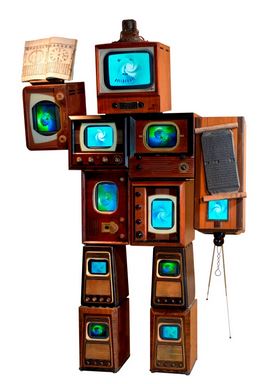
Nam June Paik, Li Tai Po, 1987, 10 antique wooden TV cabinets, 1 antique radio cabinet, antique Korean printing block, antique Korean book, 11 color TVs, 96 by 62 by 24 inches. Photo John Bigelow Taylor. @Artnews December 18, 2014.

Now, anything that Mr. Paik recorded would have the same issues as those I mentioned about for Mr. Warhol and Jamie Nares. As his existing videos are upgraded to newer digital formats, are they the same works as envisioned by the artist? Of have they lost some of his hand? And is the art the image or is it the whole experience? The clatter of earlier projectors? The grain of video tape (or film)? The refresh rate on the screens being used to display the work? Is the series of images or story the artwork or the entire physical experience?

Now, Mr. Paik’s work is even more problematic. He used a lot of, by our contemporary place in art history, some pretty archaic television sets. Certainly museums and collectors can conserve the old television cabinets and a competent furniture maker would repair or replace damaged wooden pieces. But what about the tubes that powered a lot of 1950s and 1960s televisions? Fortunately there is a revival of mid-century radios and musicians’ tube amplifiers so there is some limited availability to replace power tubes. But what about the picture tubes (cathode ray tubes)? Will there be a limited supply available for restorations in 2075 when an old Paik TV wears out? That’s a good question. Will the antique and collectible market along with the conservators provide enough demand for those things to be manufactured ad infinitum?

And what if someone decides to replace that old picture tube with a contemporary LCD display? What have we lost? Can they physically do it? The flicker rate is different. The image definition is different. Colors will appear with different intensities and tones. Can a LCD fit into a mid-century wooden chassis? Will the rest of the electronic portion of the unit need to be replaced as well? And if any or all of this is replaced, is this the same sculpture as created by the artist? Or is only the concept the relevant art here and not the equipment? Will we accept it as a Nam June Paik? Will a museum? Will a collector?

Btw: I asked a friend who repairs old radios. He is not aware of anyone who manufactures new picture tubes but they can sometimes be repaired.

I don’t envy future conservators. It seems to me that the conservator staff will expand beyond the experts with paint brushes and q-tips to include people who can solder and test vacuum tubes and repair picture tubes and migrate videos to whatever the new technologies bring. Oh oh, technologists! Can they get along with arty types? LOL!

P.S. I haven’t been able to find the exact quote on the internet, so I’ll paraphrase. But in Men In Black (I), Tommy Lee Jones’s character Agent K is explaining a new alien audio technology that is about to be released and he laments that he will have to buy another copy of The Beatles White Album now. Maybe we’ll all be feeling his pain in the near future.

Museum of Wisconsin Art Plans To Re-open In July

From my email this morning! I am looking forward to MOWA and other museums eventually re-opening.

The past few months and weeks have thrust extraordinary and unsettling change into all of our lives. Whether the result of the global pandemic and the financial crisis or the shocking reminders of brutal injustices inflicted on our nation’s communities of color, one thing is certain—no one has been untouched. As these disturbing events have unfolded from hospital wards to city streets, it has become increasingly clear that there will be no going back to what we were or how we functioned just three short months ago. Nor should we. 

When I last wrote to you in early April just days after closing the museum, I felt a keen sense of loss and even nostalgia as the museum plunged headlong into an uncertain future. Today, as we prepare to reopen in early July, I am saddened by the suffering of so many of our friends and neighbors and the disproportionate impact of these disturbing events on our communities of color. But I am also buoyed by a sense of optimism that MOWA can do more in these challenging times. 

Museums have always played an important role in creating platforms for difficult, thought-provoking conversations. In MOWA’s role as the museum for the State of Wisconsin, we also have a responsibility to represent and support all of our communities—black, brown, and Indigenous as well as white and all others. I and our Board of Directors take that mission seriously. Over the last couple of years, MOWA has made significant progress in increasing exhibition opportunities and in supporting emerging artists from black and brown communities. But we acknowledge that we can do more to promote racial and social equity in everything we do, and we will. 

As MOWA’s Executive Director, I pledge to all of you that in the coming weeks and months, the museum will implement the following initiatives:

When we reopen in July, our members will find reinstalled galleries, educational materials, and future exhibitions that create a more inclusive story of Wisconsin art 

We will take immediate action to increase the diversity of our Board of Directors and to provide anti-racism training for our entire staff and volunteer corps

We will make a commitment to acquiring artworks that further expand the diverse voices of the museum’s permanent collection, and 

We will create an ongoing, paid internship to support a university student of color seeking a career in the museum industry.

So, yes, I am optimistic, more optimistic about the future than I have ever been. I believe that MOWA and the arts can be part of building a better and more equitable community. My staff and I do not have all the answers and we will undoubtedly make mistakes along the way, but we will learn and we will look to all of our devoted members to help guide us.  

Together, we can and will do so much more. 

Laurie Winters

Executive Director | CEO

MOWA stands with our Wisconsin communities during these challenging times and we support Black Lives Matter

Very positive changes and I am excited to see what their new programming will include.

And for those of us concerned about going out in public again…MOWA is taking precautions for visitors and employees in light of the COVID-19 pandemic. They plan on opening July 8th and here is the safety information from the museum.

but just a couple of highlights, typical for most businesses as they re-open:

Reducing capacity requirements by 25% to ensure social distancing.

Access to hand-sanitizing stations throughout the museum.

Mandatory face coverings for all members, visitors, and employees. Disposable high-quality face masks provided free of charge if needed.

Special hours for seniors (60+) and vulnerable members to access(Wednesday – Sunday, 9:30 am – 10:30 am).

So, stay safe, and enjoy Wisconsin Art!

Announcing American Players Theatre: Out of the Woods Readings

EDITOR’S NOTE: The videos of the readings have been extended and are available for viewing through AUGUST 9! Here’s the link: https://pbswisconsin.org/out-of-the-woods/

This is very exciting news. I have been hugely disappointed that I won’t be making a trip to Spring Green this season to see one or two or three shows:

Beginning Friday June 12 and for several consecutive Fridays, American Players Theatre of Spring Green Wisconsin will be joining PBS Wisconsin in presenting six play readings performed and directed by members of APT. The readings will be performed and recorded live. That opening Friday will feature three one-act plays by Anton Chekhov.

APT’s Core Acting Company, along with other APT actors, will be reading a selection of plays using Zoom virtual meeting software. The readings are streamed live and recorded by PBS Wisconsin. Play readings will be posted on Fridays at 7:00 PM CST on pbswisconsin.org, and free to view. On opening night, they will also stream on both APT’s and PBS Wisconsin’s Facebook pages. All six readings will be available on PBS Wisconsin’s website the week of July 12 –19.

Artistic Director Brenda DeVita said of the play-reading series, “As it became increasingly clear that we would not be able to safely produce plays this summer, we knew we would need to find new ways to connect our art with our audience. Sharing stories can be healing; creating conversations and remaining curious is more important than ever -so we knew we had to do that in whatever way we could. So we’re so thankful to PBS for partnering with us on this beautiful project. And thankful that we will be able to continue to bring the words of these great playwrights, and the talent and voices of these phenomenal actors, and just this little piece of our Hill to our audience where they live. We encourage you all to stay safe and take care of each other.”

Here is the entire schedule:

June 12 Chekhov One Acts By Anton Chekhov. Directed by Aaron Posner. Three stories about the complexities of love and life; marriage and moving on. These one-act plays were produced at APT in 1985 and 1986. The Bear featuring Tracy Michelle Arnold (Popova), Brian Mani (Smirnov), James Ridge (Luka). On the Harmfulness of Tobacco, featuring David Daniel (Nyukhin). The Proposal, Sarah Day (Chubukov), Colleen Madden (Natalya Stepanova), Marcus Truschinski (Lomov).

June 19 As You Like It By William Shakespeare. Directed by John Langs. A quite-nearly-perfect Shakespearean comedy, featuring one of his greatest heroines. As sure as anything to make you feel like you’re at home in our woods for an evening. Featuring: Tracy Michelle Arnold (Jaques), Kelsey Brennan (Phoebe), Nate Burger (Orlando), David Daniel (Touchstone), Sarah Day (Madame Le Beau/Reverend Olive Martext), Jim DeVita (Charles/William), Alys Dickerson (Celia), Tim Gittings (Corin/Jaques de Boys),Gavin Lawrence (Silvius), Colleen Madden (Audrey), Brian Mani (Duke Frederick/Duke Senior), Melisa Pereyra (Rosalind), James Ridge (Adam/Hymen), Marcus Truschinski (Oliver/Amiens), Marco Lama (Lucius).

June 26 Arms and The Man By George Bernard Shaw. Directed by William Brown. Love and war collide in a uniquely Shavian fashion when an “enemy” soldier climbs in through the idealistic Raina’s window, throwing her life and worldview into disarray. Featuring: Kelsey Brennan (Louka), Nate Burger (Bluntschli), David Daniel (Russian Officer)Sarah Day (Catherine), Tim Gittings (Nicola),Melisa Pereyra (Raina), James Ridge (Petkoff), Marcus Truschinski (Sergius).

July 3 Julius Caesar By William Shakespeare. Directed by Stephen Brown-Fried. Growing unease over Caesar’s popularity spreads through Rome, spurring good people to do terrible deeds. A riveting political thriller about blood spilled in the name of the republic, and hands that hold the blades. Featuring: Tracy Michelle Arnold (Cassius), Kelsey Brennan (Marulius/Metellus/Titinius/Ensemble), Nate Burger (Flavius/Trebonius/Pindarus/Ensemble), David Daniel (Carpenter/Decius/Lucilius/Ensemble), Sarah Day (Caska/Dardanius/Ensemble), Jim DeVita (Brutus), Tim Gittings (Cinna/Caesar’s Servant/Messala/Ensemble), Gavin Lawrence (Marc Antony), Colleen Madden (Soothsayer/Portia/Cinna the Poet, Volumnius/Ensemble), Brian Mani (Julius Caesar/Ghost), Melisa Pereyra (Calphurnia/Octavius’s Servant/Clitus/Ensemble), James Ridge (Cicero/Ligarius/Lepidus/Ensemble), Marcus Truschinski (Cobbler/Artemidorus/Octavius/Ensemble), Marco Lama (Lucius).

July 10 Are You Now Or Have You Ever Been…By Carlyle Brown. Directed by David Daniel. Writer and activist Langston Hughes faces down his fears by writing a poem on the eve of his appearance before the Senate Permanent-Sub-Committee on Investigations on Un-American Activities. Featuring: Jim DeVita (Senator Dirksen), Jamal James (Frank Reeve), Gavin Lawrence (Langston Hughes), Brian Mani (Senator McCarthy), James Ridge (Roy Cohn), Marcus Truschinski (David Schine).

July 17 An Improbable Fiction By James DeVita. Directed by Tim Ocel. A world-premiere reading of James DeVita’s new play, told largely in Shakespeare’s own words. It’s plague time, and Shakespeare’s characters are out of sorts (and out of work). Several of our favorites reunite at The Boar’s Head Tavern to celebrate life, and ruminate on the state of the world. Featuring: Brian Mani (Falstaff), Sarah Day (Mistress Quickly). Also featuring Tracy Michelle Arnold, Nate Burger, Gavin Lawrence, Melisa Pereyra.

For more information, visit their website here!

About the Theatre: APT is a professional repertory theater devoted to the great and future classics. It was founded in 1979 and continues to be one of the most popular outdoor classical theaters in the nation.

The Theatre is located in Spring Green, Wis., on 110 acres of hilly woods and meadows above the Wisconsin River. The outdoor amphitheater is built within a natural hollow atop an oak-wooded hill. Under the dome of sky, 1,089 comfortably cushioned seats encircle three sides of the stage. In 2009, APT opened the 201-seat indoor Touchstone Theatre, offering a different type of play and experience.

and that’s not enough? try these:

Out of the Woods joins other virtual content APT and its acting company have been involved in creating, such as the Words from the Woods poetry-reading series and APT Diversions newsletter including Artist at Home videos and behind-the-scenes stories–these videos can be found at americanplayers.org/news.