Sunday In The Park With George Is A Musical Romp At Lake Country Playhouse!

Do you ever wonder where playwrights get their ideas for grand Broadway musicals? Well, Sunday In The Park With George, might be a little unusual and then, maybe not. But clearly James Lapine (book) and Stephen Sondheim (lyrics and music), started with Georges Seurat’s masterpiece painting, A Sunday Afternoon on the Island of La Grande Jatte. And then they imagined the life and personality of many of the prominent individuals that Seurat has depicted, developed a back story for each of them, and wove then all together into a grand and masterful Broadway musical. But trust me, they did take some poetic license with some of the figures chosen. There isn’t a one to one correlation…but it is amazing nonetheless. But do keep in mind, despite this taking place in a real place and time, and with a real historical figure, this is just a bit of very clever story telling.

A Sunday Afternoon on the Island of La Grande Jatte, By Georges Seurat 1884 – Art Institute of Chicago, Public Domain.

But the real magic isn’t in the dots on the canvas or the story from Sondheim and Lapine, it’s from the masterful direction of Caitlin Nettesheim who needs to weave the historic characters and references in with the contemporary back references and 18 actors, many of them doubling up, and produce the engaging presentation that I experienced this past Sunday at Lake County Playhouse & Academy. And extra credit for her clever use of cacophony several times to change scenes and casts.

Suze Falk and Company. Photo courtesy of Lake Country Playhouse & Academy. Photo by Marie Helser Photography.

The obvious focus of Sunday In The Park With George is Georges Seurat. Lapine has a bit of fun during the first act poking some fun at the stereotype of the artist but there is also a serious love story here, a love triangle of sorts, between George and Dot (his model and lover) and George and Art. Jack Anderson plays a George who never loses focus on his painting often at the expense of his personal life and social life. He never stops sketching whether he’s got a willing model or just catching others from afar each Sunday on the Island of La Grande Jatte. Anderson presents the distracted work ethic and focus of an artist. And his adept muttering and giving under the breath voice to self utterances as he daubs at the painting in the studio, certainly set the scene for his eventually personal loss. Some more red here, and here some blue. But, to quote the great man (in the play): “White, a blank page or canvas. The challenge: bring order to the whole, through design, composition, tension, balance, light and harmony.”

Jack Anderson and Suze Falk. Photo courtesy of Lake Country Playhouse & Academy. Photo by Marie Helser Photography.

Suze Falk is a willing model as Dot but not above complaining about the working conditions! It’s Hot! It’s so early! And Falk’s Dot isn’t above overdoing directions from George partly of course to get a reaction out of him but to great comic effect to the audience. George:, please lower your chin a bit. Dot: immediately plunging her chin to her chest. And Dot wants to be an active young Parisian, out in public, and sharing her time with the man she loves. George has feelings too and Anderson struggles to suppress them as he remains immersed in his work. At last Dot leaves him for the baker and can’t quite let go and Falk’s portrayal of a conflicted and still in love young woman is very very compelling. She returns to George a number of times to see if she can crack through his shell. But in the end, she moves to the practical and takes care of herself and child (and George’s child). Whether the playwrights meant George to be the main character or Dot, I am not 100% sure, but Falk certainly steals the show here. And her voice ranges from coy to charming to full throated as she expresses the full range of emotions she’s set to experience.

(L to R) Jack Anderson, Elizabeth Nisley, and Luke Hahn. Photo courtesy of Lake Country Playhouse & Academy. Photo by Marie Helser Photography.

There are many other characters, but some notable performances. Luke Hahn as Jules, another painter who is more established than Seurat with some pull in the artistic community. Hahn easily plays the pompous Jules and moves from a critical voice of George’s work to claiming to be a friend. And his even more pompous and self-important wife, Yvonne, given full voice and presence by Elizabeth Nisley. And all of the characters are society darlings or wannabes, except the Boatman played as a common no nonsense working man by Mark Thompson. And the baker, Louis, played by Bradley Carter. The script describes him as well liked and generous and always blinking, and Carter demonstrates those attributes quite ably and for some real comic effect at times. No wonder he draws the attentions of Dot eventually.

Bradley Carter and Suze Falk. Photo courtesy of Lake Country Playhouse & Academy. Photo by Marie Helser Photography.

And ACT I ends with all of our characters forming a tableau resembling the original painting. And they start ACT II in those same positions, complaining about their various positions or plights in their poses. High humor here and this isn’t my best side!

(L to R) Mark Thompson. Jeffrey Polak, and Kelly Clemens. Photo courtesy of Lake Country Playhouse & Academy. Photo by Marie Helser Photography.

And then we have ACT II itself, which is in the contemporary era. And Anderson is still a George, but the great-grandson of Seurat. He is also an artist but not as obsessed or focused, and doubtful much of the time. Anderson captures these various moments quite effectively. It is the opening for his latest piece, an electronic light piece, but related to Seurat in it uses light and color for a particular visual effect. And it is in fact a commission that is meant to be inspired by the great painting. Most of the actors from the previous acts now appear as contemporary art consumers, art critics, or philanthropists. Current George doesn’t handle the social responsibilities very well either.

Tanya Stewart and Emily Keiner. Photo courtesy of Lake Country Playhouse & Academy. Photo by Marie Helser Photography.

There is a lot to unpack here but I will leave most of it to you to discover when you attend the play. But George decides to visit Paris and present his Seurat inspired electronic bit on the Island of La Grande Jatte. And after reviewing the technical needs with his assistant, he asks for some time alone. And now we come full circle as Dot and other characters appear to him , to ask questions and fill in some plot points and bring closure to our story. As some younger generations might say, this final meeting will bring on the feels.

(L to R) Abby Nicola, Gin Mitchell, and Mason Shefchik. Photo courtesy of Lake Country Playhouse & Academy. Photo by Marie Helser Photography.

Some side notes: Nettesheim does an amazing job telling this story through movement and postures. A lot of story gets told in a rather small space. And the set is simple and spare, with just a small raised ridge down the center parallel to the audience that allows certain characters prominence. And the back wall is simply an off white, canvas colored. When we are on the Island it becomes the mounting point for the park trees and when we are in the studio, it IS the canvas that George works on.

But the costuming here is amazing. Lush and decadent. Top hats and morning coats, rich colorful formal dresses, and particularly for Dot, bustles. Costume Designer Sarah Jo Martens is always spot on, but she has outdone herself this time.

And there is of course, incidental and supporting music throughout the show, it is a musical after all. There are six musicians on stage: two wind players, two keyboards, a cello, and a percussionist. They were delights!

And check the painting above for the soldiers before you come, thank me later.

Sunday In The Park With George plays at the Lake Country Playhouse & Academy in Hartland WI from now through October 11, 2026. RUNTIME: 150 minutes. + 15 Minute Intermission

Additional information HERE and Tickets HERE

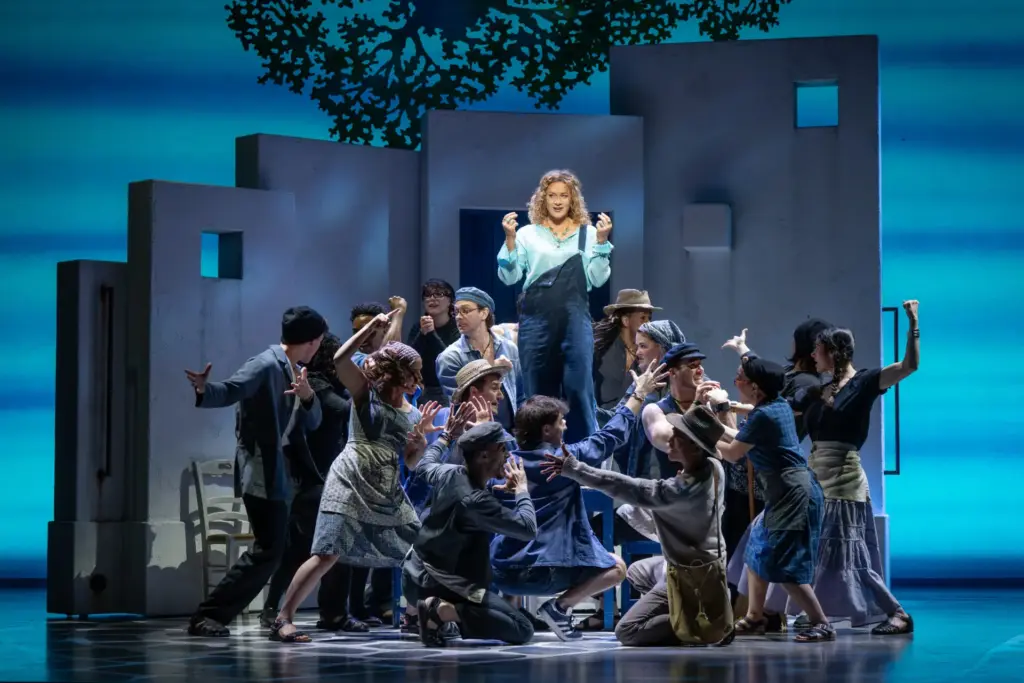
MAMMA MIA! Broadway at the Marcus Performing Arts Center

I knew that Mamma Mia was out there but I didn’t really know anything about it so didn’t now what to expect as I took my seat this past Tuesday. But you can never go wrong with ABBA music. <–Fact!

So I was surprised to find myself observing a Greek Island just in advance of a young couple’s wedding. Sophie is the bride in question. She is the daughter of a single mom, Donna, who runs a taverna on the island. She doesn’t know who her father is. So she snoops in her mother’s old diary and comes up with three possible suspects and invites them to her wedding using her mother’s name but without her mother’s knowledge. They all accept. What could possibly go wrong? Well everything and nothing but we have a wonderful story to tell with wonderful songs. And, I forgot, Donna was something of a rock star in her day in an all girl band, the Dynamos, and they are attending the wedding too, that’s Rosie and Tanya. So not only do we get the usual musical excitement as actors break into song but we got an extra treat of a Dynamos performance in platform boots and Vegas style costumes. Are you ready for Dancing Queen?

From the MPAC website

A quick formality: The lyrics and music are by the mavens behind ABBA of course, Benny Andersson and Bjorn Ulvaeus with the book (story) by Catherine Johnson. And this high powered and vibrant touring production is directed by Phyllida Lloyd! One other production superstar is the lighting designer, Howard Harrison. His lighting emphasis and washes really really enhanced the performances on stage.

From my seat, the star of this show is Juliette M. Ojeda! She personifies what I feel the character of Sophie is all about here. And her voice is just a marvelous instrument and carries the weight of each song and the mood of the moment. And her dance steps are a smooth, lithe, and agile as any I’ve seen on this stage. Ojeda also knows how to work with and work off of the other performers on stage. Her mother, Donna, is played by Jessica Crouch, and she pulls off being a bit older version of Sophie. That relation should be the other way around but I couldn’t take my focus off of Ojeda. And Crouch too has the moves and the voice to be the focal point in every scene she enters. And she is majestic when she takes on her role as the leader of Donna and the Dynamos.

From the MPAC website

And the Dynamos? Given that Sophie is 20 now, they must be about 40 somethings? But Erica Mansfield as Tanya and Kayla Ryan Walsh as Rosie still show us the moves and the style and the youthful exuberance that they obviously have worked to maintain. And they can still strut in their own platform shoes and colorful ABBA outfits to boot.

When the father possibilities show up, Sophie tries to determine, without any luck, which one is her father. In a sense of desperation she asks all three to walk her down the aisle. They don’t all know that initially but accept it. Then after a few conversations and dreams, Sophie decides the only one really deserving of walking her down the aisle is her mother.

From the MPAC website

There are a few other shenanigans before and during the wedding, but true love wills out, but not necessarily as we would expect, but everyone will be happy in the end.

But, but, we aren’t done yet. AFTER the curtain call, there is a grand finale with the entire cast and chorus singing these marvelous ABBA songs and the audience is welcome to join in. So brush up on your lyrics and get your voice in shape because if ABBA is your thing, you will want to have that last bit of fun.

And I hope the full moon is getting scale, because he’s spending a lot of time on stage.

One Quibble: It’s a live band. A great live band. But it could tone down a few decibels. Particularly in the first act, even though the actors are well mic’d, the music drown them out a few times.

Mamma Mia! runs at the Marcus Performing Arts Center from now through September 27, 2026.

TICKETS!! Additional INFORMATION!

From the MPAC website

TRAYF. Next Act Theatre Explores Identity and Friendship.

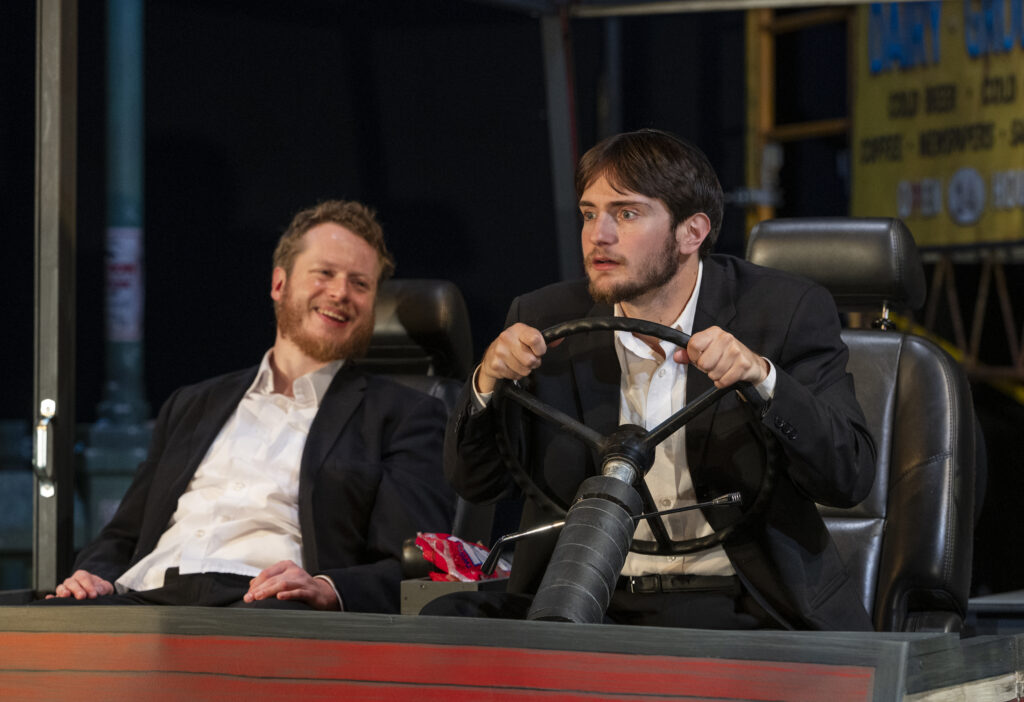
It’s 1991 and we are in Brooklyn. And we are confronted with a Hertz rental van or RV with Mitzvah Tank emblazoned on its side. A Brooklyn looking a bit tired in Jeffrey Kmiec’s and Bianca Gonzalez memorable period set design…with a very sad vehicle that they have cobbled together as well. The Mitzvah Tank will put on some miles figuratively as it is driven around town and literally as it is pushed forefront and later to stage left as the story line requires. And the Tank will be utilized by two young eighteen year-old Orthodox Jewish men to light the lamp in the Jewish souls of other Jews as influenced to do by their spiritual leader known by the nickname Rebbe. Our two new friends are Zalmy and Shmuel

Left to right: A.J. Magoon, Alex Mitchell. Photo by Michael Brosilow and courtesy of Next Act Theatre.

Shmuel gets to be the driver of the Mitzvah Tank because his father rented it. But there is more to it than that. In Alex Mitchell’s portrayal of Shmuel, he is direct, sure of himself, thoughtful, and a planner. And Mitchell shows us a man very focused on his goal and his faith. But don’t think for a moment that he is an emotionless individual. He can and does get angry and is personally hurt when Zalmy’s allegiance to their friendship seems to waiver. But even Zalmy states that Shmuel was always admired as the smart one. And Mitchell maintains something of a scholarly air about him…but he let’s some suspicions in as well.

A.J. Magoon’s Zalmy is just as committed to their project but he’s more curious and lighthearted than Shmuel. Yes, he is more curious and this ignites some of the conflict that is about to arise. Zalmy is the navigator and DJ in the tank. And he likes to play little guessing games at times…trying to guess how many Rebbe tapes that Shmuel has along. These are tapes of Rebbe’s speeches and such. Shmuel plays along but teases Zalmy a bit. But no secular music is allowed! Magoon marvels at the 322 tapes and is visibly excited in his role as DJ to the point of totally ignoring Shmuel’s request for help in parking the Tank. Magoon exhibits a special exuberance and excitement in his gestures and voice.

Zalmy and Shmuel are certainly committed and prepared (they plan for snacks) but they may be a bit naive all at the same time. They’ve never been out of their community and are so sure of their project they aren’t quite ready for the rejection. Their fervor doesn’t waiver but at times a sense of disappointment does set in. But they are beyond their community even venturing into Wall Street, offering their brochures and asking the people that they meet, Are You Jewish? And then we meet Jonathan.

Left to right: Alex Mitchell, A.J. Magoon, Lucas Prizant. Photo by Michael Brosilow and courtesy of Next Act Theatre.

Lucas Prizant presents a Jonathan of a care free nature and practiced nonchalance. We meet him as he approaches Zalmy at the Tank. But he has apparently talked with Shmuel previously, as Shmuel warns Zalmy that he doesn’t think that Jonathan is Jewish because he hesitated too long when asked Are You Jewish before saying yes. But Jonathan presses them into conversation. And Prizant changes tone as he becomes a bit sad and confused when recounting the discovery that his late father was Jewish and had escaped Nazi Germany. As this conversation progresses, Zalmy’s curiosity slips into high and he invites Jonathan for Shabbos dinner. This becomes a common occurrence and Jonathan gifts some secular music to Zalmy which affects him a great deal. And although he hides the music from Shmuel, Shmuel suspects and some other things become inflection points and Zalmy and Shmuel start to drift apart. Not unusual for young adults but quite a surprise given the backgrounds here. Well Jonathan begins his conversion to Judaism and Prizant starts to drop the care-free attitudes and takes on a similar persona to Zalmy and Shmuel. And besides being a wedge between our heroes here, it is a problem elsewhere:

Left to right: A.J. Magoon, Alex Mitchell. Photo by Michael Brosilow and courtesy of Next Act Theatre.

Rachel Zientek bursts onto the scene as Leah when only Shmuel is present at the tank. Zientek is forceful, direct, and full of indignation. She is Jonathan’s girl friend and a reformed Jew and wants her Catholic boyfriend back. She is clearly upset about Jonathan’s new trends as a Jewish convert and didn’t sign up for this. And she makes some revelations about Jonathan’s and Zalmy’s activities that include planning and doing things that Shmuel had designed to do with Zalmy. So the rift widens and the friendship seems doomed.

But friendship does in fact win out. Identities are examined and reaffirmed for Zalmy and Shmuel, but are newly discovered for Jonathan. For our characters that seems to be a good thing.

Left to right: A.J. Magoon, Alex Mitchell. Photo by Michael Brosilow and courtesy of Next Act Theatre.

This is a comedy but there are serious topics underlying the story. Director Elyse Edelman has done an exemplary job of maintaining the humor while enriching the serious stories being told here. I love her directing work but I hope it doesn’t keep her off stage in the future.

Yes, this is set in a Jewish enclave in New York. But you don’t have to be Jewish to enjoy the questions we all ask ourselves about our identities or who we choose to be friends with. We just have to remember what it was like to transition from youth into adulthood. Attend willing and ready to remember those things in your life and you will enjoy Trayf a great deal.

Trayf runs from now through October 4, 2026 at their theater at 255 South Water Street in Milwaukee, Wisconsin. Tickets Here and More Information Here. TRAYF is 1 hour and 25 minutes with no intermission.

Extra Credit Reading: The Playbill or The Enrichment Guide. Reading the enrichment guide before you attend may help in understanding some of the terms and cultural references made during the play.