Dinner With The Duchess: Who Defines Your Legacy?

Next Act Theatre couldn’t have selected a better play to end their season and highlight Laura Gordon’s return to their stage than Dinner With The Duchess. And Laura Gordon is absolutely at the top of her game here. So, if like me, you have been waiting to see Gordon in front of the footlights again, this is the show you want to see.
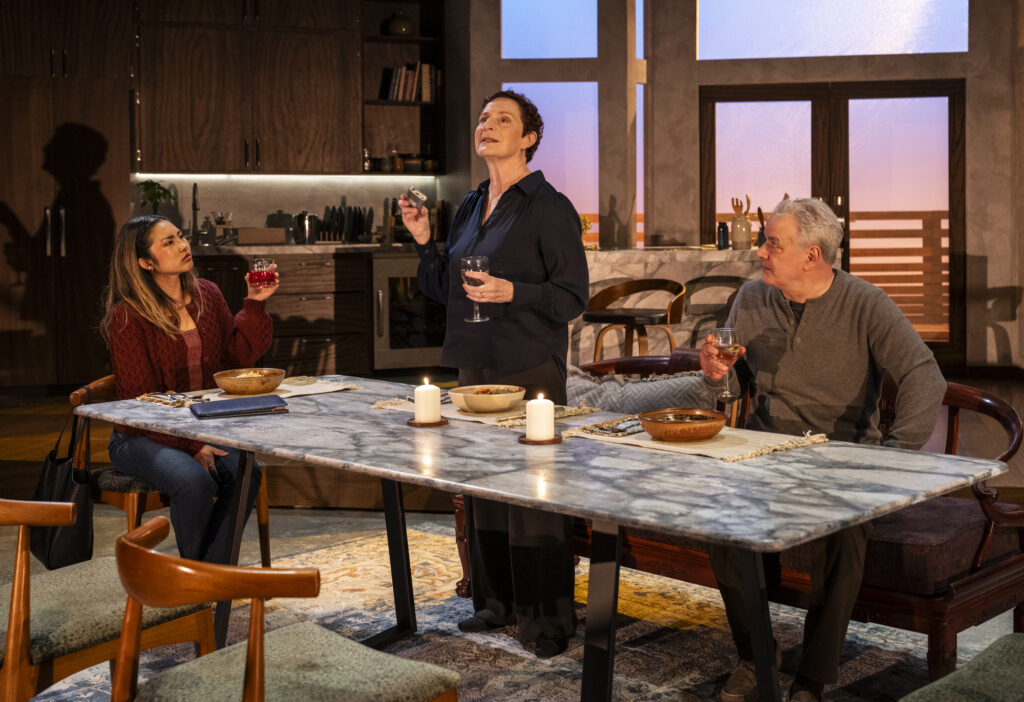
Left to right: Mai Abe, Laura Gordon, Andrew May. Photo by Michael Brosilow and courtesy of Next Act Theatre

We meet Margaret as she enters the stage from what we will later learn is the primary bedroom. The set is a small modern kitchen with a sleek island facing a contemporary dining room table surrounded by mid-century modern chairs and settee. She goes out to the balcony to have a cigarette and returns to answer the door. And she welcomes Helen into her home. Laura Gordon is Margaret and Mai Abe is Helen. They seem wary and unsure and both actors clearly represent that discomfort and maybe project just a bit of icy demeanor. We don’t know either character yet but the initial conversations seem to indicate it might be a generational thing since Helen is much younger than Margaret.
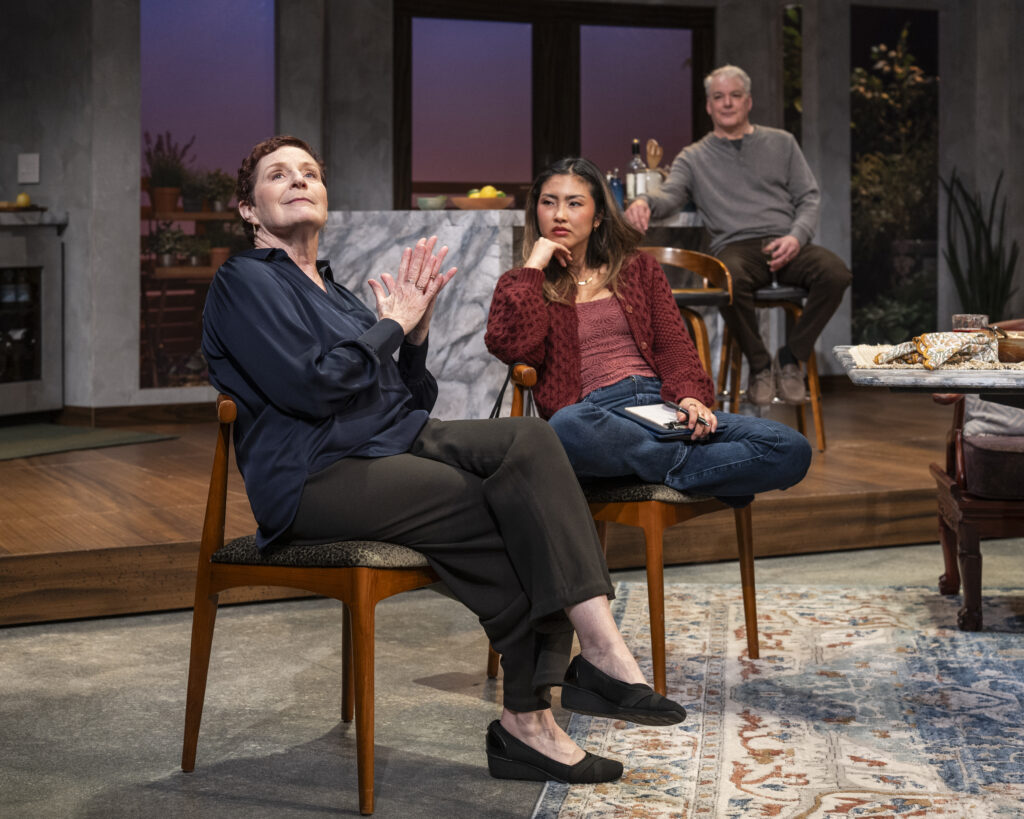
Left to right: Laura Gordon, Mai Abe, Andrew May. Photo by Michael Brosilow and courtesy of Next Act Theatre.

And now we meet our characters. Margaret is an accomplished violinist who has performed world wide and is retiring from her position as concert master from an unnamed and un-sited symphony orchestra. She is granting her last interview to Helen, a journalist who is hoping to make a name for herself via this interview. It isn’t an assignment but an idea she pitched to her editors. So the chill in the room is now apparent. Margaret wants to talk about the music and Helen the events in Margaret’s life and both want to define Margaret’s legacy. Abe is a consummate professional journalist. She exhibits the proper directness you’d expect in a journalist and is sure of her footing since she has done all of the necessary research into her subject. Gordon’s Margaret, for all of her accomplishments, is guarded and uneasy and insists they talk about the music. But she gives us the impression that she has something to hide. And maybe she hasn’t totally convinced herself that she is ready to retire?

And then the other shoe drops and the dynamics in the room change a bit a Margaret’s husband, David, arrives with take out Italian food from a restaurant from their fabled past but whose food they have come think of as bland. Andrew May plays David as a suave, flirty, mature presence but leans toward the sarcastic side. He insists on enhancing the meal before serving with his major contribution being lemon zest. And that is sort of a backdrop for his role too as David often interjects himself into the conversation…often providing background that Helen would relish but sometimes embarrassing himself or Margaret in the process.
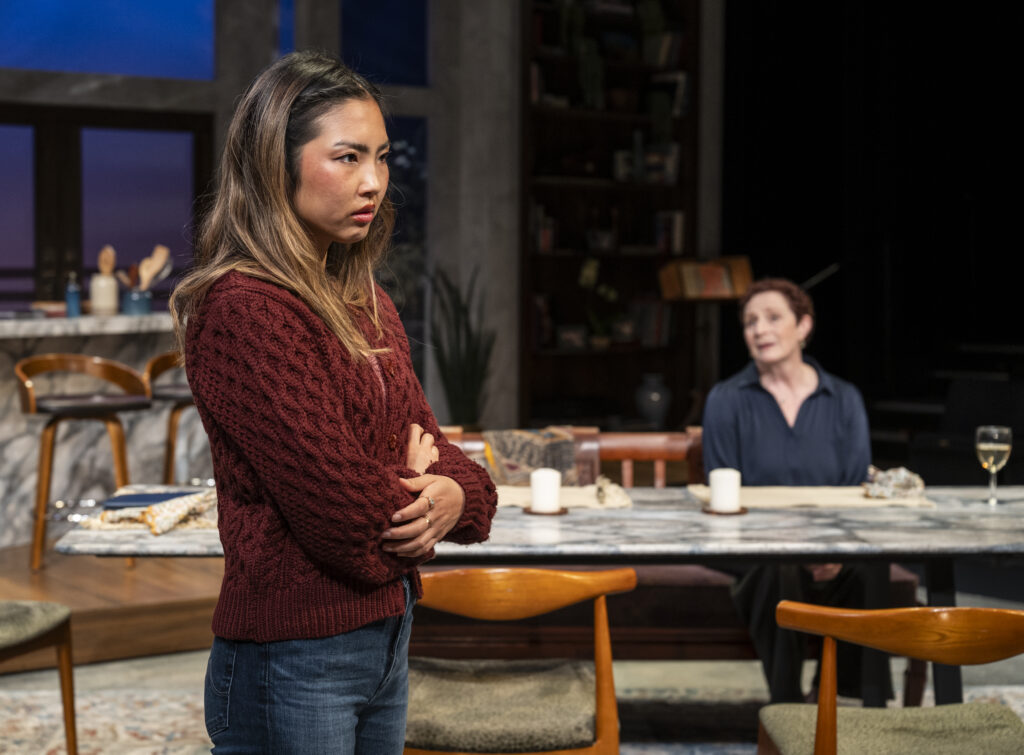
Left to right: Mai Abe, Laura Gordon. Photo by Michael Brosilow and courtesy of Next Act Theatre.

May knows how to mutter under his breath effectively and just how to twist the knife effectively. And although both Margaret and David regale Helen with some very romantic stories from their life, there is a palpable undertone of hostility. Abe’s Helen can sense it and wonders how to react. I sensed that maybe Margaret and David were still together out of habit rather than the continuing love story that they defend. But the lemon zest in their life might just be a bit of seasoning ala Who’s Afraid of Virginia Woolf? When their dueling finally comes to a head, David storms out of the room to the bedroom and slams the door. This is the pivot in the action. (small quibble: I found the door slam unsatisfying)
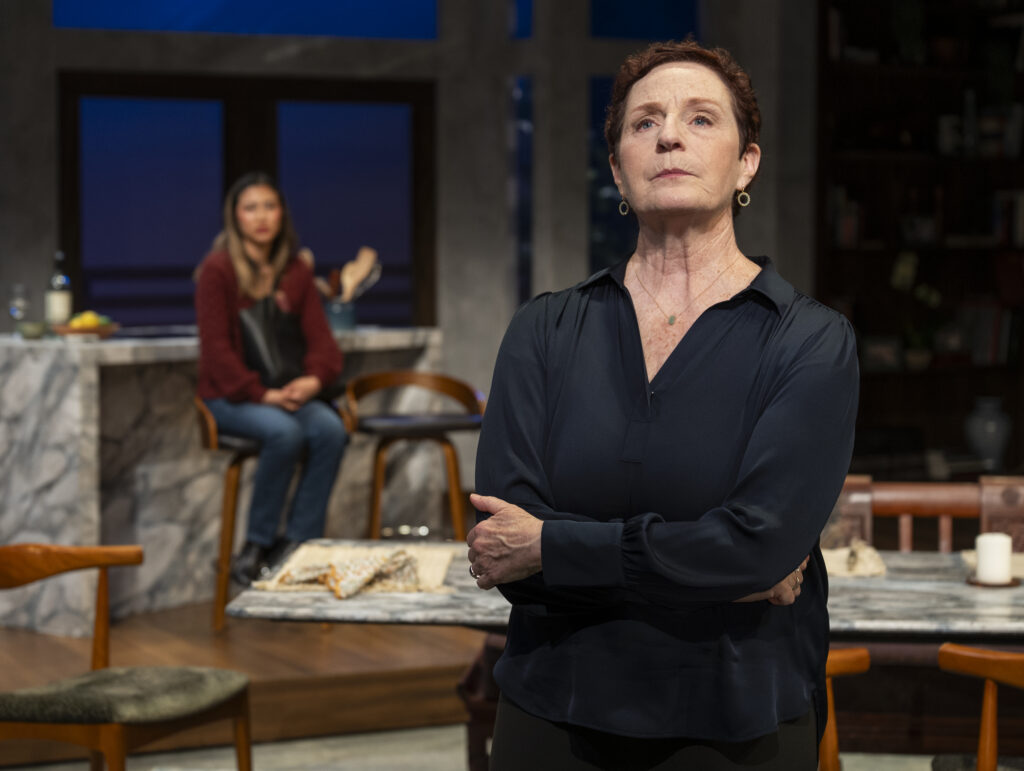
Left to right: Mai Abe, Laura Gordon. Photo by Michael Brosilow and courtesy of Next Act Theatre.

But that slam triggers Margaret and allows Gordon to launch into an elegant tell all soliloquy. Playwright Nick Green has put together an amazing stream of consciousness script here, an absolutely engaging precise bit of language, that finally answers all of the questions that Helen has raised during the course of the evening. Gordon just takes hold of this speech and unravels it as if it were her own life and experience that she is describing. I just sat there enthralled, trying to take it in. When she finishes Helen doesn’t know what to do and the distance between the two women doesn’t seem to have narrowed. Margaret starts to play a recording of her signature performance and Helen leaves.

When the music’s over, turn out the lights.

Mai Abe is making her Milwaukee debut and Andrew May is making his Next Act debut. I want to thank director Samantha Martinson for bringing them together with Laura Gordon for Dinner With The Duchess. Such a delightful and perfectly balanced cast. I hope we see Abe and May again soon.
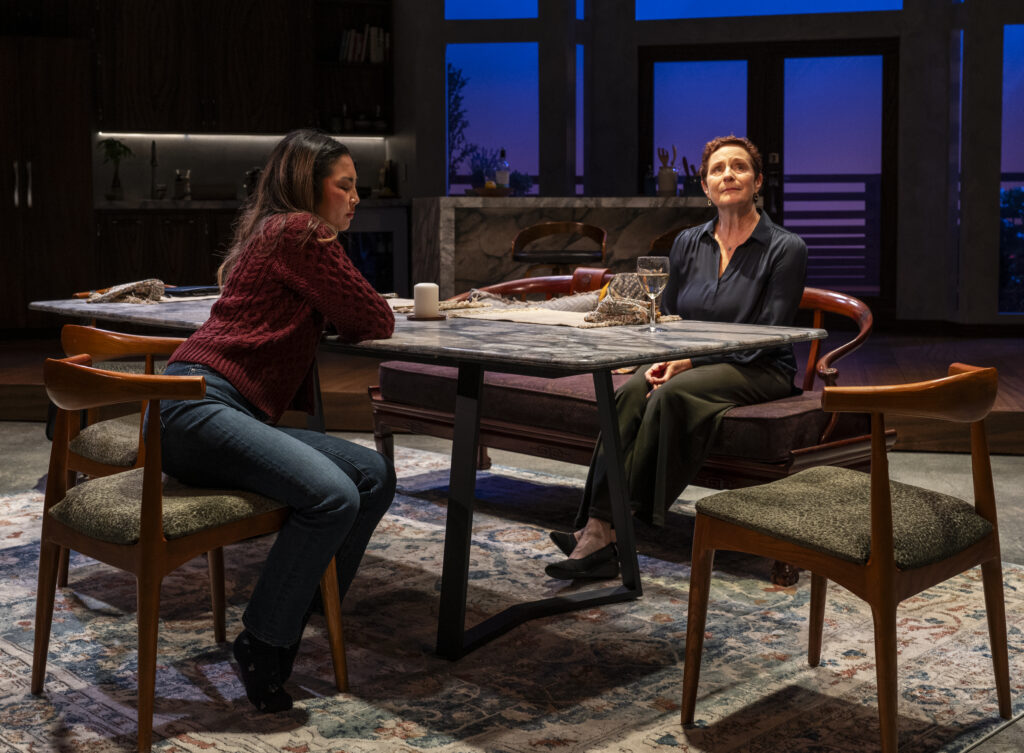
Left to right: Mai Abe, Laura Gordon. Photo by Michael Brosilow and courtesy of Next Act Theatre.

Dinner With The Duchess runs at Next Act Theatre from now through May 17, 2026 at their theater at 255 South Water Street in Milwaukee, Wisconsin.

Additional information and tickets here.

P.S. A question for Nick Green: Given there was a movie with a dinner theme some time ago, was it intentional or a coincidence that the unseen but oft mentioned symphony conductor is named Andre?
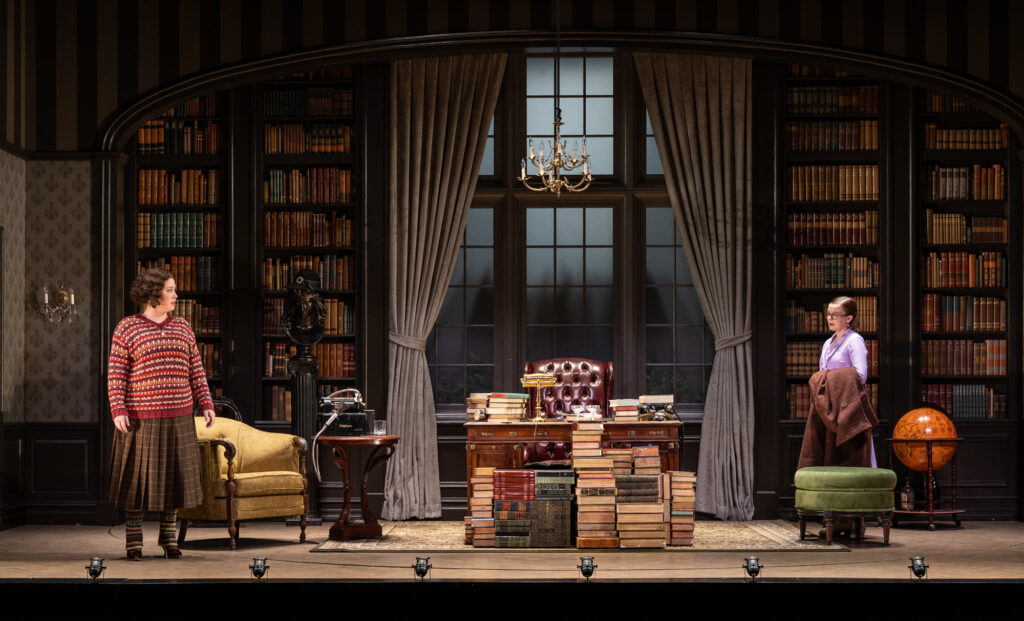
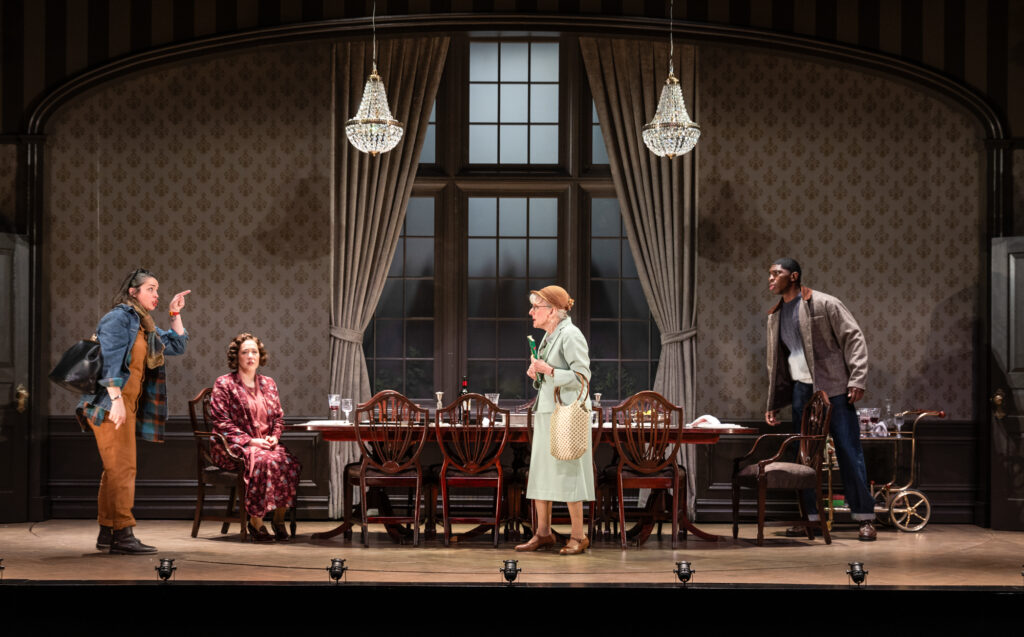
Mrs. Christie. Where Were You…

Wisconsin playwright Heidi Armbruster leans into her strength and writes in a seemingly serious drama format but then wraps it all up in a hilarious comedy. This time Armbruster dabbles in a parallel universe around an unexplained disappearance by Agatha Christie in 1926 and a super-fan tries to solve the case from clues ‘discovered’ at a 2026 Christie festival on Christie’s estate.

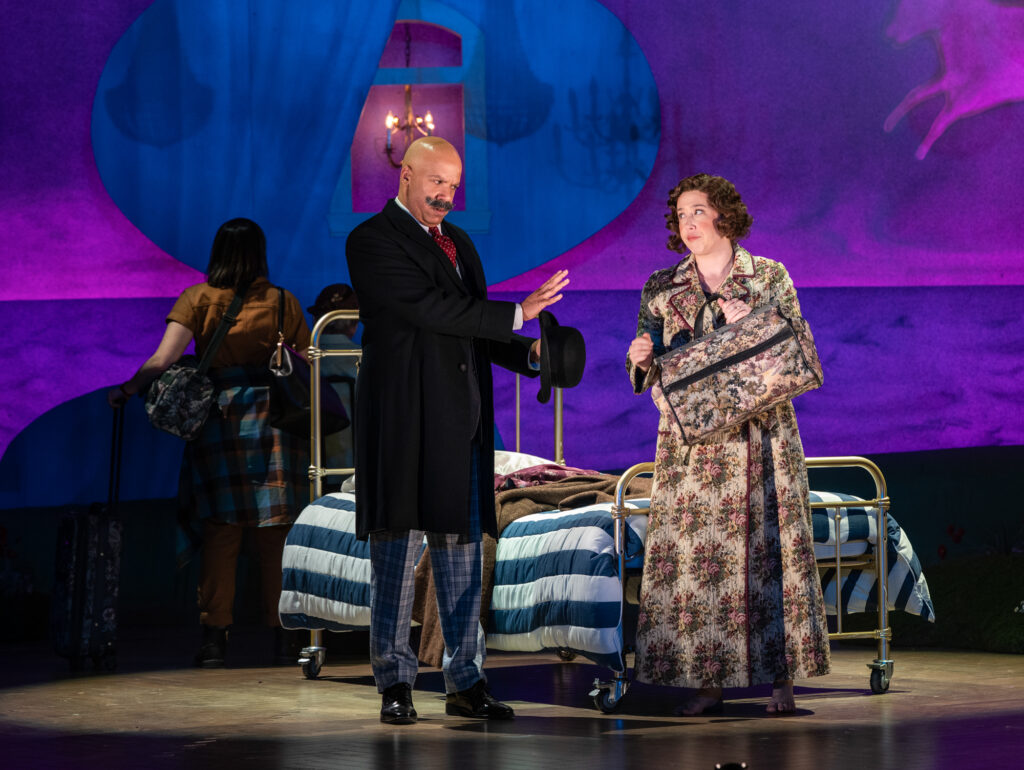
Pictured L to R: Alex Keiper and Betsy Hogg. Photo by Michael Brosilow.

We first meet Agatha Christie in her home totally upset because she believes her dog has died. Alex Keiper’s Agatha is distraught, distracted, and clearly mentally elsewhere. And in many ways this sets the tone for her character deeper into the play. Armbruster’s and Keiper’s Agatha Christie isn’t the smart focused British writer that we would have anticipated. The very next instant it appears the dog is still with us but Agatha is also confronted with the open infidelity of her husband, Archibald Christie. And Matt Bowdren’s Archie is precisely the imperious and stuffy aristocrat that you might expect. Agatha clearly still loves him and he clearly wants to go and they are at an impasse. She won’t give him a divorce so he wants to prevent her from writing. Archie does everything in his power to hurt Agatha including parading his paramour around in their home.

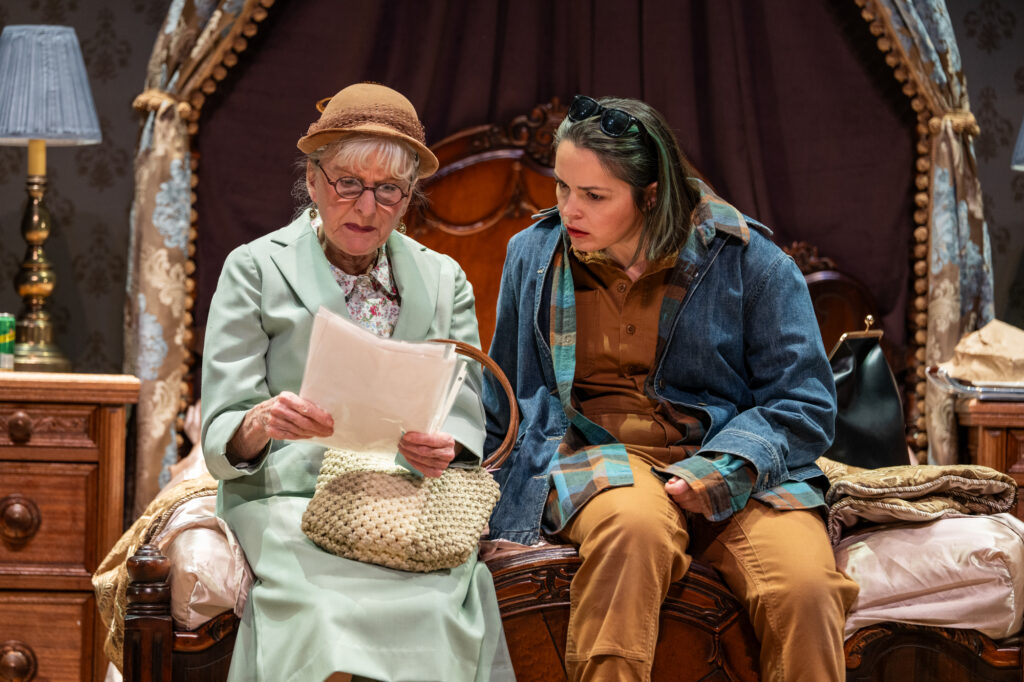
Pictured L to R: Zoë Sophia Garcia, Alex Keiper, Dale Hodges, Blake Hamilton Currie. Photo by Michael Brosilow.

And then it is 2026 and there is an Agatha Christie festival going on on the grounds of the Christie estate. On the grounds is an important factor because we find ourselves in the same library work place as in the earlier 1926 scene. The home is now a museum and the library is off limits during the festival yet people keep wandering in. First is Lucy, a fan of Christie, who is attending the festival, and I guess is something of an ‘ugly American’? Zoe Sophia Garcia presents Lucy at seemingly loose ends and a little free with her hands. Touching everything, a few ‘relics’ make their way to her purse before she is confronted by the caretaker. She talks her way into staying a few more minutes when she encounters William, a Christie scholar and assistant to a Christie scholar. Blake Hamilton Currie is a smooth sexy lothario as William. And he has a few photocopied pages of a ‘lost’ Christie notebook that he uses as bait to seduce incredulous Christie fan girls. Garcia’s Lucy plays along but might be the better player and somehow manages to take possession of the lost papers. And then Dale Hodges as Jane wanders in. An elderly lady seeming just a bit confused, she sits down and starts knitting. But, she too is more than she seems and ends up partnering with Lucy to solve the mystery suggested in the purloined pages. Tally HO!

Pictured L to R: William Sturdivant and Alex Keiper. Photo by Michael Brosilow.

To avoid spoiling too much fun, I will simply say that we follow Christie to a seaside resort where she seems to exist in a drug induced haze…and Monsieur Hercule Poirot makes an appearance. Their conversations poke a lot of fun at detective story traditions and William Sturdivant nails the Poirot stereotype right on the head. And our intrepid Jane and Lucy turn their search for a solution into a scavenger hunt of sorts.

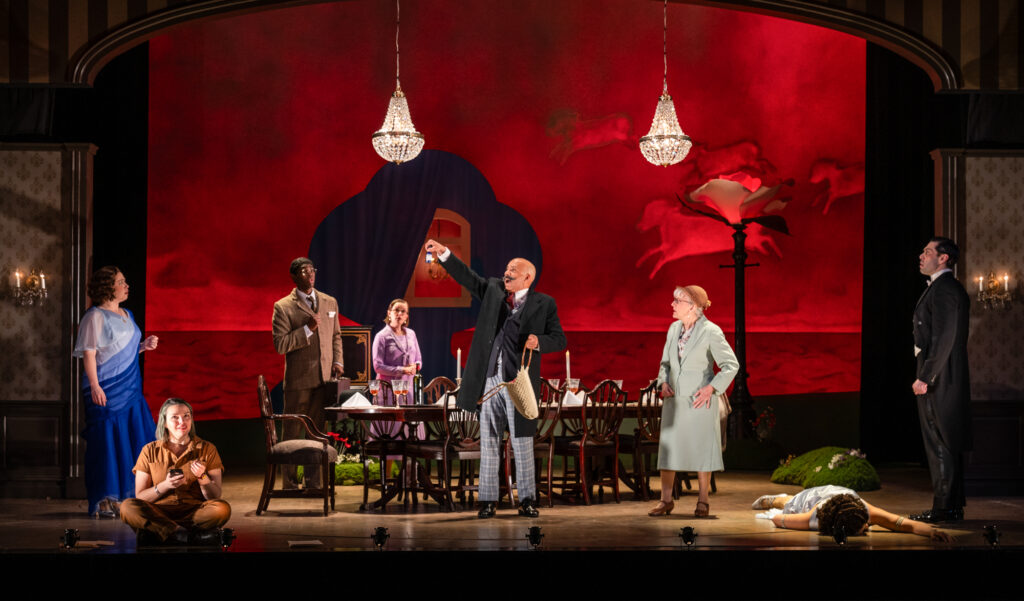
Pictured the cast of Mrs. Christie. Photo by Michael Brosilow.

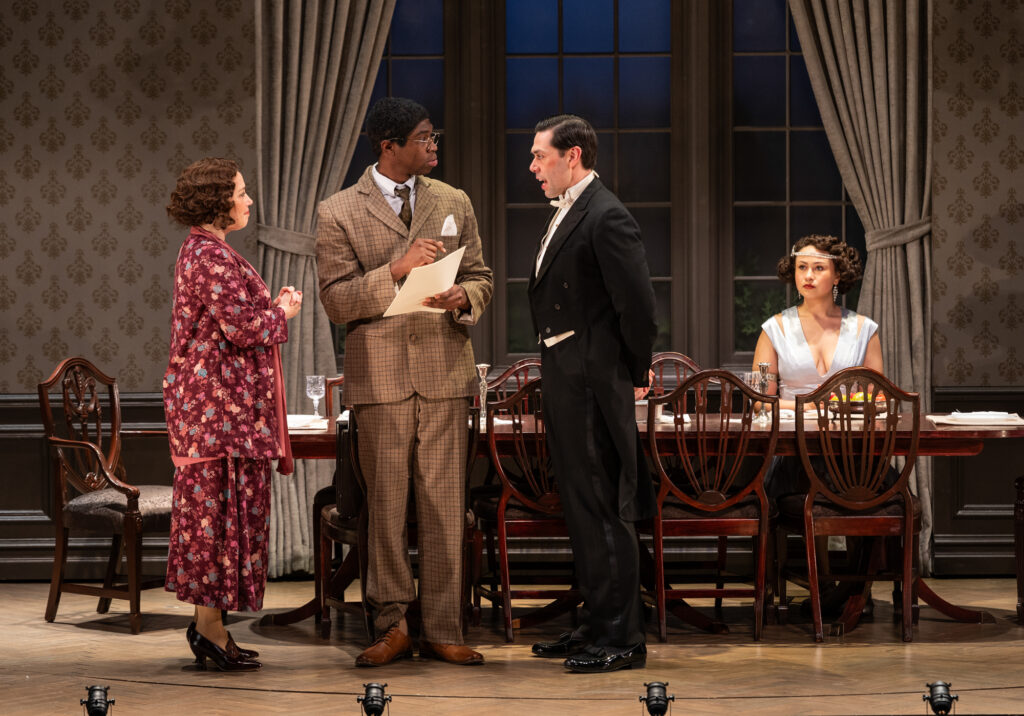
But never fear, there is a traditional resolution. As a book end to a dinner gathering in Act I, all of the characters are again gathered together in the dining room of the Christie home. And everything is pretty formal and cold until Archie’s arm candy, Nancy, played by Amira Danan, falls to the floor after drinking her glass of wine. Everyone in the room has a motive and Poirot steps to the forefront. Every detective story ox is gored, all is revealed, and a solution to the case is found. This scene generated the greatest amount of laughter of the evening…as it should! It is smartly overwritten, overwrought, and overacted with hilarious results.

And laughter: kudos for Director Joanie Schultz for pulling out all of the wonderful humor built into this play. I didn’t expect to have quite this much fun with Mrs. Christie.

Character that you will hate: Charlotte, Mrs. Christie’s secretary. She is played by Betsy Hogg and shows up later as the 2026 as the gate keeper in the library, and at the beach resort. Hogg performs as exactly the same character in all three instances.

Pictured L to R: Dale Hodges and Zoë Sophia Garcia. Photo by Michael Brosilow.

Character that you will love: Dale Hodges, Jane. She is maybe the smartest cookie in the box and draws in our empathy as we watch her move through the real world. Generally she likes to travel alone but is willing to humor Lucy!

At one point, Lucy declares that they are just going around in circles. And at that point she and Jane literally are as the Rep has again pulled out a rotating stage. Initially used to change room locales, during their travels, our intrepid searchers are walking around the edge of the stage as it rotates. Marvelous scenic work by Se Hyun Oh.

Now, fair warning. This play requires all of your concentration. There are moments of sleight of hand that need to be seen that are important to the story. And with the English accents and Poirot’s Belgian French, you want to pay attention so you don’t miss a good joke!

Mrs. Christie runs about two hours and 15 minutes including an intermission. It is being presented on the main stage of the Checota Powerhouse Theater. It runs from now through May 10, 2026. Additional information and tickets can be found HERE

Extra credit reading: The Playbill

. Pictured L to R: Alex Keiper, Blake Hamilton Currie, Matt Bowdren, Amira Danan. Photo by Michael Brosilow.

All photos courtesy of the Milwaukee Repertory Theater.

Milwaukee Rep’s Frida…A Self Portrait…In One Actor

In the first half of the 20th Century, male artists dominated the art scene just as they have done for centuries. Fortunately two woman artists of the Americas were able to break out of the patriarchy, Wisconsin’s own Georgia O’Keefe and Mexico’s Frida Kahlo. Certainly a major reason for their visibility is the remarkable artwork that they created which clearly still speaks to us today. But Kahlo is also intriguing not only because she was a landmark artist but because of the difficulties that she endured in her personal life.

And it is that endurance plus a personal spiritual connection to Kahlo that brought Vanessa Severo to write and perform Frida…A Self Portrait. Frida is directed by Joanie Schultz.

Vanessa Severo. Photo by Michael Brosilow and courtesy of the Milwaukee Repertory Theater.

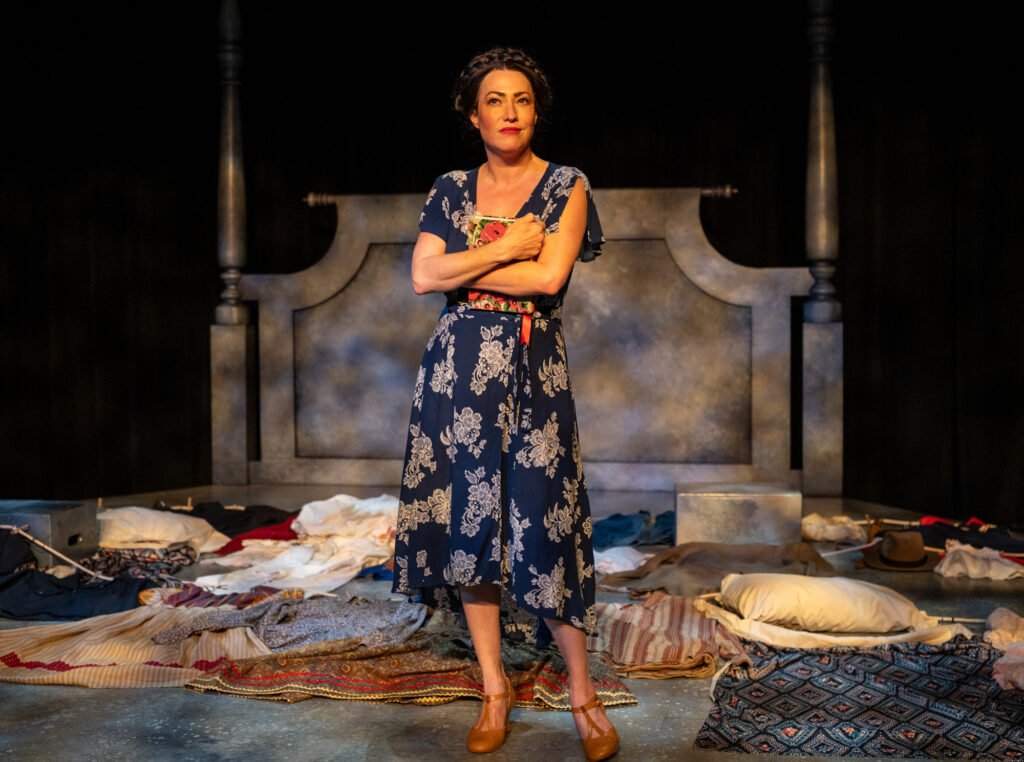
Fittingly for a play subtitled, an autobiography, there is only one actor, Vanessa Severo. So in essence, Frida gets to tell her own story. But don’t be fooled into thinking that with only one actor, that there is only one character on stage. The first one is prominent. It is Severo the playwright who in at least three different moments speaks to the audience directly and has Severo the actor explain the various whys and hows that brought this play about. There is enough drama in these interludes for an actual play on its own…but we really want to see and hear Frida.

Vanessa Severo. Photo by Michael Brosilow and courtesy of the Milwaukee Repertory Theater.

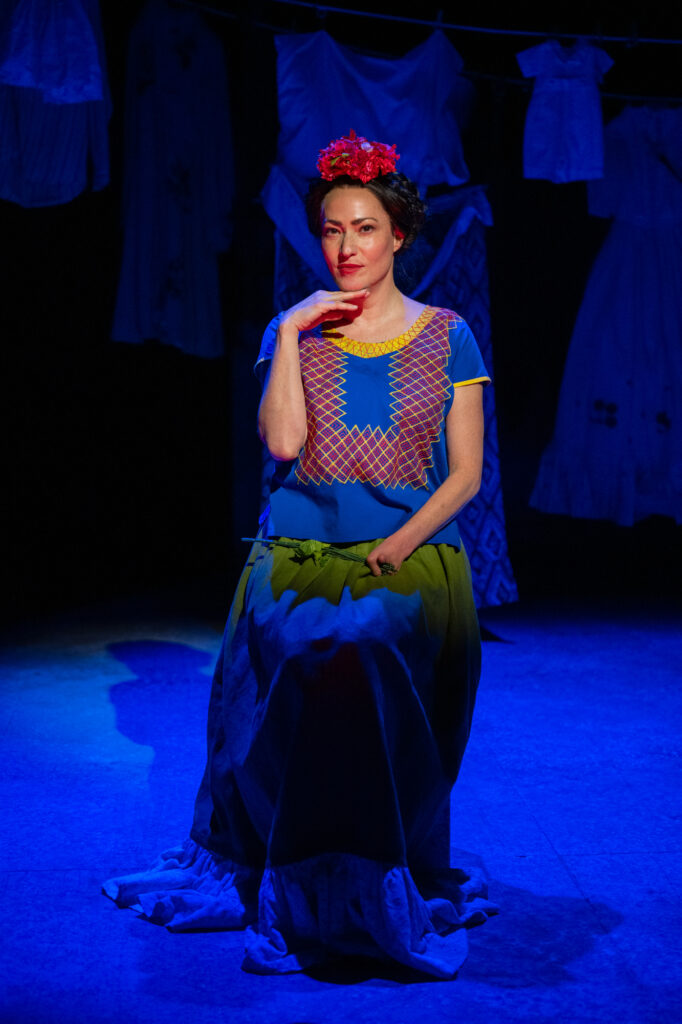
And hear Frida, we do. She narrates her life story with all of its drama in a very engaging manner often telling us how she feels, how she perceived the events around her, and why she decided to do some of the things she did. All of the major events in her life are examined. Many of them in Frida’s own words but often with Frida ( or is it Severo, the lines are at times blurred), impersonating another character in costume or just in narration. It depends. Many many different people make an appearance but most importantly, there are major moments with her father Guillermo Kahlo and her husband Diego Rivera. These re-tellings and impersonations are fraught with drama and edged with humor, both in word and the visuals. Severo moves from one focus point to another in an uninhibited fluid dance that just dares you to look away for even a moment. Intriguing story telling at its finest.

Severo is intensely Frida Kahlo and you will suspend disbelief readily and accept that you are witnessing a private story from Frida.

Vanessa Severo. Photo by Michael Brosilow and courtesy of the Milwaukee Repertory Theater.

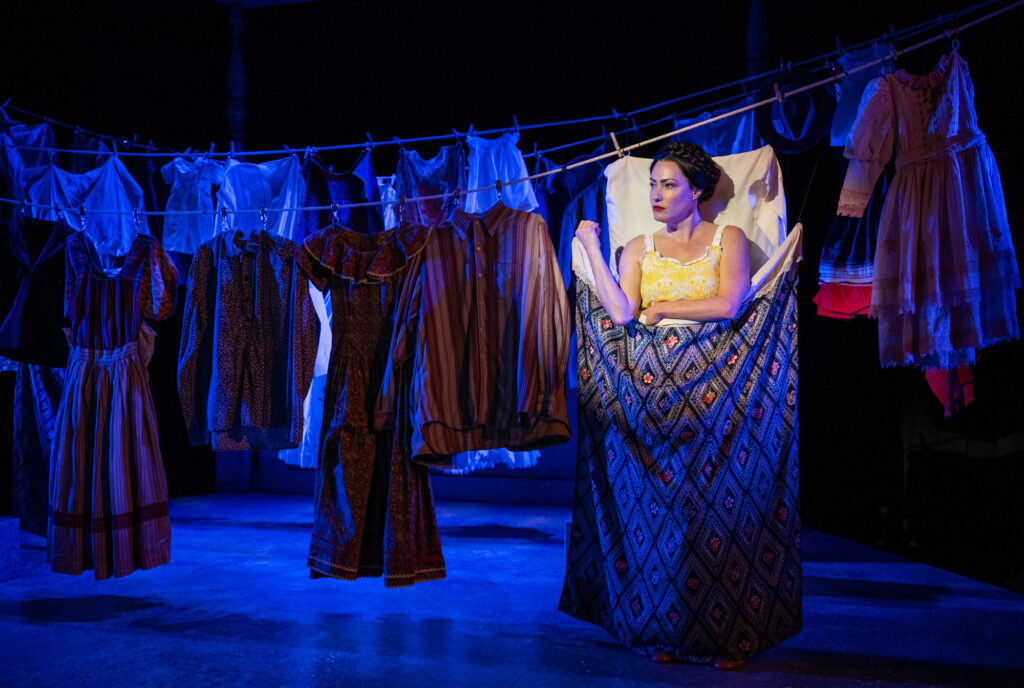
The framing story is Frida entertaining a guest who is visiting to view the architecture of her home, La Casa Azul. But instead of concentrating on the history of the house, Frida wanders off in her mind and recounts the key memory points in her life. The simple set aids the flow and ebb in the story telling. Overhead and to the rear, the general set is a four poster bed that is key to the backstory as Frida spent many days in bed recuperating from one injury to another. And after Severo finishes her prologue to the audience, the stage is festooned by three clotheslines of clothing and bedding that have been questioningly lying on the stage until Severo begins as Frida. These clothes provide the costuming and decor needed for different characters and environments as the story proceeds and Severo discards them stage left or right as their utility vanishes. And there are some stories that remain unspoken…but are told via Severo’s interactions with individual items, lighting, and sound. Some of these moments are particularly sad and should remain unspoken.

Besides the settings, the story is subtly enhanced but the background sounds including insects chirping, city street noises, and such. Very nice, thank you Thomas Dixon. And with just one actor on stage, lighting is very important to help tell the story and to lead the audiences focus and to set the mood and timbre of a scene. Hats off to Rachel Cady.

Vanessa Severo. Photo by Michael Brosilow and courtesy of the Milwaukee Repertory Theater.

Frida…A Self Portrait runs about 80 minutes without an intermission.

Frida is being presented in the Herro-Franke Studio Theater at the Milwaukee Rep from now through May 17, 2026. More details and ticket information here.

Extra Credit Reading: Program