So you think you know Gertrude Stein? Not! But director Cole Castine of Wisconsin Classic Stage does and in Doctor Faustus Lights the Lights he will convince you that a rose is a rose but not a rose…and that’s neither here nor there.
Castine eschews traditional theater presentation here. And as you will read below, that’s with good reason. Rather than a stage front and center with a back set and the audience out front, Castine as rearranged the seating on the Calvary Presbyterian Church to run along the longitudinal walls of the nave. One row of seating and standing room behind with their backs to the walls. Alley seating. There is no stage. Instead the action occurs down the middle of the nave from sanctuary to choir loft and all points in between. Some actors actually enter and exit this playing area via gaps in the seating. So the audience is fully immersed in the play itself. Castine is also credited as the designer and lighting designer for Faustus. And given his treatment of the text as director, I am not sure anyone else could have foreseen or designed to his vision.
I am not sure how you would describe this play, here, now, in the 21st Century. It isn’t a traditional drama, nor a traditional comedy, nor a traditional musical. But it does certainly have a number of very dramatic scenes and a number of rather funny exchanges and retorts and it has music…both instrumental and ensemble singing and solo moments. Stein is often described as a modernist playwright. I am not sure exactly what than meant when this was published in 1938. But in Castine’s development, and at nearly a hundred years on, it takes on tendencies from absurdist theater from later in the 20th Century to beatnik poetry readings to psychedelic pastiches from the hippie era. Not quite of a place at all but of no place either. Neither here nor there. But all is not lost, Stein is at her best Stein in her playing with words and tracing odd complexities of the language…and their place in our efforts to communicate. There is much poetry in it. A rose is a rose is a rose is a rose…and she is she, and he is he, and I am me, and we are we. Absolutely, or so it will seem. Faustus is said to be from Stein’s narrative period. Narrative? That is hard to trace. But as scholar Betsy Alayne Ryan states, Stein did not, “leap foolishly into ordinary comprehensibility.” So don’t be surprised if you find ordinary comprehensibility lacking here. But don’t think for a moment that makes this Faustus any less intriguing.
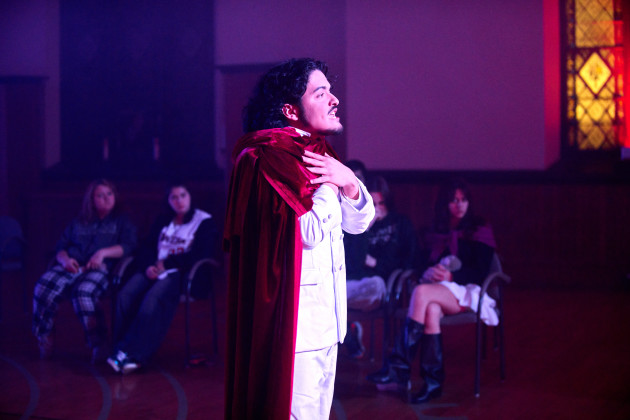
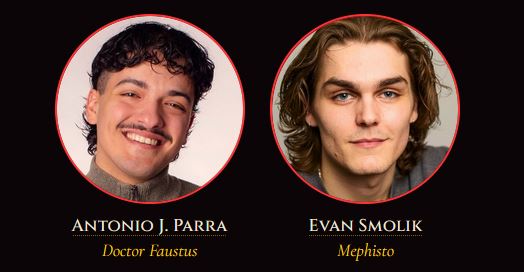
I could see how Stein’s text could bring a director to a catatonic state. But Castine prevails and introduces all twelve actors graciously and gracefully and slowly limns the actual characters as the narrative unfolds. There’s that ‘n’ word again. Dr. Faustus, Dr. Faustus! Are you Dr. Faustus? Antonio J. Parra is Dr. Faustus. Parra can provide a doctor both regal and haughty but later nonchalant and without a care…seeming to lord over Mephisto denying he had a soul to sell to playing his own games of deception with both Mephisto and the other characters. And finally Parra, calmly demands his right to enter hell, but Mephisto is having none of it until Faustus performs one more hateful act. Faustus true feelings and nature might be more true to the rantings and demands that Parra makes to be left alone…even to his main companions and suppliants. But never fear, only Dr. Faustus can turn night into day.
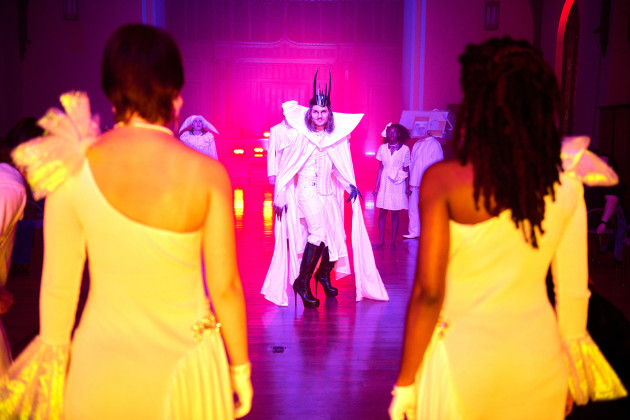
Evan Smolik stands tall as Mephisto. No, really, in the highest black heels that I have ever seen. Smolik remains surprisingly calm despite being taunted by Faustus but does come apart just a bit when he accuses of Faustus of deceit. ?? Smolik’s already imposing voice is rendered even more sinister via electronic means…so after his imposing height above the rest of the cast, his imposing voice can easily strike out to the fearful. How did Dr. Faustus fall under the thrall of Mephisto? Well, the glare and amazement that is the electric light. He had to possess it. Not just the moth is drawn to the flame.
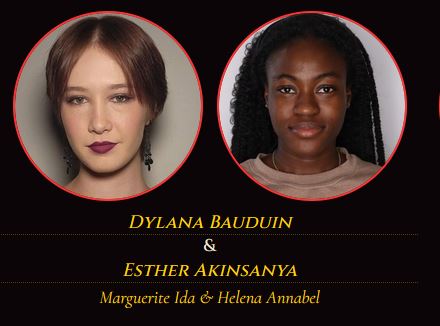
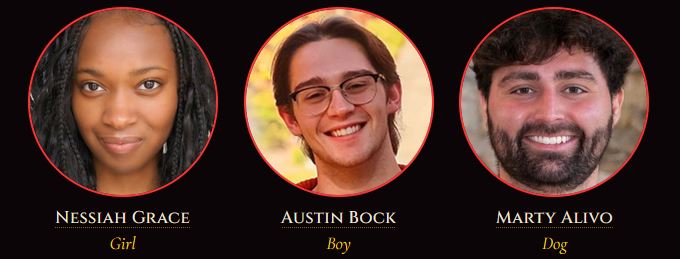
The good doctor’s main and endearing companions? Austin Bock as boy and Marty Alivo as dog. Thank you dog. Two other standouts are Dylana Bauduin as Marguerite Ida and Esther Akinsanya as Helena Annabel. They are inseperable and the she is she proponents in the play. They also are grand inquisitors of is there there or here here or it’s just neither. But are they sisters, twins, companions, partners, or ??? Nessiah Grace is Girl. There is no more explosive energy on stage than the skipping, dancing, and running by Grace as Girl.
There are distinct mood shifts here…sadness, despair, desperation, hope, fear, death, and at times jubilation. And they don’t necessarily follow any set pattern or one logically follow another. But it is dark before it is light.
This was envisioned as an opera or operetta back in 1938. It comes to us today as something of an operetta or maybe a bit of a musical but not quite either. Yes the playwright is Gertrude Stein but the original music is by Lincoln Donner with additional music by Ryan Holifield. One odd bit of consistency is the song I believe is sung and repeated by Tyler Stauffacher: it seems to take its cue from doo-wop music of the mid-1950s. A refreshing little twist.
Costuming is an amazing thing some days. Today is one of those days. Tianna Lee did the costuming for Faustus. Some of them were obvious choices, like a stark and menacing devil costume for Mephisto. But save for Dog (black) and Faustus (red cape), all of the costumes were white. And intriguing. Many of them seem to have come from nursery rhyme characters or maybe dreams or other metaphysical writings. Simple, elegant, but eerie in their way..
Calvary Presbyterian Church is a good venue for theater. The acoustics in most cases are amazing. These acoustics certainly enhanced the musicians and the various singing bits during the performance. But at times the church also consumed the spoken text of individual actors and some of it was simply lost to me.
Wisconsin Classic Stage will be forming (that’s a typo, it should be performing, but in editing, thinking about the fluidity of narrative and the loose staging, forming may be the correct designation) Faustus Lights the Lights at Calvary Presbyterian Church from now through November 8, 2026. Running time is about 90 minutes but be forewarned! Some music set to prepare the mood and stage starts about ten minutes before curtain…a bit of free jazz to not jazz to not quite music…instead a clarion call to attention…and the cast takes these moments to position themselves or as does Parra as Faustus, start to inhabit their roles and declare their presence on stage.
Extra Credit Reading: The Program
More information and ticket ordering here.