First Stage Presents: THE WATSONS GO TO BIRMINGHAM – 1963

-An exploration of how the love and strength of family can transcend adversity- 

Performance runtime is approximately 70 minutes, with no intermission. Suggested for families with young people ages 8+. 

This looks like it will be a lot of fun., The Watsons Go To Birmingham – 1963 kicks off 2022 at the First Stage. The play is based on a book by Christopher Paul Curtis and adapted for the stage by Cheryl L. West with original music by Paris Ray Dozier. The First Stage presentation is co-directed by Brandite Reed and Jeff Frank, The synopsis courtesy of First Stage:

Ten-year-old Kenny chronicles the events of a fateful summer for the Watson family of Flint, Michigan. When Kenny’s older brother Byron starts getting into too much trouble, Mama and Daddy decide the family needs to pay a visit to Grandma Sands in Alabama to set him straight. Mama, Daddy, Kenny, Byron, and youngest sister Joetta set out on a cross-country journey, heading south and toward a moment in American history where the world seems to change before their eyes.

And what the co-directors have to say about the play!

Co-director Brandite Reed shared this about the play: “THE WATSONS GO TO BIRMINGHAM is the perfect piece to make my directorial debut at First Stage. It’s a timeless work of art that illustrates the foundation and strength of the African American family throughout the direst of times in the civil rights movement in the 1960s. During rehearsals, I get a sense of nostalgia watching the young performers and wonderfully talented cast of adults bring this 1963 classic to life. For me it is perfect timing to show our communities of today, how the love and the strength of family can transcend adversity of any kind. I am very thrilled to be directing this piece alongside Artistic Director Jeff Frank. Together, I feel we can highlight all the important but beautiful moments this story has to offer.” 

Co-Director and Artistic Director Jeff Frank added: “The Watson’s Go to Birmingham – 1963 is one of my favorite books of all time. It is laugh-out-loud funny. The self-proclaimed “weird” Watsons are an amazing family; and it is a joy to spend time with them. We follow young Kenny’s journey as he tries to make sense not only of his mixed-up family, but also the mixed-up world in which he lives. In his search for perspective, Kenny provides us all with a deeper perspective on family and on our collective history.” 

And the where and whens but please visit First Stage’s website here for more information as things may change: THE WATSONS GO TO BIRMINGHAM – 1963

THE WATSONS GO TO BIRMINGHAM – 1963 runs January 21 – February 13, 2022 at the Marcus Center’s Todd Wehr Theater, located at 929 N. Water Street in downtown Milwaukee. Tickets start at $21 and can be purchased in person at the Marcus Center Box Office at 929 N. Water Street, by phone at (414) 273-7206 or online at firststage.org. 
P.S. Here is the link to their current safety protocols.

Picturing Motherhood Now at the Cleveland Museum of Art

If you’ve been following along you know what I did on my pre-holiday vacation. A little trip to Cleveland and a lot of time spent at the Cleveland Museum of Art.

Just across the hall from the Revealing Krishna show is Picturing Motherhood Now! Quite a thought provoking locally curated show that presents us with a lot of different representations of what we think motherhood can be. Some of the works are exceptionally touching. Some of them didn’t quite connect me to the idea of motherhood. But there is a lot of very accomplished and dynamic work to see here.

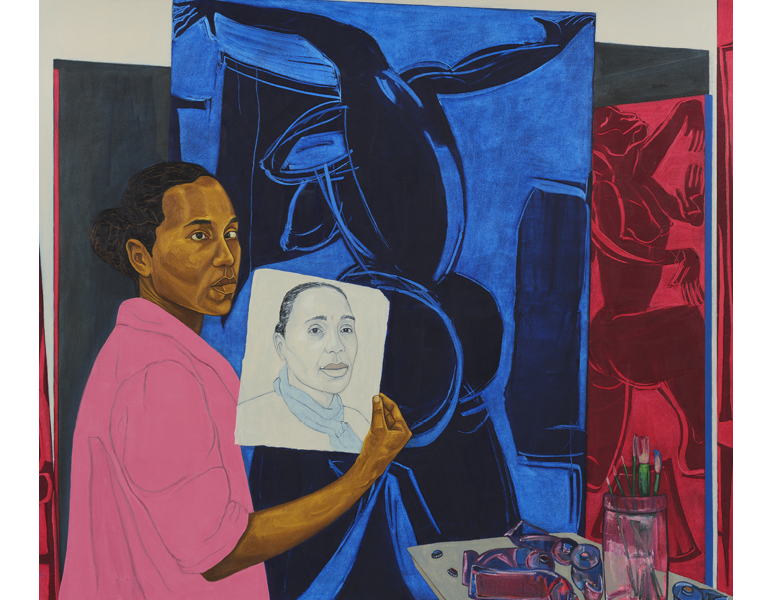
One of the paintings that captured my attention and emotions is Portrait of her Mother by Mequitta Ahuja (American, born 1976). She writes, “I make paintings by scraping away paint, figuring something new out of loss”. This painting was done during the last months of her mother’s life and I find it quite compelling.

Portrait of Her Mother, 2020. Mequitta Ahuja (American, b. 1976). Oil on canvas; 182.9 x 213.4 cm. Courtesy of Mequitta Ahuja and Aicon Art, New York. © Mequitta Ahuja

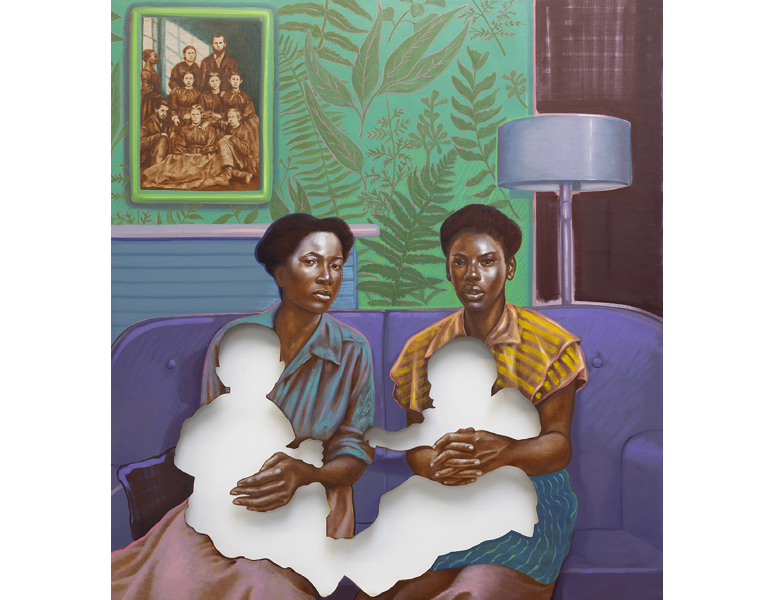
Another painting that puts me in a similar frame of mine is Titus Kaphar’s Not My Burden. The painting features two Black women who have been touchingly depicted and are certainly two individuals. But they are holding children consciously absent…so absent that the canvas has been actually cut away to show the exposed gallery wall in a brilliant white. The museum wall card suggests that the missing children might represent white children who are often cared for by Black women or Black children who have been tragically lost and a hole is left to their mothers. This painting is probably the show’s centerpiece and most gripping…

Not My Burden, 2019. Titus Kaphar (American, b. 1976). Oil on canvas; 167.6 x 153 cm. © Titus Kaphar. Image courtesy of the artist and Gagosian. Collection of Ellen Susman, Houston, Texas. Photo: Rob McKeever

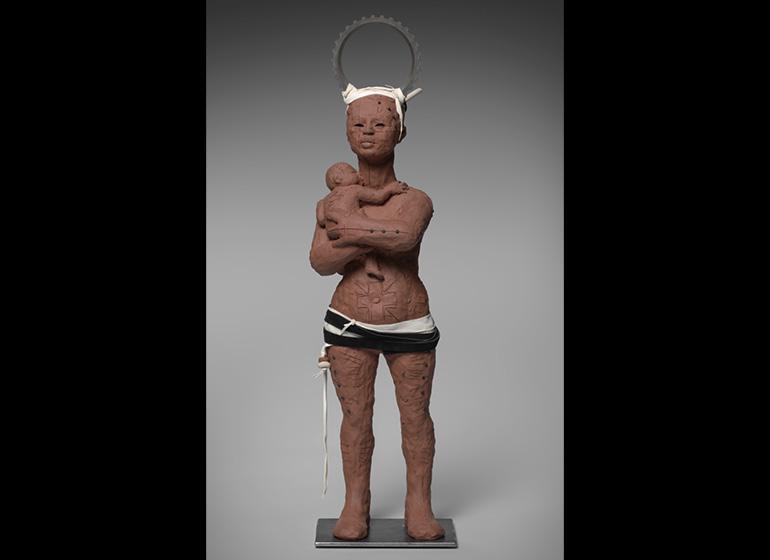
There are a number of very elegant but evocative sculptures as well. This clay mother and child or Madonna by Rose B. Simpson (American, born 1983) is a prime example. Ms. Simpson is working with traditional methods used by her family and ancestors in the American Southwest. Titled Genesis this sculpture is both tied to our immediate era and timeless at the same time.

Genesis, 2017. Rose B. Simpson (American, b. 1983). Ceramic and mixed media; 83.8 x 22.9 x 15.2 cm. Courtesy of the artist and Jessica Silverman, San Francisco. © Rose B. Simpson

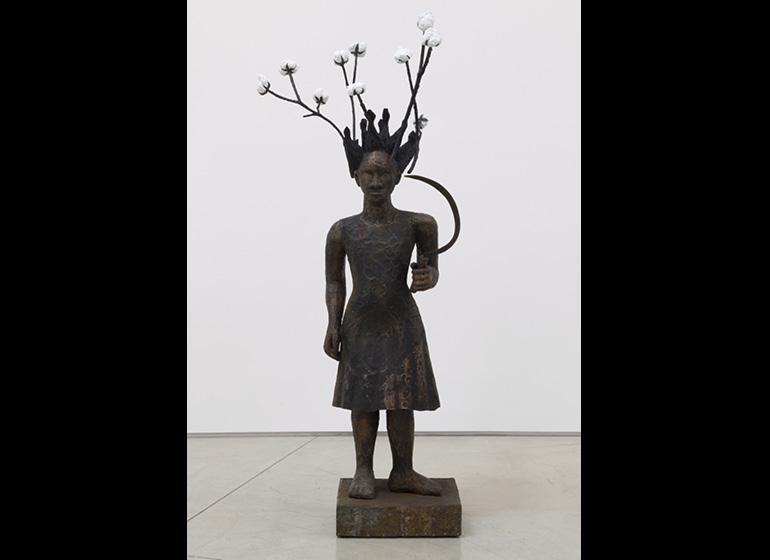
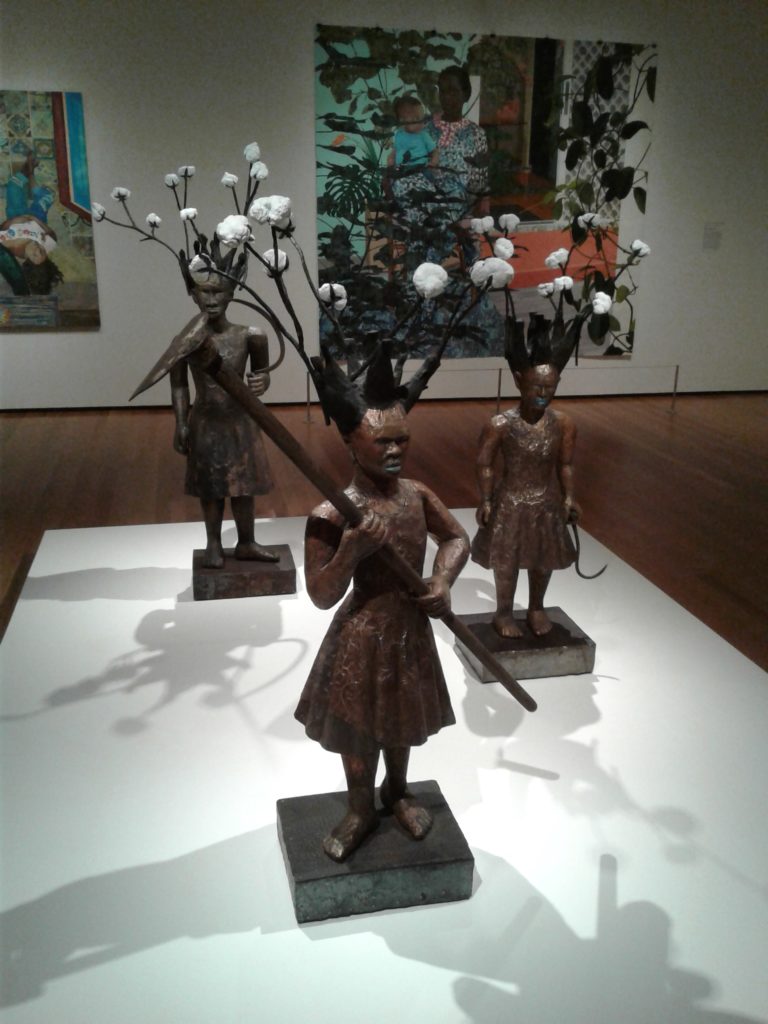
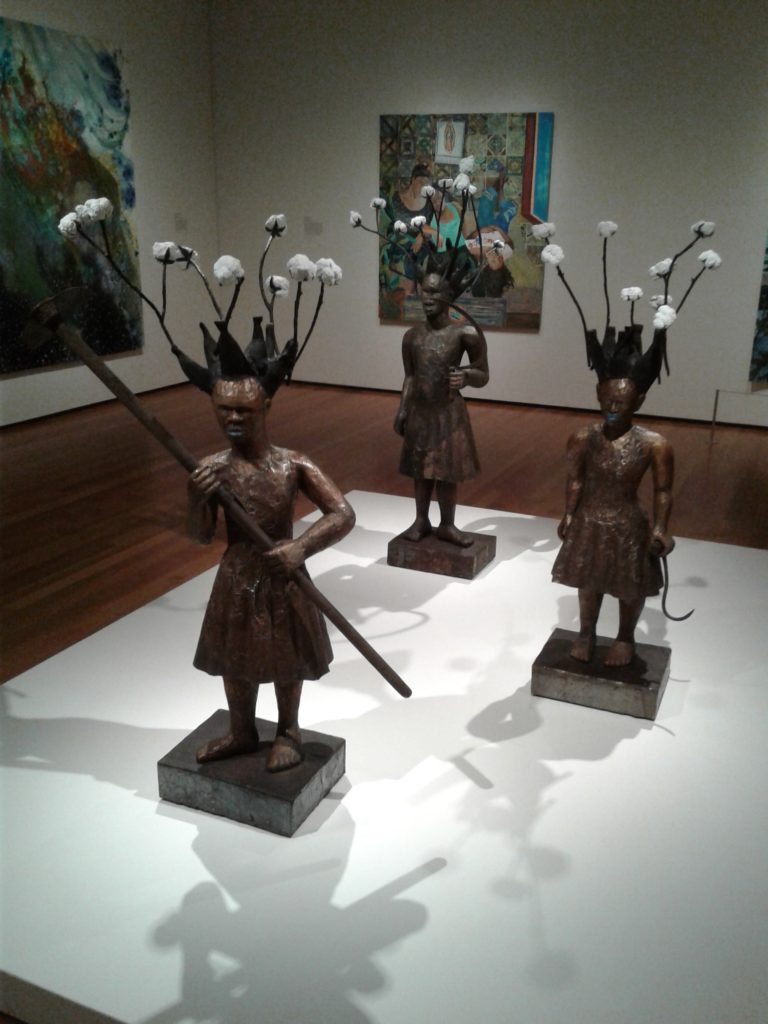
And then we have a group of multi-media sculptures by Alison Saar (American, born 1956) that are troubling in their content. These works are based on an enslaved child character, Topsy, from Harriet Beecher Stowe’s anti-slavery novel Uncle Tom’s Cabin. I am going to post a number of photos here. One from the museum that shows us the clear vision of Rice, one of three sculptures on display from a series of five. And then I will provide two more that I took that show all three in the context of the show. The three figures are Indigo, Cotton, and Rice. The youngster is clearly shown wielding the tools of slavery and harvesting cotton. A clear indictment of our past…and a prod to think about what that means to our present.

Rice, 2018. Alison Saar (American, b. 1956). Wood, copper, ceiling tin, bronze, tar, and vintage found tools; 162.6 x 76.2 x 63.5 cm. Collection of Susan Morse, Los Angeles. © Alison Saar. Courtesy of L. A. Louver, Venice, CA
photo by Ed Heinzelman

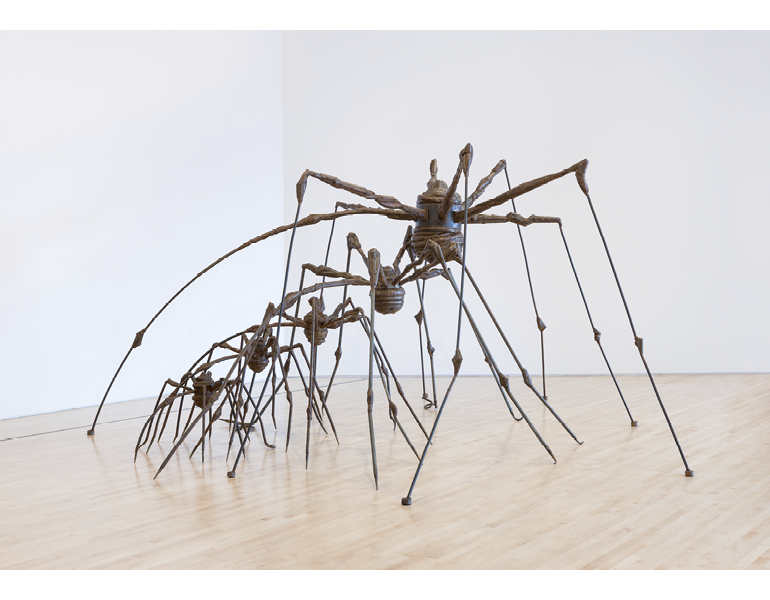
And now a bit of whimsy: Louise Bourgeois (American, 1911 – 2010):

The Nest, 1994. Louise Bourgeois (American, 1911–2010). Steel; 256.5 x 480.1 x 401.3 cm. San Francisco Museum of Modern Art, Purchase through the Agnes E. Meyer and Elise S. Haas Fund and the gifts of Doris and Donald Fisher, Helen and Charles Schwab, and Vicki and Kent Logan, 98.193.A–E. © The Easton Foundation / Licensed by VAGA at Artists Rights Society (ARS), New York. Photo: Katherine Du Tiel

Picturing Motherhood Now runs through March 13, 2022. This show is ticketed and tickets can be purchased online at the link shown here. Be sure to check the museum website for COVID precautions before visiting.

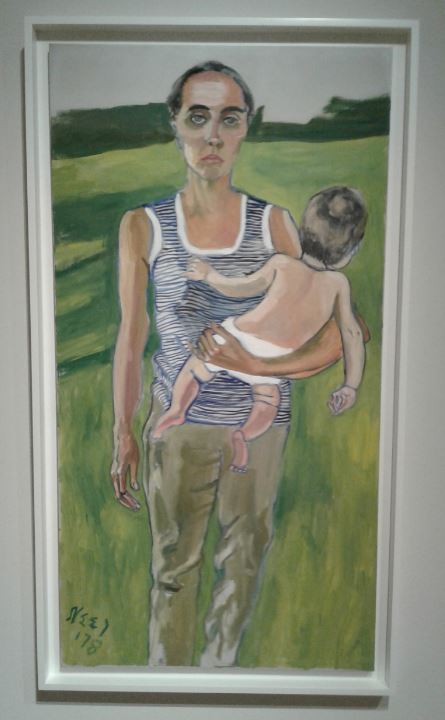
Ginny and Andrew, 1978 by Alice Neal (American, 1900 – 1984) oil on canvas, from a private collection. photo by Ed Heinzelman