
UWM’s Peck School of the Arts: Winterdances 2026: Resilience

It’s that wonderful time of the year…a week or so after Groundhog’s Day and just a few days into the Spring semester…UWM’s Winterdances. I always find this to be a cheerer upper in the gloomy days of February. And the 2026 version, named Resilience, didn’t disappoint. We were graced with four world premiere dances, each unique and extremely expressive, and absolutely engaging.

The first dance would be an exhilarating start to any dance program. Be My Ground, When The World Lets Go was choreographed by Peck School of the Arts Associate Professor Mair Culbreth in movement collaboration with the cast. Opening with an ensemble front stage dancing in a great bit of fluidity…we slowly become aware of four more dancers hanging against the back wall from harnesses and cable who begin to move up, down, or across the wall, only to eventually join their colleagues on the floor. Fluidity! This piece is all about that…as individual dancers, or pairs of dancers, or small groups spin off or leap across the stage in very natural yet hyperactive motions that just simply personify fluidity. But then everything gets crazy fun and each dancer takes a turn locking into a rope and harness and takes a turn defining space and distance on their own terms…sometimes solo and other times in unison with another dancer. You may be excused if you sense chaos here because no one dancer or core group is center focus anymore and it is hard to decide where to look and whom to watch…but it looked like such fun! And the sense of confusion was enhanced by the selection of different pieces of music providing a variety of sensual moods and feeling. From her notes, Culbreth stated: “This work began with a kinesthetic investigation of vertigo—as both a bodily sensation and a condition of ambivalence.” Her cast certainly took on that investigation in full.

Next dance, Ghana Must Go, is a very different experience…more sober…but also an example of fluidity, but more human and less mother nature perhaps. Assistant Professor Ishmael Konney is the choreographer on Ghana Must Go in collaboration with the performers. Based on the 1983 expulsion of Ghanians from Nigeria, this is a very telling human story. We first encounter a troupe of eight dancers moving in unison carrying bundles on their heads. At first just seemingly marching together, each dancer eventually breaks out for a moment and performs a short solo performance before reentering the group. The music is beautiful and rhythmic allowing the dancers to keep in time with each other while still moving away to express their individual personas. And as the dance progresses there is some signs of distress and sadness for certain, but the group comes together as a community…certainly an expression of resilience.

And after intermission, we were instantly called to pay full attention, as PSOA faculty member, Dawn Springer’s Harps That Once, bursts out as loud and fast and athletic. Many opening moves involve running break neck across the stage and later the group is running place…this all certainly exhibits references to athleticism. And then it evolves into an organic matrix of arms stretching skyward and legs kicking toward the horizon, and then falling back in graceful arcs to perpendicular, while the dancers spin and swirl and form and reform like a flock of birds. Using a vast variety of music for the settings, things change, break down, and again take on different moods and feelings. There is also a bit of chaos here, but a sense of structure too…and resilience!
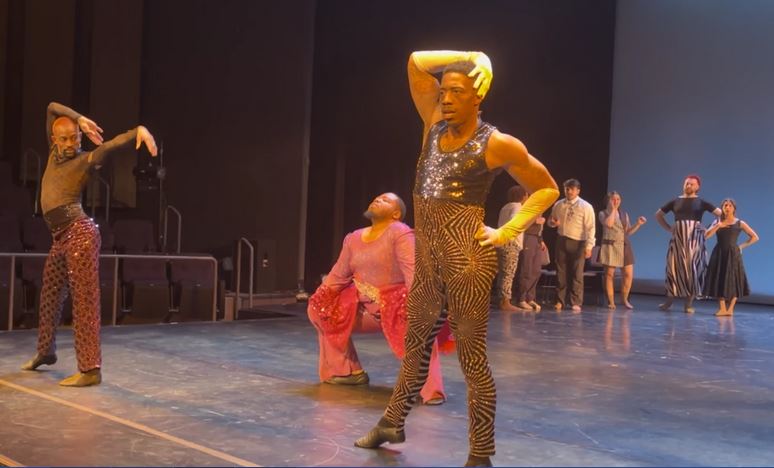
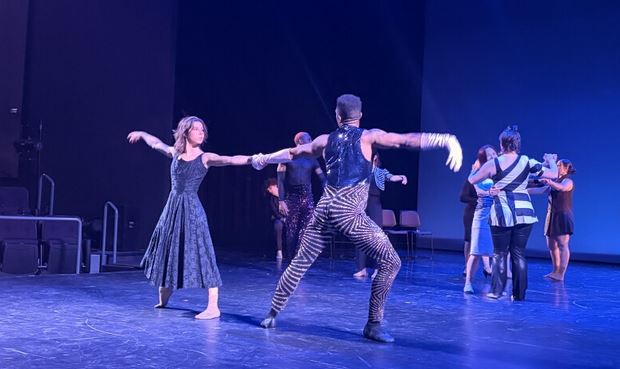
And the finale, Care, conceived by visiting choreographer David Roussève, was also choreographed by Roussève in collaboration with the performers including guest performers Richard ‘Buda’ Brasfield, Jacques Infiniti-Hall (Mizrahi), and DaCosta Martin. Care is a homage to Ballroom House dancing and the LGBTQIA+ community that developed it over the years and celebrates it today. In Care, we first experience a Debutante Ball, chaperoned by a very vigilant chaperone, PSOA Artistic Director, Maria Gillespie. With a keen eye and harsh whistle Gillespie keeps the dancers moving and separated at the ‘appropriate’ distance. UNTIL, Buda, Mizrahi, and Martin show up expecting a Ballroom House ball. “What kind of a ball is this?”, they ask. “A debutante ball”, Gillespie replies. And? “Not anymore it isn’t!”, is their reply. And the music shifts and our three guests start to vogue, making their own presence in turn, and starting to attract the younger dancers. Gillespie tries to maintain decorum and control and keep some of her charges in line but it is a losing battle. One by one the debutante ball participants move over to the voguing trio and urge them to continue and to show them how to do it. The dance continues as each guest teaches and encourages the new devotees on the dance floor and a whole new energy comes to life right there on stage. The victory is complete when Gillespie is gifted with a bright red pair of elbow high satin gloves and they are quickly put on and showcased. There was no end to the flash, glamour, and exuberance during Care, until it did finally come to an end. Care received the biggest applause and cheering of the evening…obviously a big hit with the mostly student audience.
There were a number of stand out performers over the evening, but I don’t know their names so I can’t go on in detail. But as I said in my opening, Winterdances 2026, is still the highlight art event at UWM’s Peck School of the Arts in the spring semester.

Extra Credit Reading: The Playbill with bios, choreographer notes, and complete music listings

Editors Note 2/12/2026. While listening to WUWM this morning, they said that they had some photos from this version of Winterdances…but in my search I only found a few for Care…so I stole two of them an inserted them here!

Lovabye Dragon, A Look At Friendship Up Close And Personal

First Stage has put together one of the cutest productions for the younger set that I have seen over several seasons. And to make it even better it is in the very intimate Goodman Mainstage at the Milwaukee Youth Arts Center. The Goodman is a theater in the round so no one is far from the action. And to add to the fun many of the front row chairs have been replaced with carpet squares so the youngest among us can have a stage side front row seat! This play appeals to the 3 to 8 year olds so this seating arrangement was well met…yes it was!

Lovabye Dragon was adapted from Wisconsin author Barbara Joosse’s Dragon and Girl books by First Stage’s Executive Artistic Director Jeff Frank and Barbara Joosse with original music by The Happy Racers. And Director Marion Frank makes it all sing and come alive on stage!

Christopher Feiereisen (left) and Mac Heinrich (center) and the Magic Cast in Lovabye Dragon. First Stage, 2026. Photo by Paul Ruffolo.

Since I don’t anticipate too many 4 year olds reading this review, I don’t think I need to hold back on any of the story. We meet Girl, a princess, celebrating her birthday with her Mother, the Queen, and Father, the King, in their castle home. After blowing out the candles on her cake which is almost immediately swept away, she opens her birthday present. It is a stuffed dragon. She laments that she asked for a real dragon and even wished for one as she was blowing out the candles on her cake. Mother and Father of course, being protective parents, outline all of the reasons that a dragon is unsafe…and you can never ever really trust a dragon. Father: “My motto is: Play it safe”. And then for safety the girl is sent to her room. She cries in sadness and frustration and her tears magically transport to the cave of a dragon, who too is lonely and in due course the dragon comes to her rescue (and his own as well).

Izze Yanovskiy (left) and Lainey Techtmann (right) in Lovabye Dragon. First Stage, 2026. Photo by Paul Ruffolo.

And Girl suggests that they go outside and play and engage in a round of hide and seek. Girl has never been outside. But Girl hides too well and too far from the castle and night falls before they are reunited. Girl finds a treasure map in a bottle washed up on shore and they are off on a great great adventure…with challenges and new characters…and three little Viking trolls who want her gold. But here is the moral of our story…gold is friendship and our Vikings quickly understand that true friendship is truly gold.

Bree Beelow (front), Mia Raines (middle), and Owen McDonald (back) in Lovabye Dragon. First Stage, 2026. Photo by Paul Ruffolo.

Like many First Stage productions for youngsters, this play is anchored by a number of adult actors. Bree Beelow as Mother, Jesse Weinberg as Father (and part of the dragon…more later). The most involved adult here is Christopher Feiereisen as the Troubadour. Luckily for us and Girl and Dragon, Feiereisen isn’t quite an adult in his own imagination yet. He clearly displays the youthful and playful character of a youngster, all the while framing the story for us in wonderful rhyme and dance and music. If it weren’t for the dragon, Feiereisen would be the star of the show.

(L to R) Amelia Sajdak, Penny Whitmore, and Christopher Feiereisen in Lovabye Dragon. First Stage, 2026. Photo by Paul Ruffolo.

And as usual, the young actors are split into two casts, the Magic Cast and the Wish Cast. The named lead of course is Girl who is played by Lainey Techtmann in the Magic Cast and Amelia Sajdak in the Wish Cast. I saw the Magic Cast, and they were marvelous. Girl has the major speaking role and also performs a number of the key songs that tell the story. But from experience, no one will ever be disappointed by any cast in a First Stage production. But do keep in that if you wish to see a particular young actor, pay careful attention to which cast they are a part of and which days they perform.

Magic Cast of Lovabye Dragon. First Stage, 2026. Photo by Paul Ruffolo.

And now, THERE ARE PUPPETS! What wonderful, what marvelous puppets. And I enjoy puppets a great deal and First Stage always uses them to great effect and has an amazing puppet workshop (see my previous posts on First Stage presentations to see a vast array of their puppetry). The major puppets are of course Dragon, operated by three actors, one working the head, one working the tail, and one serving as the legs and framework of the body. A great colorful walking dragon!

And there are a number of smaller dragons who represent the dragon in travel and the three little Viking trolls who are just as lively and incredible as our dragon. Props to puppet designer Brandon Kirkham and his helpers.

Wish Cast of Lovabye Dragon. First Stage, 2026. Photo by Paul Ruffolo.

One amazing thing I did learn: Dragons wag their tails when they are happy!

And one other feature of every First Stage production. There is always a short talk back at the end where the younger members of the audience get to ask questions of the cast. It is such fun to hear what they see and how they react to each play. This time one young lady was perplexed on what Girl’s name was. She didn’t want to accept that it was Girl. And one young man wanted to know why it took two people to work the dragon puppet. It is pretty large as is apparent in the photos. He was surprised to find out that it was actually three actors…he had missed the actor inside the body allowing the dragon to dance and walk.

First Stage’s Lovabye Dragon is at the Goodman Mainstage at the Milwaukee Youth Arts Center from now until February 15th, 2026. Additional info and tickets here.

Approximately 50 minutes with no intermission. Recommended for families with young people ages 3-8 and brave explorers of all ages.

Extra Credit Reading: Enrichment Guide! Social Narrative!

I Am My Own Wife. But You Are An Impossibility.

The first sentence in my title is the title of the play currently on stage at the Milwaukee Chamber Theatre. The second is a paraphrase from Doug, the alter ego of playwright Doug Wright, from one of his interactions with Charlotte von Mahlsdorf in the play. Charlotte is an open transvestite living in Germany. She is an impossibility because she survived the Nazis during the Second World War and later the Soviet occupation of East Germany. She was an antiquarian, portrayed as having a particular affinity for Victrolas and other late 19th and early 20th Century music systems and mechanical clocks. And according to Wright’s play, she kept a museum of her treasures and conducted detailed tours through the 28 rooms of her museum. The items were acquired through purchase and trades but much of it salvaged during WWII and the Cold War. The story revolves around interviews between the play’s fictional Charlotte and the fictional Doug…

Jonathan Riker. Photo courtesy of Milwaukee Chamber Theatre. Photographer: Michael Brosilow

Charlotte’s life wasn’t an easy one by any means. First an abusive father who meets an untimely end and of course the indignities that queer people and transvestites in general experience in the mid 20th Century. All of these instances are described in detail in conversation with Doug or acted out for our benefit, sometimes in great detail, by Riker/Charlotte. So there is a lot of different contexts here. From general and specific homophobia and its changing face over 50 years and of course the antisemitism of the Nazis. This is history that 21st Century society needs to remember and guard against forever.

Jonathan Riker. Photo courtesy of Milwaukee Chamber Theatre. Photographer: Michael Brosilow

There is but one actor in I Am My Own Wife. And that actor is Jonathan Riker who is credited at Charlotte et al. And that is because as written, Riker plays all of the roles. Not an easy task at any time but particularly difficult here given not only the varieties of gender but the varieties of nationality. Riker is an impeccable Charlotte, the graceful moves, the lilt in her German, and the intense feeling for the music and the music machines. Oh, and a delightful German accent that clearly makes the point but without being too strict for these Midwestern ears to understand. But with a droop of the shoulders or a turn of the head, Charlotte becomes Doug the playwright and interviewer, or Doug’s friend John who ‘discovers’ Charlotte and alerts Doug to her existence, or her lesbian Tante who helps Charlotte identify her sexuality and provides support, or any number of other friends or acquaintances who are keys to the story. Going from the feminine lilting German to a very deep masculine Texas drawl would be daunting for anyone, but particularly here in the midst of a half dozen other voices. But Riker nails it and has fun with it. There is an audible chuckle in the audience the first time he makes the transition. There’s also a sly look on Riker’s face!

Jonathan Riker. Photo courtesy of Milwaukee Chamber Theatre. Photographer: Michael Brosilow

Director Alexander Coddington has orchestrated a very simple but inviting dance on stage for telling this involved story. How he put this all together is simply staggering…so seemingly simple…but such elaborate story telling. And kudos to Coddington for keeping Riker so focused and on track through the two hours it takes to tell this story well.

Jonathan Riker. Photo courtesy of Milwaukee Chamber Theatre. Photographer: Michael Brosilow

There is a second star of the show, the set. Riker works in a spare shallow space with a dining room table, two chairs, and a cabinet. But behind is a painted backdrop that resembles a paneled dining room until the lights behind are turned on…and at one time we see an elaborate bar and back bar setting that Charlotte saved from a gay bar and later a mass collection of furnishings adorned with a milieu of mantel clocks and hall clocks or simply a sitting room. Quite s stunning achievement from the scenic staff of Sarah Hunt-Frank, Adam Hastings, and Maaz Ahmed.

Jonathan Riker. Photo courtesy of Milwaukee Chamber Theatre. Photographer: Michael Brosilow

I was a bit late to the dance on this one: I Am My Own Wife is at the Milwaukee Chamber Theatre through February 8, 2026. Ticket information is here!

And an answer to the unasked question stuck in the back of my head: there has been an understudy performance added on Tuesday February 3rd.