Gertrude Stein’s Doctor Faustus Lights the Lights at Wisconsin Classic Stage

So you think you know Gertrude Stein? Not! But director Cole Castine of Wisconsin Classic Stage does and in Doctor Faustus Lights the Lights he will convince you that a rose is a rose but not a rose…and that’s neither here nor there.

Castine eschews traditional theater presentation here. And as you will read below, that’s with good reason. Rather than a stage front and center with a back set and the audience out front, Castine as rearranged the seating on the Calvary Presbyterian Church to run along the longitudinal walls of the nave. One row of seating and standing room behind with their backs to the walls. Alley seating. There is no stage. Instead the action occurs down the middle of the nave from sanctuary to choir loft and all points in between. Some actors actually enter and exit this playing area via gaps in the seating. So the audience is fully immersed in the play itself. Castine is also credited as the designer and lighting designer for Faustus. And given his treatment of the text as director, I am not sure anyone else could have foreseen or designed to his vision.
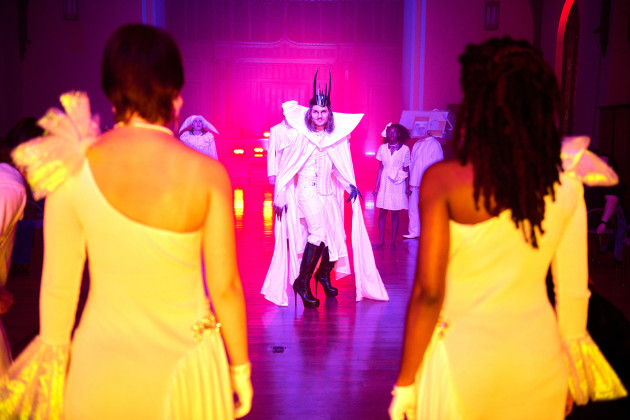
Evan Smolik center.

I am not sure how you would describe this play, here, now, in the 21st Century. It isn’t a traditional drama, nor a traditional comedy, nor a traditional musical. But it does certainly have a number of very dramatic scenes and a number of rather funny exchanges and retorts and it has music…both instrumental and ensemble singing and solo moments. Stein is often described as a modernist playwright. I am not sure exactly what than meant when this was published in 1938. But in Castine’s development, and at nearly a hundred years on, it takes on tendencies from absurdist theater from later in the 20th Century to beatnik poetry readings to psychedelic pastiches from the hippie era. Not quite of a place at all but of no place either. Neither here nor there. But all is not lost, Stein is at her best Stein in her playing with words and tracing odd complexities of the language…and their place in our efforts to communicate. There is much poetry in it. A rose is a rose is a rose is a rose…and she is she, and he is he, and I am me, and we are we. Absolutely, or so it will seem. Faustus is said to be from Stein’s narrative period. Narrative? That is hard to trace. But as scholar Betsy Alayne Ryan states, Stein did not, “leap foolishly into ordinary comprehensibility.” So don’t be surprised if you find ordinary comprehensibility lacking here. But don’t think for a moment that makes this Faustus any less intriguing.
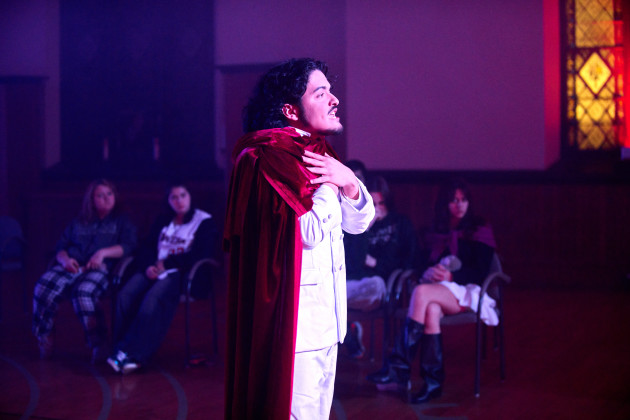
Antonio J. Parra

I could see how Stein’s text could bring a director to a catatonic state. But Castine prevails and introduces all twelve actors graciously and gracefully and slowly limns the actual characters as the narrative unfolds. There’s that ‘n’ word again. Dr. Faustus, Dr. Faustus! Are you Dr. Faustus? Antonio J. Parra is Dr. Faustus. Parra can provide a doctor both regal and haughty but later nonchalant and without a care…seeming to lord over Mephisto denying he had a soul to sell to playing his own games of deception with both Mephisto and the other characters. And finally Parra, calmly demands his right to enter hell, but Mephisto is having none of it until Faustus performs one more hateful act. Faustus true feelings and nature might be more true to the rantings and demands that Parra makes to be left alone…even to his main companions and suppliants. But never fear, only Dr. Faustus can turn night into day.

Evan Smolik stands tall as Mephisto. No, really, in the highest black heels that I have ever seen. Smolik remains surprisingly calm despite being taunted by Faustus but does come apart just a bit when he accuses of Faustus of deceit. ?? Smolik’s already imposing voice is rendered even more sinister via electronic means…so after his imposing height above the rest of the cast, his imposing voice can easily strike out to the fearful. How did Dr. Faustus fall under the thrall of Mephisto? Well, the glare and amazement that is the electric light. He had to possess it. Not just the moth is drawn to the flame.
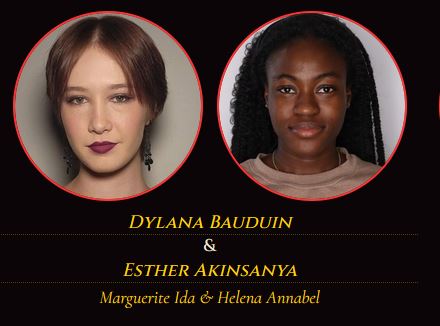
The good doctor’s main and endearing companions? Austin Bock as boy and Marty Alivo as dog. Thank you dog. Two other standouts are Dylana Bauduin as Marguerite Ida and Esther Akinsanya as Helena Annabel. They are inseperable and the she is she proponents in the play. They also are grand inquisitors of is there there or here here or it’s just neither. But are they sisters, twins, companions, partners, or ??? Nessiah Grace is Girl. There is no more explosive energy on stage than the skipping, dancing, and running by Grace as Girl.

There are distinct mood shifts here…sadness, despair, desperation, hope, fear, death, and at times jubilation. And they don’t necessarily follow any set pattern or one logically follow another. But it is dark before it is light.

This was envisioned as an opera or operetta back in 1938. It comes to us today as something of an operetta or maybe a bit of a musical but not quite either. Yes the playwright is Gertrude Stein but the original music is by Lincoln Donner with additional music by Ryan Holifield. One odd bit of consistency is the song I believe is sung and repeated by Tyler Stauffacher: it seems to take its cue from doo-wop music of the mid-1950s. A refreshing little twist.

Costuming is an amazing thing some days. Today is one of those days. Tianna Lee did the costuming for Faustus. Some of them were obvious choices, like a stark and menacing devil costume for Mephisto. But save for Dog (black) and Faustus (red cape), all of the costumes were white. And intriguing. Many of them seem to have come from nursery rhyme characters or maybe dreams or other metaphysical writings. Simple, elegant, but eerie in their way..

Calvary Presbyterian Church is a good venue for theater. The acoustics in most cases are amazing. These acoustics certainly enhanced the musicians and the various singing bits during the performance. But at times the church also consumed the spoken text of individual actors and some of it was simply lost to me.

Wisconsin Classic Stage will be forming (that’s a typo, it should be performing, but in editing, thinking about the fluidity of narrative and the loose staging, forming may be the correct designation) Faustus Lights the Lights at Calvary Presbyterian Church from now through November 8, 2026. Running time is about 90 minutes but be forewarned! Some music set to prepare the mood and stage starts about ten minutes before curtain…a bit of free jazz to not jazz to not quite music…instead a clarion call to attention…and the cast takes these moments to position themselves or as does Parra as Faustus, start to inhabit their roles and declare their presence on stage.

Extra Credit Reading: The Program

More information and ticket ordering here.

Renaissance Theaterworks World Premiere Of Great White Throne

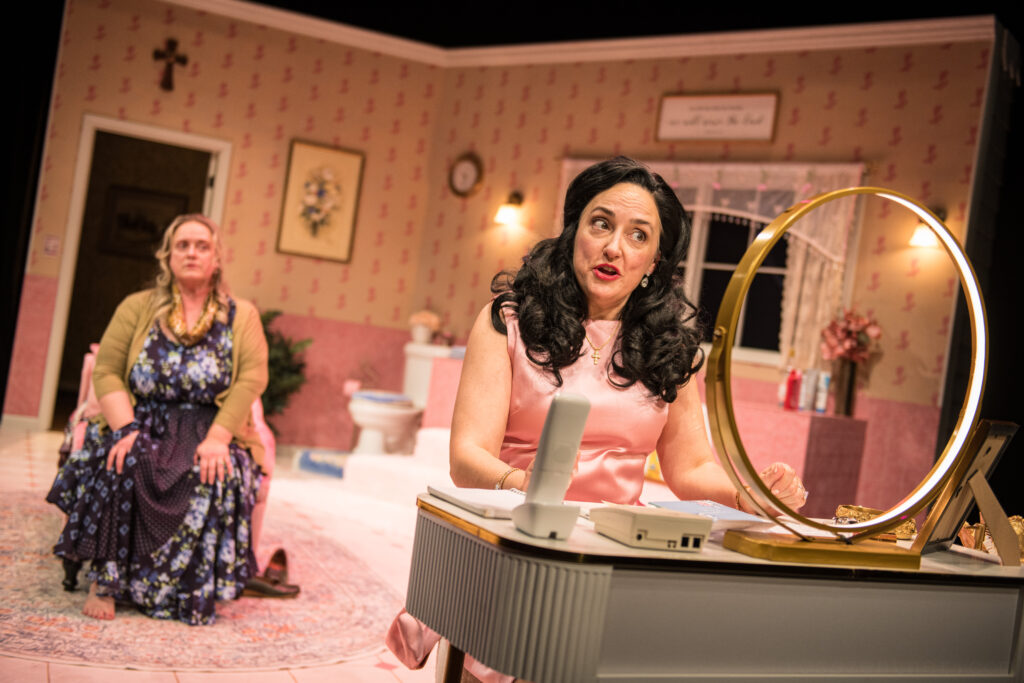
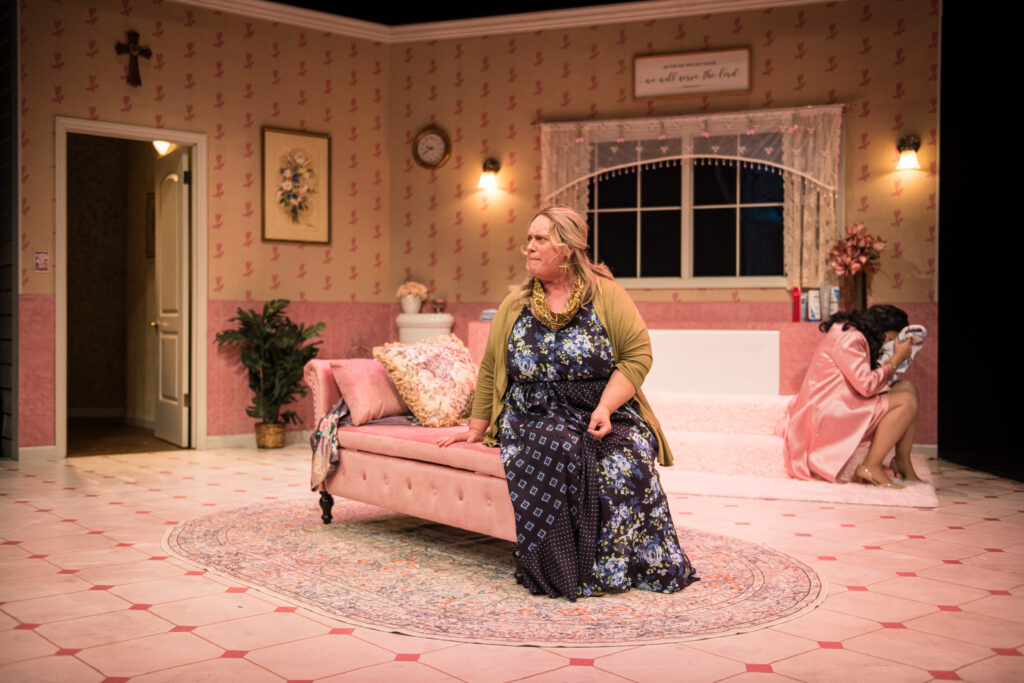
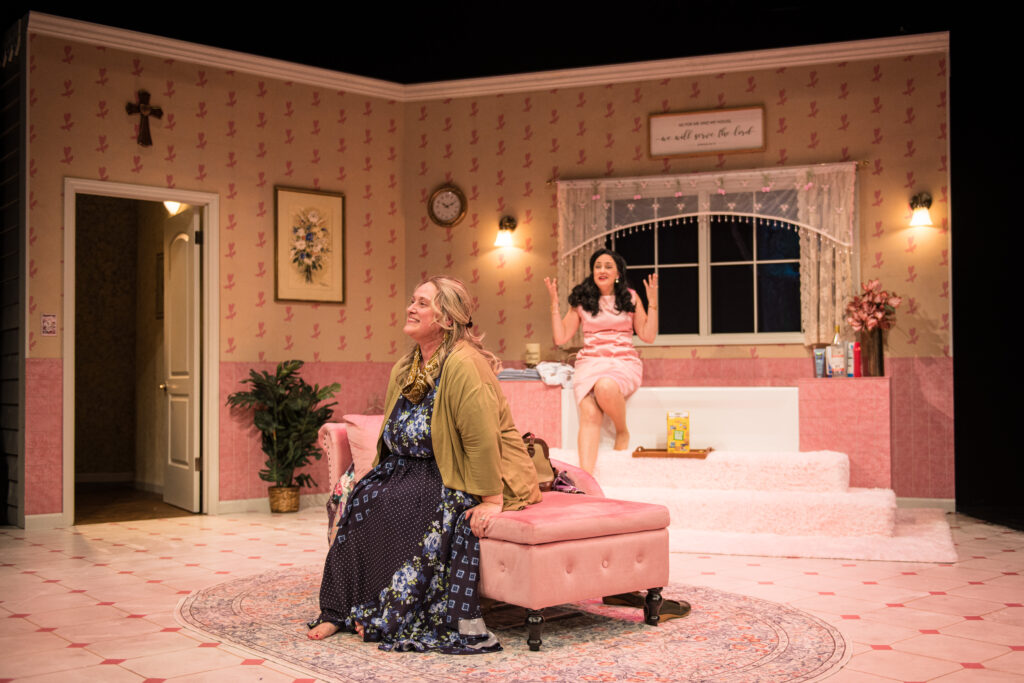
Let’s start with a quote from Maria Amenabar Farias’ Director’s Notes: “…how many plays have you seen fully set in a bathroom?!” Well here we go! And a pink bathroom at that. A very pink bathroom! Until the wizardry of lighting designer Jason Fassl makes the pink even more intense. And doesn’t it seem since the nearly universal adoption of LED lights, that lighting has even more influence on the movement in a play? Well this season so far, it certainly seems that way. But here at first, we just take it for granted…it’s just a pink bathroom after all…until it becomes something of a pivot point late in the play.

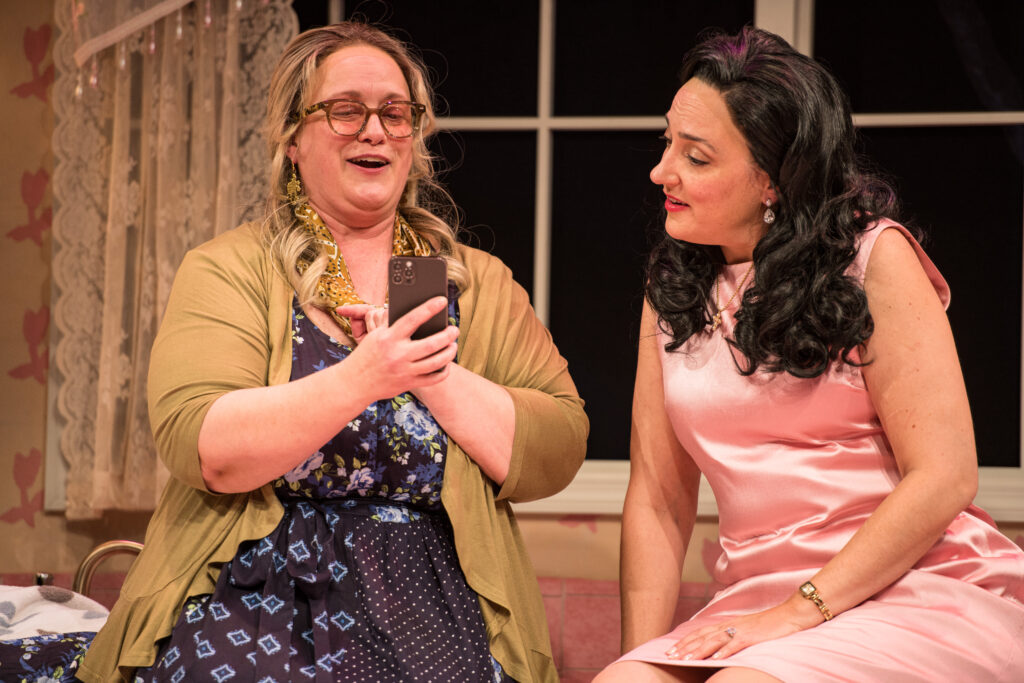
Marcella Kearns and Libby Amato.

This is a World Premiere Wisconsin presentation and was written by Cara Johnston. Johnston is originally from Dallas Texas (which might prove interesting to our story line? listen and see!) but now resides in Milwaukee and has had a number of plays performed by Renaissance Theaterworks. The playbill places our activity as being from a few years ago, and very late on a Sunday evening. I might quibble with the few years ago, it feels a bit older than that, but then I am not from the cultural setting as are our two characters in the play.

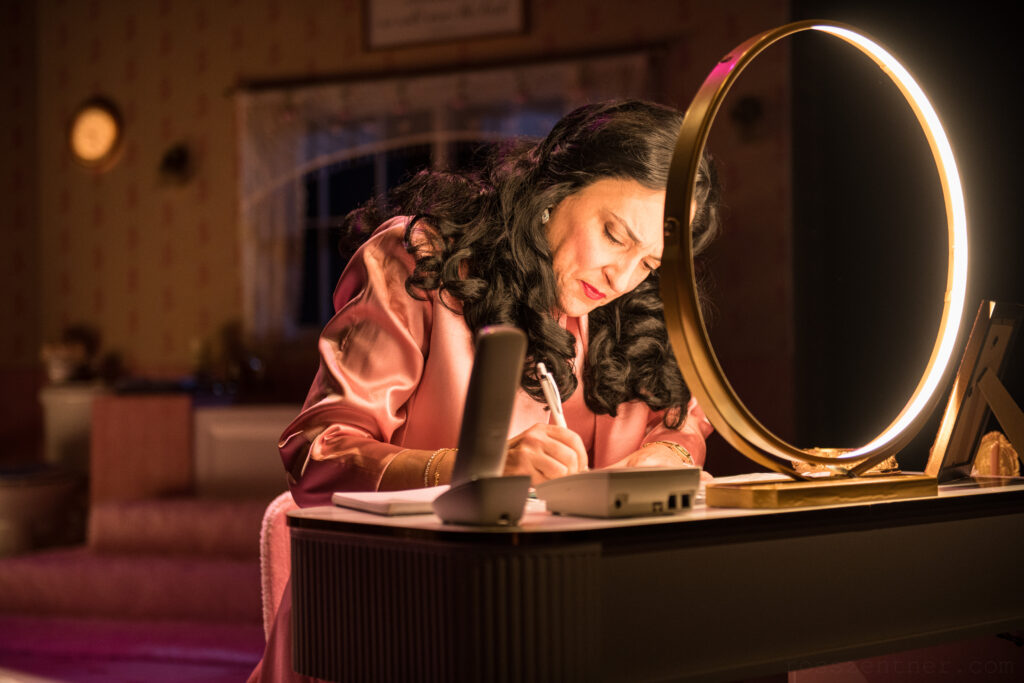
Libby Amato.

Opening, a very distraught woman rushes into the bathroom wearing a pink as pink can be stylish sheath dress and frantically searches around until she finds the objects of her desire. She writes a check (in a bathroom ? OTOH this is the largest bathroom I have ever seen, with a landline phone, and in a parsonage yet). Then realizing that she has lost her keys, she screams. And in bursts a second woman, swinging her purse like a cudgel, ready to do battle, until she realizes where she is and who she is with. And she is carrying a set of keys and said she rushed in because she heard a scream. She is dressed in lovely and stylish attire, but obviously more casual and comfortable in her approach. She quickly realizes that the lady in pink is the Pastor’s Wife and our knight in shining armor is the Deacon’s Wife.

Libby Amato (foreground) and Marcella Kearns (background).

These ladies know each other on the surface, but they don’t know each other, despite the Deacon’s Wife being a church member for 30 years and the pastor leading the church for the past 20 of those years. But that’s all about to change. We will see that about all that they have in common is the love of their church and the love and respect for their faith. And we don’t actually know their names throughout the play.

RTW offers Great White Throne as a Dark Comedy. It is all that. And a hysterical comedy, but I don’t mean as in belly laughs and guffaws. The humor here is more gentle laughter, sighs of recognition, or gasps of surprise. No, the comedy here often relies on the characters verging on the hysterical.

Libby Amato and Marcella Kearns

Libby Amato is the Pastor’s Wife. Amato manages to present a woman at wit’s end who isn’t sure what she should do or where she should go. All she knows is that for the moment is her husband has gotten himself into some legal trouble and her job is to write a check for bail and bring it to the jail. And when the Deacon’s Wife appears, Amato presents a woman torn between duty to husband, maintaining her composure in front of a congregant, and just holding her self together in the moment. Amato’s character is not comfortable in her own skin, now or later in the play.

Marcella Kearns (foreground) and Libby Amato (background)

Marcella Kearns’ Deacon’s Wife, is in fact comfortable in her own skin. And while walking around the neighborhood waiting for her husband who is attending a meeting in the church, she encounters the front door of the parsonage wide open, sees the keys still in the lock, hear’s a scream from inside, and runs to the rescue. Kearns’ shifts from rescuer to Bible quoting healer, as she realizes that the Pastor’s Wife is in crisis despite her denial.

For a while the two women initially stalk each other a bit. But as they start to share a bit of what is going on, and as Amato dramatically explains her distress and her husbands plight, the two women realize that the emergency meeting next door may just determine the pastor’s future and as a result, his wife’s as well. And the walls come tumbling down and real conversation starts, how they got there, and how they feel about it.

Marcella Kearns (foreground) and Libby Amato (background).

Kearns’ is just a live wire even in the role of a new found supportive friend. Her ability to listen and relate and just express the angst and concern for the moment can be exceptionally compelling. And Kearns’ Deacon’s Wife is clearly comfortable in her own skin. Her nearly polar opposite is Amato’s Pastor’s Wife. Amato plays to the hysteria built into the character and clearly expresses a brittle existence but then slowly reaches out for that AHA moment when she realizes that she needs to care for herself. Both women clearly understand the plight of women in their society, each have dealt with it in different ways, ways they thought suited themselves. And in the Pastor’s Wife case, what she thought duty demanded. At times these conversations are uncomfortable and in modern vernacular might be TMI to share with a virtual stranger. It can be difficult to listen to at times even when the dark humor is bubbling there just under the surface.

So yes, the is that AHA moment, but we are never going to be sure exactly what form it finally takes because it ends with a big slam.

Great White Throne runs from now through November 8, 2026 at the home of Renaissance Theaterworks at their theater on South Water St in Milwaukee.

And I don’t envy the props guy or stage staff having to put the set back together each night.

Marcella Kearns. Photo by Ross Zentner and courtesy of the Renaissance Theaterworks.

CLYDE’S: The Diner Where Sandwiches May Be More Than Sandwiches, They May Be A Metaphor

But a metaphor for what exactly? Well in Lynn Nottage’s Clyde’s, you will have a number of candidates, life, work, family, person-hood, philosophy, or sometimes, just a sandwich. This is a very edgy play about a down and out diner, seemingly kept that way by the owner, Clyde. And Nottage populates it with five very unique and diverse characters who share one thing in common. They have all taken a wrong turn at some point in life and found themselves incarcerated in a state prison and are now trying to reclaim themselves and a place in society by working in the kitchen at Clyde’s.

Dennis Lewis. Photo by Anne Kenny Creative and courtesy of Waukesha Civic Theatre.

Director Ashley S. Jordan certainly has found the truth in each character and found the actors to voice that truth in her production at the Waukesha Civic Theatre. And Jordan didn’t shy away from the rough language and rough back stories for each of the characters either. Jordan brings them front and center since they are key elements in what this story is all about.

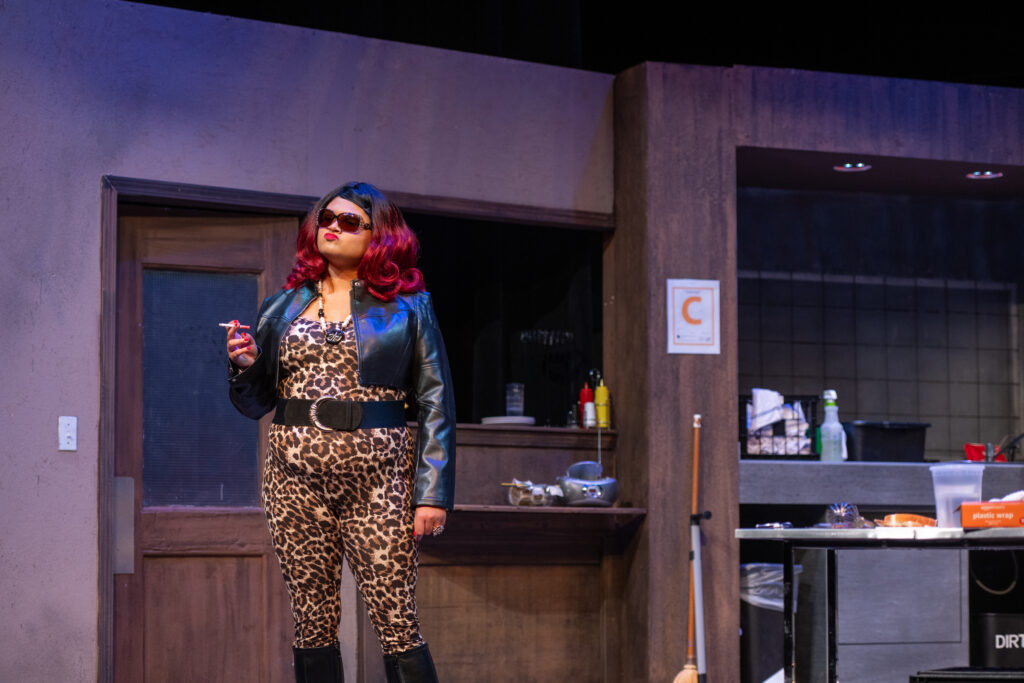
All of the action takes place in the kitchen at Clyde’s. Evan Crain has designed and built a serious looking kitchen area with complete grill, sink, and refrigeration areas. And I would like to add a thank you to sound designer Antoine Reynolds for the ‘soundtrack’ to the action, from contemporary rap, to classic soul, to lively Hispanic tunes, and finally to over the top loud metal music, and back. The set expresses the soul of the joint and the music expresses the soul of the characters.

Autumn Green. Photo by Anne Kenny Creative and courtesy of Waukesha Civic Theatre.

Yes, there are five characters here. And yes, they are all ex-cons. But one is not like the others, and that is Clyde. Clyde might still be into something nefarious?? But she knows that she can get away with mistreating her staff because Clyde’s is their last chance. And Autumn Green as Clyde, can be as mean and demanding as they come. And when Green storms onto the stage, and that’s a good description of nearly every entrance, she has the presence that just brings the chill into the kitchen and onto the audience. And here, Green’s voice has a shrill factor that at times when she is in high anger, just echoes across the entire theater. She sells it so well, that it is a bit of a shock at curtain, when this smiling waving obviously happy woman takes her final bows.

Left to Right: Ash Meeks, Kenan Pulver, and Roman Valdivia. Photo by Anne Kenny Creative and courtesy of Waukesha Civic Theatre.

The other four characters are her kitchen employees, and they know where they stand, and either keep quiet in her presence, or are very accommodating to her demands. Until the dynamic starts to change. It would be easy to ascribe the change to the arrival of a new cook, Jason, but not directly. Not only is Jason new but he too isn’t like the others. Although freshly released from prison, he isn’t a minority and feels an outsider as well as the new guy. Kenan Pulver mixes these feelings pretty well in his portrayal of Jason. Brash and bold to cover his insecurities but also a bit resistant to the current dynamic in the kitchen. Pulver also can be the fly off the handle Jason, but it is a pleasure to watch him transform as he begins to understand that he is in fact, part of the family here. Roman Valdivia plays the sous chef, Rafael. Valdivia presents a Rafael who identifies with his role and has rules around his grill. Although, at first, not really receptive to Jason, he tries to steer him clear of a confrontation with Clyde. Although cool and business like at first, Valdivia moves easily into a confident flirty attitude with Letitia, and later also moves to feeling the rapport and family vibes that he and the rest of the kitchen staff have developed. And there is a surprising emotional down moment for Rafael, that Valdivia develops very effectively.

Left to Right: Ash Meeks and Roman Valdivia. Photo by Anne Kenny Creative and courtesy of Waukesha Civic Theatre.

Letitia? Letitia is a veteran at Clyde’s and a young mother of an ill daughter. Ash Meeks gives us the frustrated and distraught mother but can move to a very determined and direct young woman who has definite and well thought out opinions on the plight of young single minority mothers in our world. Meeks moves smoothly from the tested and very emotional young mother, to the experienced and in charge of herself cook, and the worldly woman she would like to be.

Dennis Lewis. Photo by Anne Kenny Creative and courtesy of Waukesha Civic Theatre.

And then we have Montrellous. He is the main man in Clyde’s kitchen. And Dennis Lewis portrays the wise and thoughtful and maybe just a bit too philosophical Monty. Clyde’s has a menu full of sandwiches. Clyde’s is famous for its sandwiches. But Lewis’ Montrellous is searching for the perfect sandwich. It is a bit of a zen existence if you will and as each cook lists their ingredients aloud to each other, it takes on a bit of mantra. Jason resists at first but is pulled into the dynamic. At times, each character actually puts together their perfect sandwich for the others to try. And they all look up to Monty for his approval. Some attempts are better than others, but no one ever gives up in their search for their sandwich grail. Except Clyde…who does everything in her power to dissuade and discourage them. Until she pushes them too far.

Clyde’s runs from now until November 1, 2026 at the Waukesha Civic Theatre’s mainstage.

From WCT: *CONTENT WARNING 18+ SUGGESTED*⁠

Graphic Content: Bullying, Drug and Alcohol use and abuse, Emotional and verbal abuse, Sexual assault, Toxic relationships, Grief, Sexual harassment, Classism and Racism, Addiction, and Chronic illness.

There are 130 instances of strong language.

Additional information here. And Ticket information here.