For my junior year of college, I moved to UW Milwaukee. My last blues band in Pewaukee had disbanded and I was renting a room from a retired couple. So I knew I couldn’t bring my rig to town. I just had a single acoustic guitar and was exploring taking a folk singer route to musical performance.
One day I visited NMC Discount Records on Farwell on Milwaukee’s East Side. My high school buddy and the lead guitarist in that late blues band was the buyer there. But before I could visit with him, the sales clerk pulled me aside and said, you play bass right? Well, yes. He continues, I am starting a new band and we are going to play Stooges and Velvet Underground songs, would you like to audition? I had no idea who the Stooges were but had a great deal of admiration for the Velvets and I had nothing going so I said sure! But we have to get my gear into town first. No, you can audition right here. Well I didn’t see any gear, but he disappeared into the back and returns with a black leather motorcycle jacket and a pair of mirrored aviator sunglasses. So, put these on. Now sneer!
And with that I was the original bass player in the band, Death. According to the history books (The Cease Is Increase and Brick Through the Window) and a documentary film (Taking the City By Storm), we were apparently proto-punk and the godfathers of Milwaukee’s punk scene. That store clerk was Brian Koutnik who was the founder and lead vocalist of Death. And yes he confronted the audience from the stage and in the audience during solos. And his determination to growl put Tom Waits and Captain Beefheart to shame. And the band’s image was clearly one of aggression and outsider posturing and the music was similarly positioned and exploded. And maybe surprisingly to our audience, the band members were very serious musicians and there was a lot of discussion around dynamics and spacing…and many of the solos were often more influenced by free jazz than actual rock and roll. But yes we were as loud and noisy and obnoxious as we could possibly be.
I probably played in a dozen bands between 1964 and 1974, but Death is the band that I feel the most fondness for. It was the only band that really had an identity. It was the only band where my band mates became actual friends beyond the music. And friends who recognized the act on stage or for our audience, wasn’t the act we wore with friends. The longest running version of the band was Jack Stewart on keyboards, Keith Sommer on lead guitar, Jim Richardson on drums, Ed Heinzelman on bass, for a bit James Chance on sax, AND Chuck Meyer on rhythm guitar.
Chuck was probably the most relaxed member of the band. He could tell a good story and he had an infectious laugh that brought everyone around him along for the joke. He was also instrumental in bringing the band back together in the social media era. Not as a band but as friends and even created a private Facebook page called Friends to link with the band, our friends, and our close fans. Chuck lived in Boston (see more below) and once a year would visit Milwaukee to see his family and friends. And we all made the effort to meet for libations one evening during his stay to remember and catch up and just be friends again.
I was still processing my brother’s passing when I got an email from Jack Stewart titled Chuck Meyer. I knew it couldn’t be good news and I didn’t want to open it. But Jack related that he hadn’t heard from Chuck for a bit and tried messaging him without any response and finally Googled him and found this obit: Obituary: Professor Charles (Chuck) Meyer. I was totally devastated and just lost it for the rest of the day.
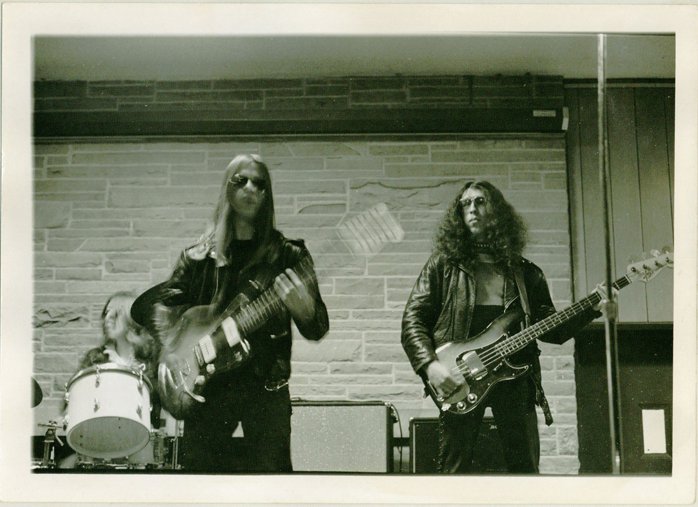
Left: Chuck Meyer, right Ed Heinzelman. Photographer Michael Gehrke
Now I knew that Chuck was a Professor Emeritus in linguistics at the University of Massachusetts – Boston. I knew he enjoyed it and was very very happy there…but I wasn’t aware of his success in academia nor how much he was admired on campus and beyond. But I wasn’t surprised. I am sure the same attention to detail that he put into his music was applied to his research, his teaching, and his studies. I am sure the warm personality and comfortable demeanor that I admired, that he had in and around the band, was the same individual who graced UMass Boston. Although I hadn’t seen him for just over a year, I still feel a profound sense of loss…
I am going to reprint a bit of his obit here, just to fill in his remarkable life:
Born and raised in Milwaukee, Professor Meyer received his B.A. in Linguistics (1976), M.A. in English (1978), and Ph.D. in English (1983), all from the University of Wisconsin—Milwaukee, where his dissertation, A Descriptive Study of American Punctuation, foreshadowed his lifelong interest in the empirical study of language and grammar.
Professor Meyer’s pioneering research in Corpus Linguistics and World Englishes transformed how we understand language variation, change, and use. As Co-Director of the American Component of the International Corpus of English (ICE), he helped lead a groundbreaking global effort to document and analyze English across national and regional contexts. He was a major figure in ICAME, the society attached to the ICE project, attending the annual conference for many years. He was invited to give guest lectures in England, Northern Ireland, Spain, Germany, and Japan. His work always transcended data collection; it sought to illuminate how language reflects identity, community, and the dynamic processes of communication and change.
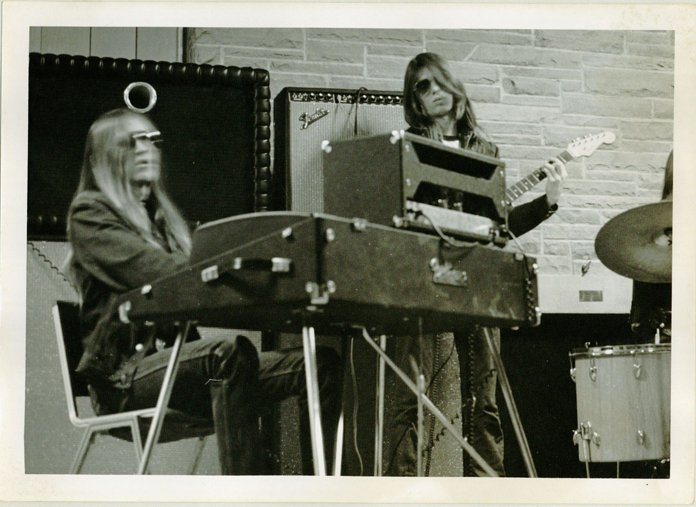
Left Jack Stewart, right Keith Sommer. Photographer Michael Gehrke
There are only three of us left. Jack Stewart, Jim Richardson, myself, and Chuck reached a ripe old age. Some of the others fell silent to the vagaries of sex, and drugs, and rock and roll much too early.
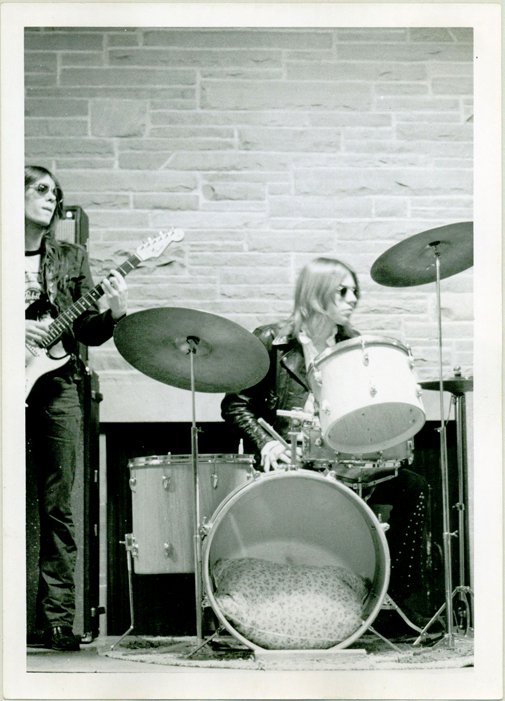
Left, Keith Sommer, right, Jim Richardson. Photographer Michael Gehrke
So my one tribute to Chuck Meyer’s legacy today is to listen to the exceptionally poor quality recordings out there in the wild that were done in the early 1970s with a handheld cassette deck and try to assimilate the energy and enthusiasm we had for the band and the music…particularly the Stooges’ I Wanna Be Your Dog and the Velvets’ Sister Ray. Death’s signature songs and the ones that we always got j-u-s-t right.
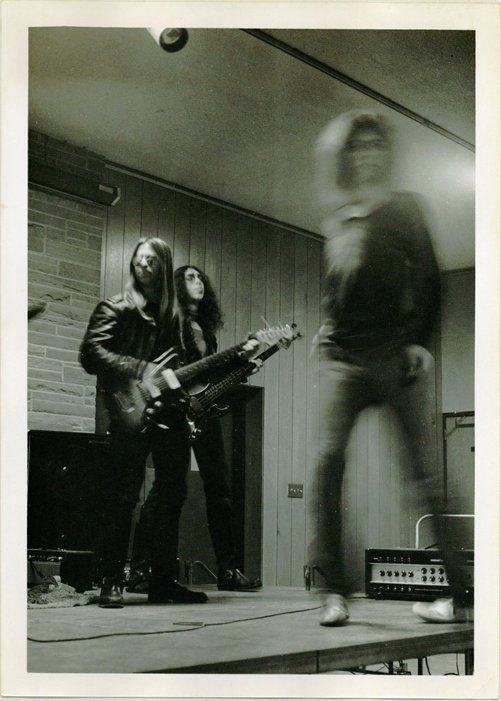
Front right, Brian Koutnik, rear left Chuck Meyer, rear right Ed Heinzelman. Photographer Michael Gehrke.
One last quote from the UMass Boston obituary: We are deeply saddened by the passing of our beloved colleague, Professor Emeritus Charles (Chuck) Meyer. Professor Meyer was a cornerstone of the Department of Applied Linguistics — a brilliant scholar, devoted educator, and kind, generous human being whose humor, humility, and intellectual depth touched everyone around him.