Milwaukee Chamber Present’s Lorraine Hansberry’s Classic: A Raisin In The Sun

Lorraine Hansberry’s A Raisin In The Sun is certainly a classic American play in the manner of say, Our Town. It is vital, it is focused, and it clearly positions us in a particular identifiable era in 20th Century America. Both plays examine the gender conflicts, generational conflicts, societal conflicts, and racial attitudes of their respective eras. Raisin is a more complex story as it contrasts the hope invested in the American Dream as opposed the actual experience of life in America for Black Americans.
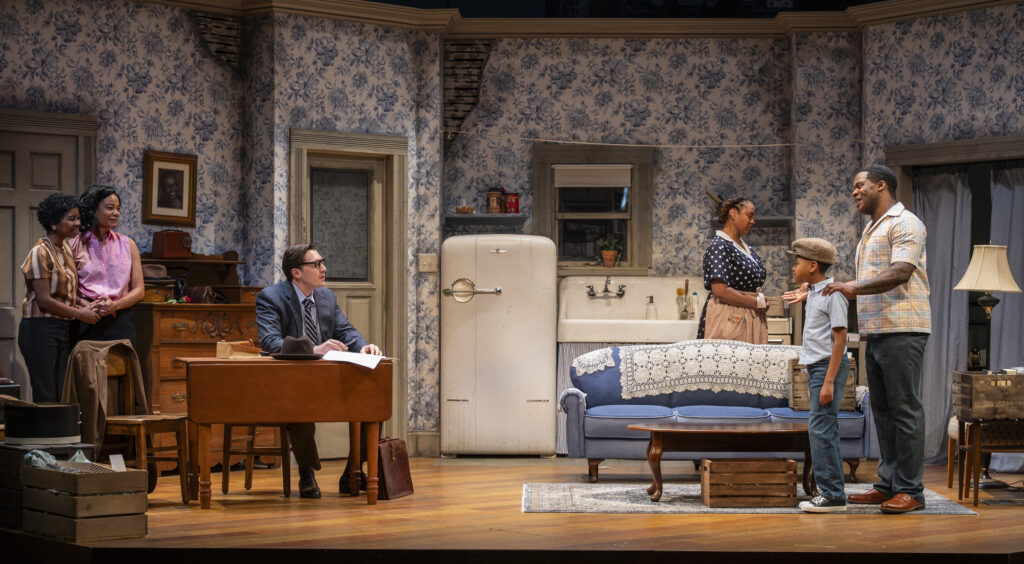
The cast of A Raisin In The Sun. Photo by Michael Brosilow and courtesy of the Milwaukee Chamber Theatre.

I don’t think we need to say anything about spoiler alerts given the stature of this play. But here is a short synopsis. Before the play begins, the patriarch of the Younger family has passed away and his life insurance pay out will provide some economic relief and opportunities that the family has not had in the past. But there is the rub. Several different family members have dreams and aspirations that this money could help them reach but that often puts them in opposition to one another during the course of the play. The money literally belongs to Mama, Lena Younger, the deceased’s widow. And her children state that is true during the play but there always seems to be a ‘but’ implied in the statement. Walter Lee Younger is frustrated with his lot as a chauffeur and wants to invest in a liquor store while his sister wants to continue her college career and become a doctor. Mama has other ideas and supports Beneatha’s college plan but given her religious beliefs, finds Walter’s liquor store idea objectionable. Lena takes her own lead and puts down a deposit on a home with the intention of moving her entire family out of the cramped squalid apartment where they currently are living. There are some mishaps, interventions, arguments, and third party disruptions…that provide a decent amount of turmoil, an interesting, deeply moving drama, and eventually, a satisfying ending.
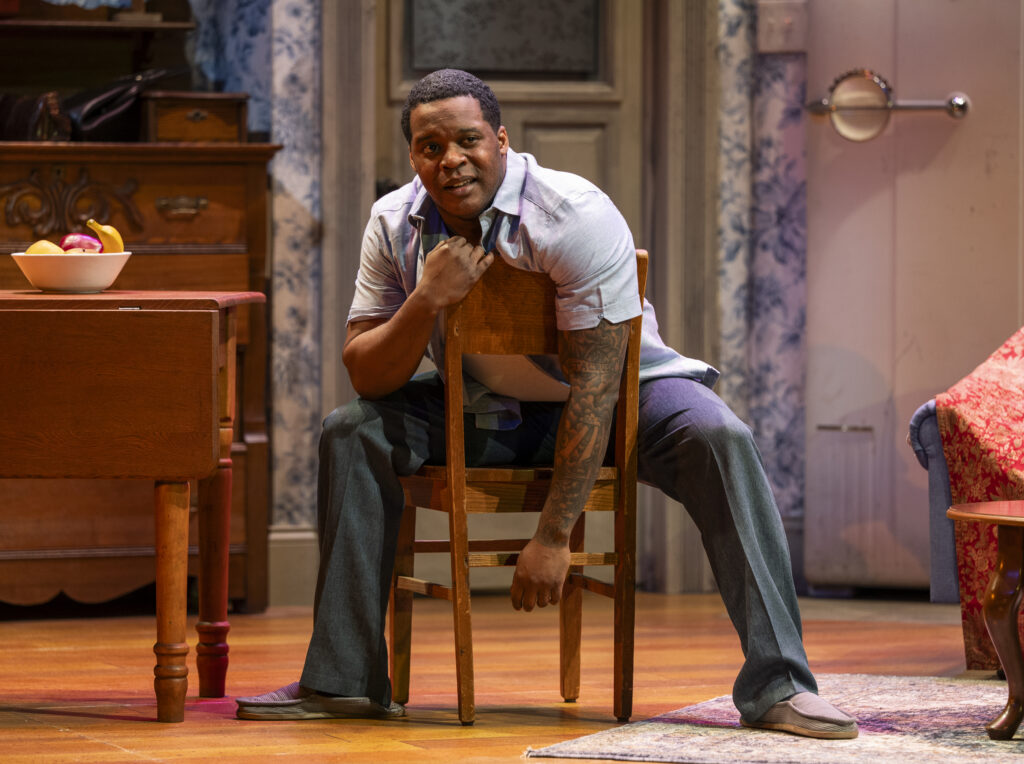
Dimonte Henning. Photo by Michael Brosilow and courtesy of the Milwaukee Chamber Theatre.

Dimonte Henning has developed into an intriguing and important member of the area theater scene both as a remarkable director and dramatic actor. So I was excited to see that he had signed on to play the very challenging role of Walter Lee Younger in the Chamber’s version of Raisin. Particularly when I realized that like many other presentations, director Kimille Howard was focusing on Walter as the lead character. This is not an easy role by any means and Henning realizes that and grabs it by the throat with both hands. Henning will make you feel Walter’s anger and frustration at his situation and you will recoil from the scenes of drunken behavior. And during one of Walter’s rages, Henning rails on about the lack of respect and understanding he feels he is getting from his family but he never exhibits a lick of empathy for their positions for a single moment. And I couldn’t quite discern the transition in his attitude when he comes into the room to find his sister dancing an ethnic folk dance…initially he is copying her moves to mock her but he seems to dissolve into an actual participant before too long. Just a bit of catharsis? Denning takes a surprising twist when he loses everything…and the expected rant and drinking…give way to the pain and a deadly quiet until he forges a new presence and new sense of manhood for Walter. And I have no idea how Henning maintains this level of intensity in the role for the entire two plus hours of the play.
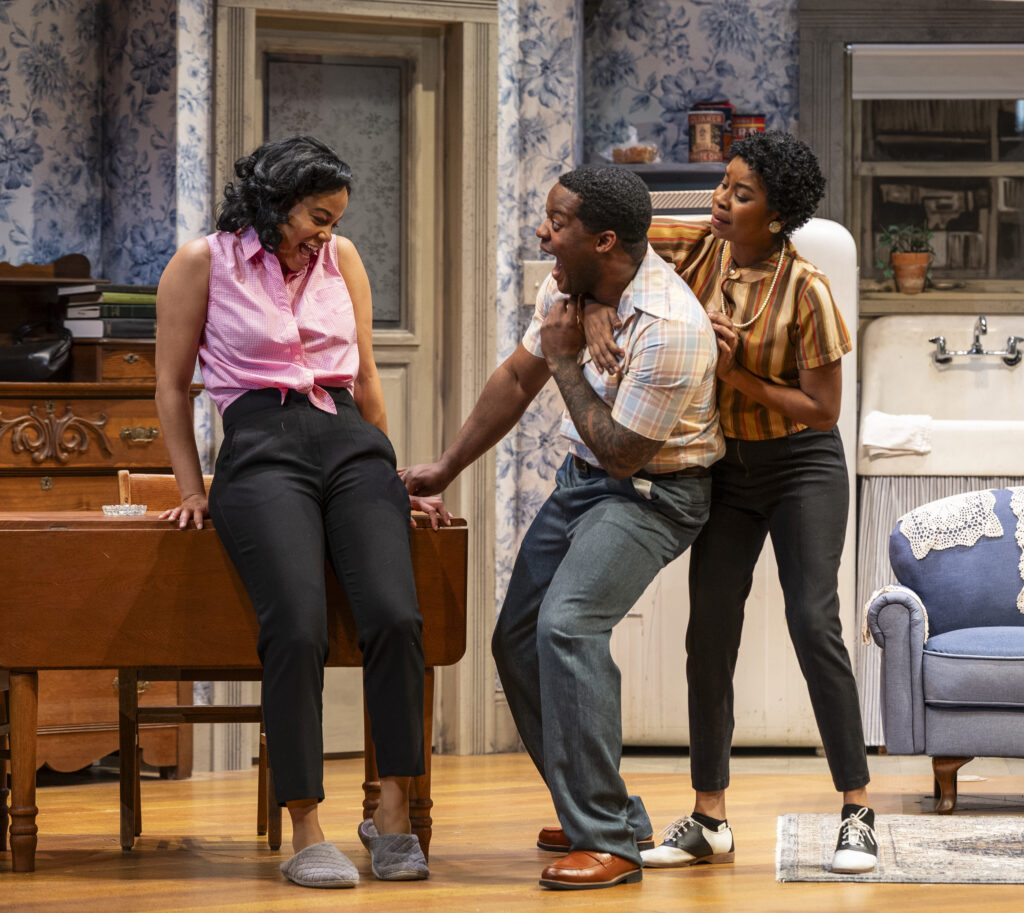
Left to Right: Paulina Lule, Dimonte Henning, and Malaina Moore. Photo by Michael Brosilow and courtesy of the Milwaukee Chamber Theatre.

It is remarkable how Paulina Lule maintains the composure called for in playing Walter’s wife, Ruth Younger. With any number of trials of her own, Lule presents us with one of the stable forces in the household despite having to mother a young son and an erratic husband and at times play peacekeeper between her in-laws. Lule has just the right resignation in their voice and actions to display Ruth’s own sadness even as Ruth feels the need to press on. As Lena, Olivia Dawson exerts her own sense of determination and makes some very dramatic decisions for her family. But she doesn’t always see eye to eye with her children and Dawson displays just the right amount of sadness and regret as Walter lets her down without losing her composure. Dawson conveys that outward calm of motherhood even when she is probably roiling inside. And Malaina Moore is just jubilant as Beneatha Younger, balancing beaus who couldn’t be more different to establishing her dream in everyone’s mind including hers. But Moore also effortlessly presents a young woman who is trying to find her own mind and set her own path for the future. Moore catches the in-between moments as well as the most apparent in her journey. And here too, Moore is amazingly calm as her brother confesses to losing her college nest egg too. Another under story in Hansberry’s grand scheme of things is the love of family will win out in adversity.
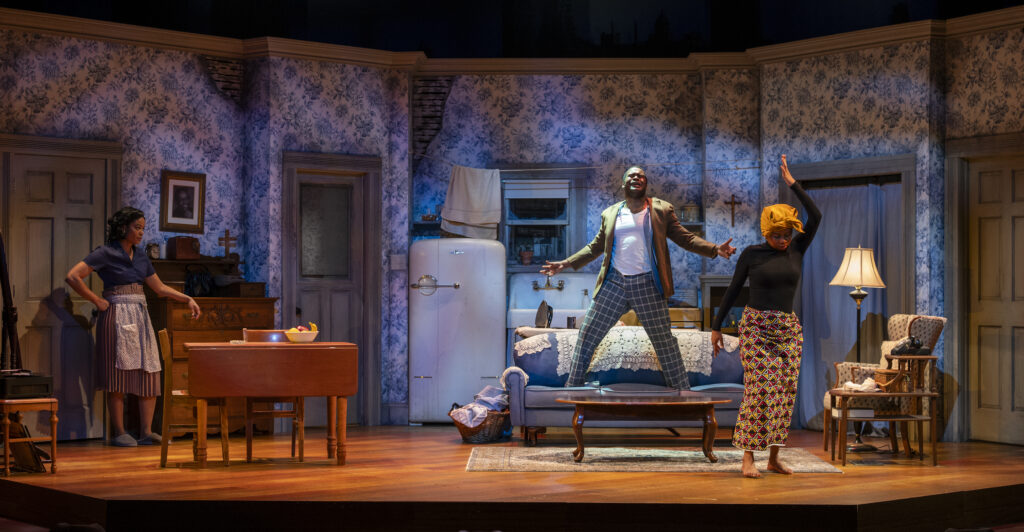
Left to Right: Paulina Lule, Dimonte Henning, and Malaina Moore. Photo by Michael Brosilow and courtesy of the Milwaukee Chamber Theatre.

And two other featured characters around the Younger family? Kamani Graham plays a cocksure young man who is convinced of his own sophistication as George Murchison. And when George is listing the things that are important, Graham sells us on George’s knowing what he should do, what he has to do, and what he is doing but he has absolutely no idea why. Not sure who he thinks he is convincing, but he’s not getting to Beneatha. And Joseph Asagai is Beneatha’s other beau, a Nigerian student, he is self assured in an entirely different sense. Ethan Hightower’s Joseph is rooted in his own power and his dream for his people and the influence he hopes to bring home on the completion of his college sojourn in the US. The energy Hightower brings to the role certainly is attractive to Beneatha and the audience.

Then there is Karl Lindner. Lindner is played by Ken Miller and Miller brings just the right amount of trepidation to his character. He knows what he is doing isn’t right but societal pressure is putting him into this unfortunate and uncomfortable position. The role must be nearly as stressful for Miller to play as it would have been for a real life Lindner.
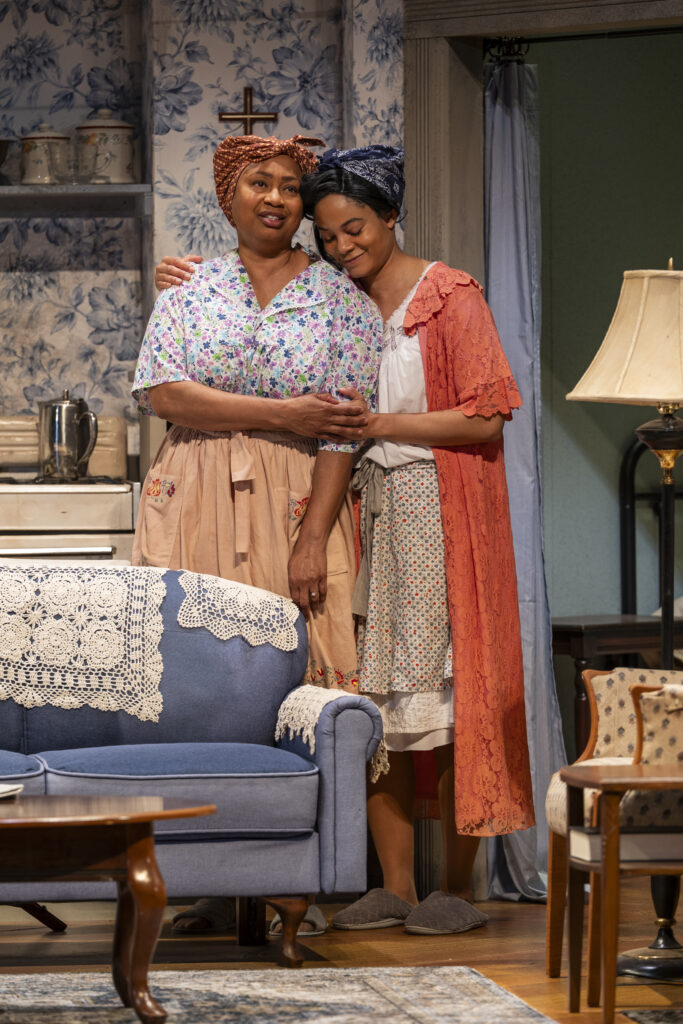
Left to Right: Olivia Dawson and Paulina Lule. Photo by Michael Brosilow and courtesy of the Milwaukee Chamber Theatre.

A quick shout out to Jordan Doidge for his portrayal of Travis Younger, the young son of Walter Lee and Ruth Younger. But I don’t think that sleepy act in the first act would have fooled my mother either. Nicely Done! Doidge alternates with Amari DeBerry as Travis. So if you are hoping to see Doidge or DeBerry, plan you visit to MCT carefully. The times and dates for their performances can be found in the links below.

This is a true classic American play and director Kimille Howard has voiced it in the proper classical perspective: a forceful performance that should be experienced on their live stage.

A Raisin In The Sun is playing at the Milwaukee Chamber Theatre from now through May 24, 2026. For those familiar with MCT, please note that they are presenting Raisin in the companion stage next door where the Skylight Music Theatre usually performs at 158 N. Broadway.

The play runs 2 hours and 45 minutes including one intermission.

Additional information HERE and Ticket information HERE.

Milwaukee Rep: George & Gracie: A Love Story

The Milwaukee Repertory Theater is presenting George & Gracie: A Love Story in their Stackner Cabaret. Written by local actor and playwright, Tami Workentin, who plays Gracie Allen here, it is part of World Premiere Wisconsin and is A John (Jack) D. Lewis New Play Development Program production.

George & Gracie: A Love Story starts with a framing tale of George Burns restarting his solo career after Gracie Allen’s passing. While waiting in the theater for his cue to go on, his mind starts to race through memories of the key points in his/their career and his life with Gracie. Workentin has merged portions of Burns & Allen routines with pivotal points in their private lives to bring us their love story.

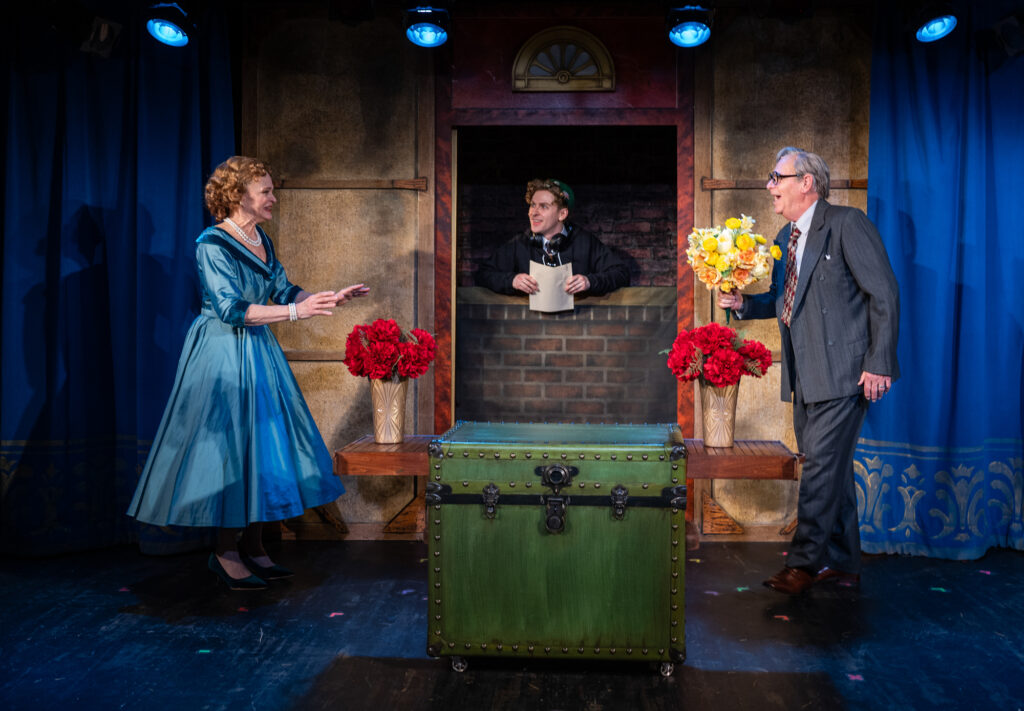
Pictured L to R: James Pickering, Tami Workentin, Jonathan Riker. Photo by Michael Brosilow and courtesy of the Milwaukee Repertory Theater.

Beyond the nostalgia of ‘experiencing’ the magic of George & Gracie, there is also the excitement around seeing James Pickering in the lead on the small Stackner stage again, playing opposite his wife, Workentin. And their obvious affection for each other certainly contributes to their depictions of George & Gracie. And this is a love story for the ages.

The humor here has aged a bit. And it was apparent in the audience response a few times on opening night this past Sunday. Some things that I thought were funny got mild laughter or a few polite chuckles instead of the noisier response I would have expected. That’s not on Workentin. She pulled together a great group of jokes and gags that express Burns & Allen to a tee. I think it’s more to the difference in humor and sensibilities inherent in 2026 compared to the middle 20th Century. Remember, they retired their TV show in 1958.

L to R:Tami Workentin, James Pickering. Photo by Michael Brosilow and courtesy of the Milwaukee Repertory Theater.

Tami Workentin is marvelous as Gracie. She has every tic, twist, and turn down pat and her inflection and timing certainly resemble Gracie and exemplify the era. Jame Pickering plays George Burns. When in contemporary Burns mode he is the loving mindful husband mourning the loss of his wife and partner. But when in the memory events, he seemed a little bit off. He certainly got the timing right and the jokes right but he didn’t quite have the joy and presence of George Burns. Sometimes its a curse to play a person still in the audience’s mind.

The third actor is one to really keep an eye on. Jonathan Riker plays the elevator guy. That doesn’t sound particularly significant, but trust me, he’s an integral part of the story. And at about 5 minutes before curtain, pay close attention to the stage. Similar to his first appearance in I Am My Own Wife at Milwaukee Chamber earlier this season, Riker is walking around the stage carefully positioning props, giving the stage one more sweep up, and picking up litter and a few scraps of torn newspaper. Just as the play begins, a bit of sleight of hand, and voila, magic! Watch, you won’t want to miss it. But after that Riker is in fact the elevator guy, train porter, bell hop, stage manager, radio announcer, and guide who keeps George on track. Riker helps sell this show!

L to R: Tami Workentin, Jonathan Riker, James Pickering. Photo by Michael Brosilow and courtesy of The Milwaukee Repertory Theater.

And the costumes are amazing for all three characters. And there are many costume changes in just this two hour show. But Jason Orlenko really went all out for the dresses and gowns that Workentin wore as Gracie. The colors and textures and fit is truly high couture.

And this is another Laura Braza direction…she has provided the Rep and Milwaukee theater any number of outstanding memorable experiences. This is another one!! Any time you see her directing, run out and see the play.

L to R: Tami Workentin, James Pickering. Photo by Michael Brosilow and courtesy of The Milwaukee Repertory Theater.

George & Grace: A Love Story runs in the Milwaukee Rep’s Stackner Cabaret from now through June 14, 2026. Running Time: Approximately 1 hour and 40 minutes with no intermission. Recommended Age: 14 and up.

Additional information and tickets here.

Extra credit reading: Program here.

The Contructivists: BUG. Plumbing The Breadth Of Contagion

The Constructivists pride themselves on presenting dark cutting edge theater. And they have certainly accomplished that with their season ending presentation, Tracy Letts’, BUG. In her program notes, director Maya Danks describes loneliness as the driving force in this play. But that is only part of the story…how far is one willing to suspend disbelief in real life in order to assuage that loneliness. In BUG, Letts suggest that there is no limit.

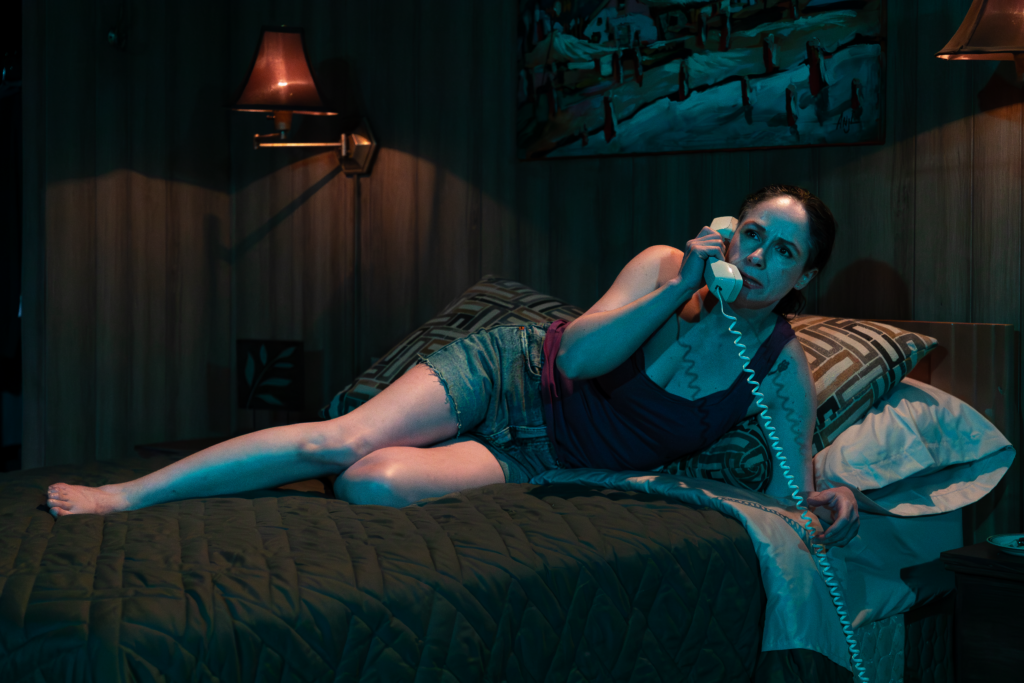
Jaimelyn Gray. Photo courtesy of The Contructivists.

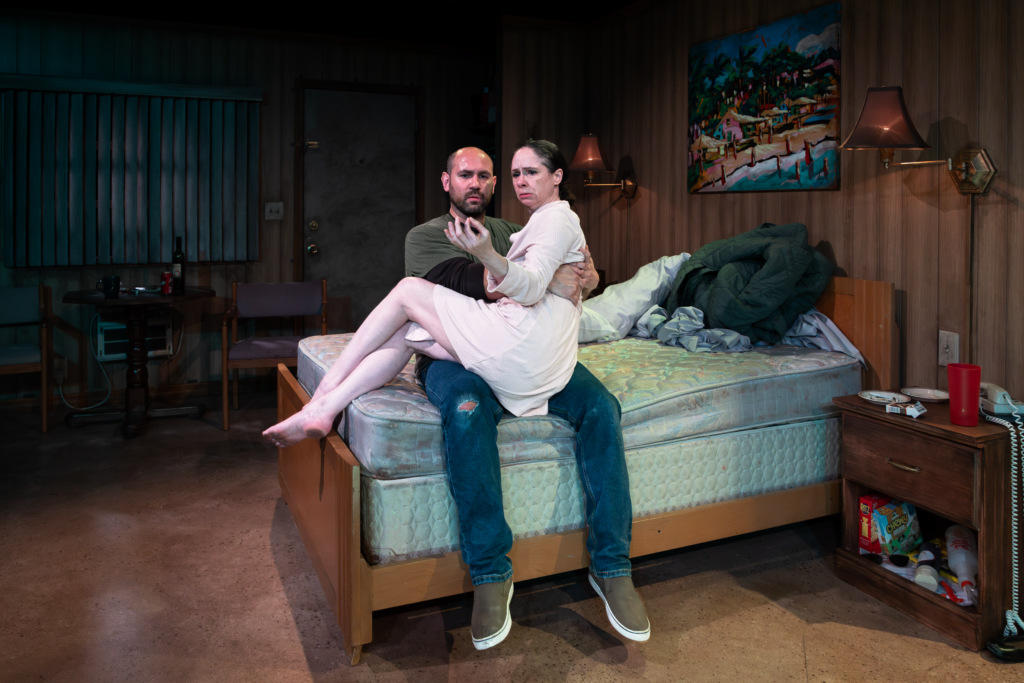
Constructivists founder and artistic director Jaimelyn Gray plays our lead protagonist, Agnes. At first Gray’s Agnes seems to be on the verge of getting her shit together, strictly on her own terms. But that bit of bravado seems to be buoyed by a fair amount of drug and alcohol use. She’s a waitress sequestered in a sketchy long stay motel somewhere in Oklahoma. And Gray moves to a subtle loss of composure as her ex-husband, out of prison on an unexpected early parole, still haunts her emotionally and then physically when he arrives on the scene. It is unsettling for us to watch as Agnes acquiesces to the violence and control of her husband once again and as she seeks shelter in the machinations of her new found friend, Peter.

So who is Peter? Well, Agnes’ friend, R.C., shows up at Agnes’ room in the middle of an evening of partying with Peter in tow. R.C. wants to have Agnes join her in her endeavors to continue partying through the evening but it’s not happening. Tess Cinpinski is a direct and forceful presence as R.C.. Also something of a wild and crazy woman who just moves on after being turned down by Agnes. Later on, acting as an advocate for Agnes, she has a showdown with Peter that is a pivotal point sending us in a new direction and the climax of the play. Cinpinski’s strong dramatic presence tends to draw much of the attention to herself in her moments on stage.

Jaimelyn Gray and Tess Cinpinksi. Photo courtesy of The Contructivists.

Peter is played by Joe Lino. He is brought to Agnes’ room by R.C. but doesn’t leave with her. They are essentially strangers who met at a party. Lino’s Peter seems to live at the periphery of the action initially. Lino very effectively tiptoes around the edges of the other cast members on stage and convincingly exhibits a number of tics and twitches describing his nervous nature. As we learn Peter’s backstory of hospitalization and military service, Lino increases the intensity of the character and brings Agnes under the sway of his issues and under his control.

Matt Specht. Photo courtesy of The Contructivists.

Goss is Agnes’ ex-husband. Matt Specht brings a forceful destructive male presence to the stage as Goss. Completely self-absorbed he ignores a restraining order and a possible parole violation by visiting Agnes and trying to take up where he left off. And he gets physical with Agnes and helps himself to her purse. Specht depicts a troubled misogynist who doesn’t realize he is troubled. This is just the normal course of events for him.

Late in the play, Goss brings Dr. Sweet to the motel. Dr. Sweet has been asking around town for Peter and claims he would like to help him by returning him to the hospital. Robert W.C. Kennedy brings a calmly somewhat detached doctor to the stage. He might be a little naive about Peter’s condition but he makes a great effort in trying to coax Peter to agree with him. Instead, this is the final breaking point. I will leave it there.

Joe Lino and Jaimelyn Gray. Photo courtesy of The Contructivists.

Maya Danks has assembled a great cast and tells a great story, despite it’s deeply troubling aspects. I can’t imagine how she moved these actors to plumb the breadth and depth of contagion and mental illness without affecting their sleep at night. But the content is on Letts’ head, Danks has made it into a great season closing presentation.

And I don’t envy the stage crew. There are literally hundreds of small props to handle, add, remove, or replace as the play progresses. And in the talk back afterword, we were told that it takes an hour to reset the stage before the next presentation can begin. And Martilia Marechal did a marvelous job with sound effects and music throughout.

And this disclosure from The Contructivists about BUG: This production contains adult subject matter. Viewer discretion strongly advised. We believe in the power of dark art catharsis. As such, every Constructivists production contains provoking words, ideas, and actions. We respect everyone’s boundaries, but also respect those who wish to know as little as possible about this production. General warnings are violence, language, and heavy drug and alcohol use. [I am going to add: spousal abuse and suicide as possible triggering activities. Ed]

BUG is being presented at the Studio Theater, Broadway Theatre Center, 158 N. Broadway, Milwaukee WI from now until May 9, 2026.

Ticket info is available here. More info about the play is here.

Joe Lino, Jaimelyn Gray, and Tess Cinpinski. Photo courtesy of The Contructivists.