Renaissance Theaterworks World Premiere Of Great White Throne

Let’s start with a quote from Maria Amenabar Farias’ Director’s Notes: “…how many plays have you seen fully set in a bathroom?!” Well here we go! And a pink bathroom at that. A very pink bathroom! Until the wizardry of lighting designer Jason Fassl makes the pink even more intense. And doesn’t it seem since the nearly universal adoption of LED lights, that lighting has even more influence on the movement in a play? Well this season so far, it certainly seems that way. But here at first, we just take it for granted…it’s just a pink bathroom after all…until it becomes something of a pivot point late in the play.

Marcella Kearns and Libby Amato.

This is a World Premiere Wisconsin presentation and was written by Cara Johnston. Johnston is originally from Dallas Texas (which might prove interesting to our story line? listen and see!) but now resides in Milwaukee and has had a number of plays performed by Renaissance Theaterworks. The playbill places our activity as being from a few years ago, and very late on a Sunday evening. I might quibble with the few years ago, it feels a bit older than that, but then I am not from the cultural setting as are our two characters in the play.
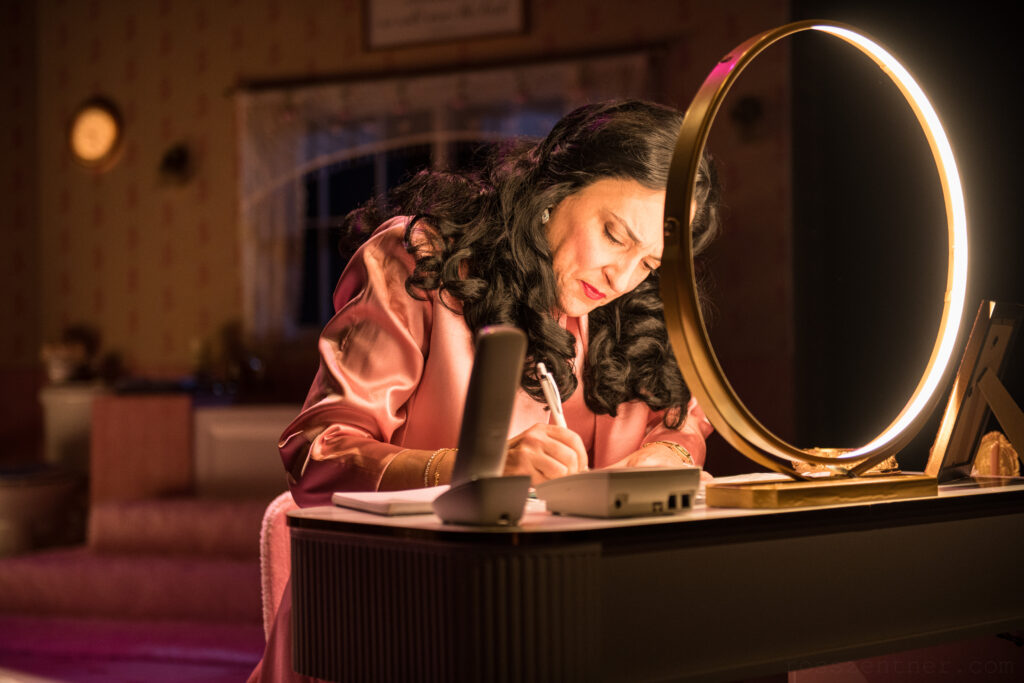
Libby Amato.

Opening, a very distraught woman rushes into the bathroom wearing a pink as pink can be stylish sheath dress and frantically searches around until she finds the objects of her desire. She writes a check (in a bathroom ? OTOH this is the largest bathroom I have ever seen, with a landline phone, and in a parsonage yet). Then realizing that she has lost her keys, she screams. And in bursts a second woman, swinging her purse like a cudgel, ready to do battle, until she realizes where she is and who she is with. And she is carrying a set of keys and said she rushed in because she heard a scream. She is dressed in lovely and stylish attire, but obviously more casual and comfortable in her approach. She quickly realizes that the lady in pink is the Pastor’s Wife and our knight in shining armor is the Deacon’s Wife.
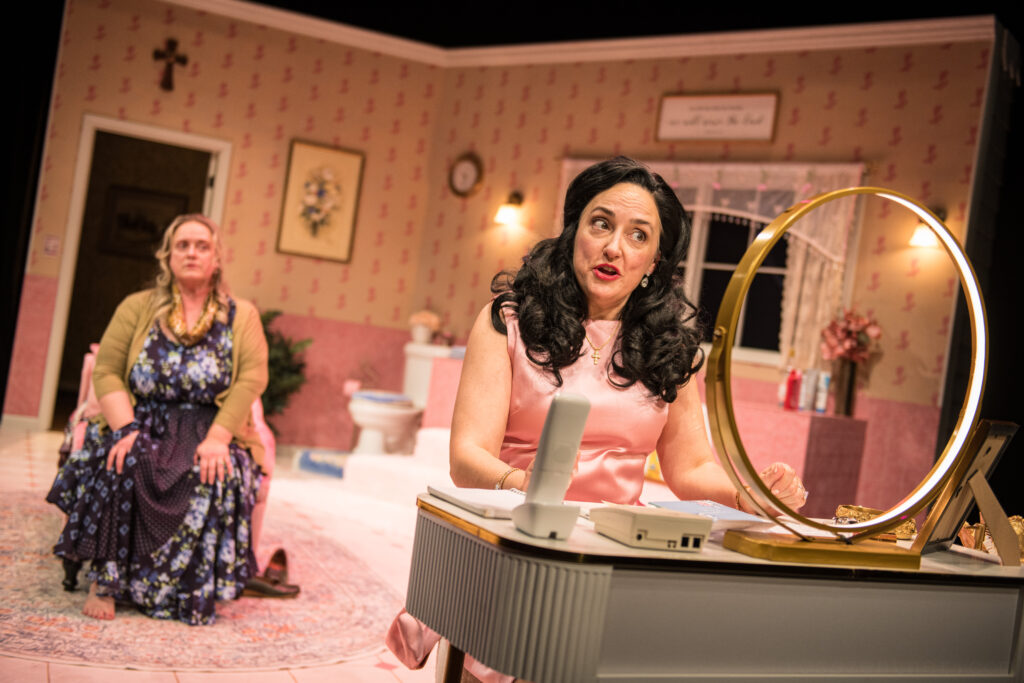
Libby Amato (foreground) and Marcella Kearns (background).

These ladies know each other on the surface, but they don’t know each other, despite the Deacon’s Wife being a church member for 30 years and the pastor leading the church for the past 20 of those years. But that’s all about to change. We will see that about all that they have in common is the love of their church and the love and respect for their faith. And we don’t actually know their names throughout the play.

RTW offers Great White Throne as a Dark Comedy. It is all that. And a hysterical comedy, but I don’t mean as in belly laughs and guffaws. The humor here is more gentle laughter, sighs of recognition, or gasps of surprise. No, the comedy here often relies on the characters verging on the hysterical.

Libby Amato and Marcella Kearns

Libby Amato is the Pastor’s Wife. Amato manages to present a woman at wit’s end who isn’t sure what she should do or where she should go. All she knows is that for the moment is her husband has gotten himself into some legal trouble and her job is to write a check for bail and bring it to the jail. And when the Deacon’s Wife appears, Amato presents a woman torn between duty to husband, maintaining her composure in front of a congregant, and just holding her self together in the moment. Amato’s character is not comfortable in her own skin, now or later in the play.
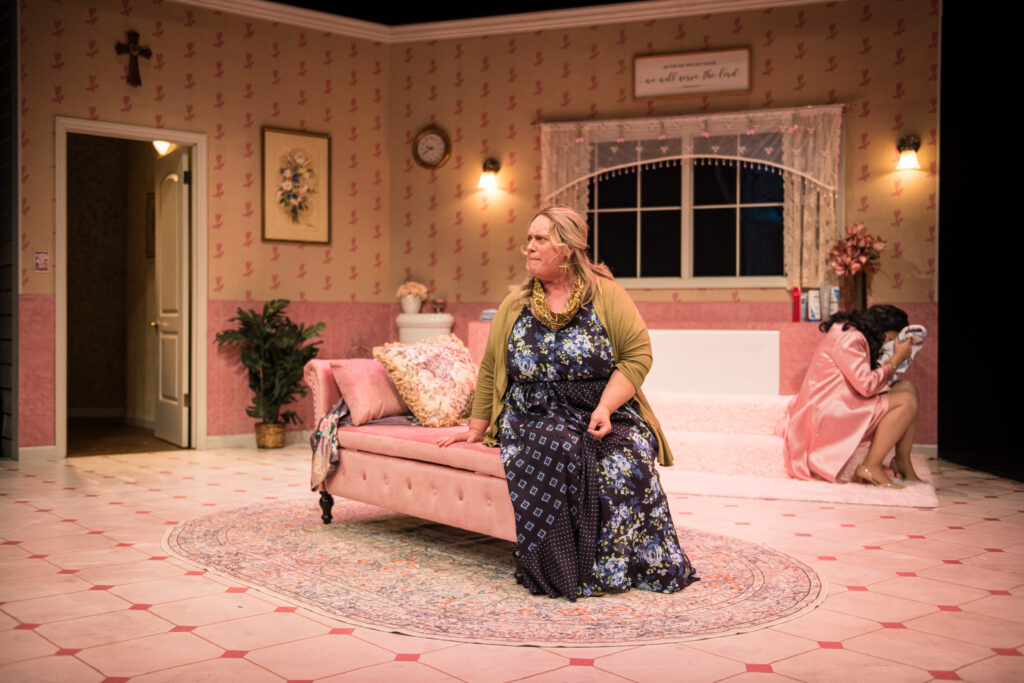
Marcella Kearns (foreground) and Libby Amato (background)

Marcella Kearns’ Deacon’s Wife, is in fact comfortable in her own skin. And while walking around the neighborhood waiting for her husband who is attending a meeting in the church, she encounters the front door of the parsonage wide open, sees the keys still in the lock, hear’s a scream from inside, and runs to the rescue. Kearns’ shifts from rescuer to Bible quoting healer, as she realizes that the Pastor’s Wife is in crisis despite her denial.

For a while the two women initially stalk each other a bit. But as they start to share a bit of what is going on, and as Amato dramatically explains her distress and her husbands plight, the two women realize that the emergency meeting next door may just determine the pastor’s future and as a result, his wife’s as well. And the walls come tumbling down and real conversation starts, how they got there, and how they feel about it.
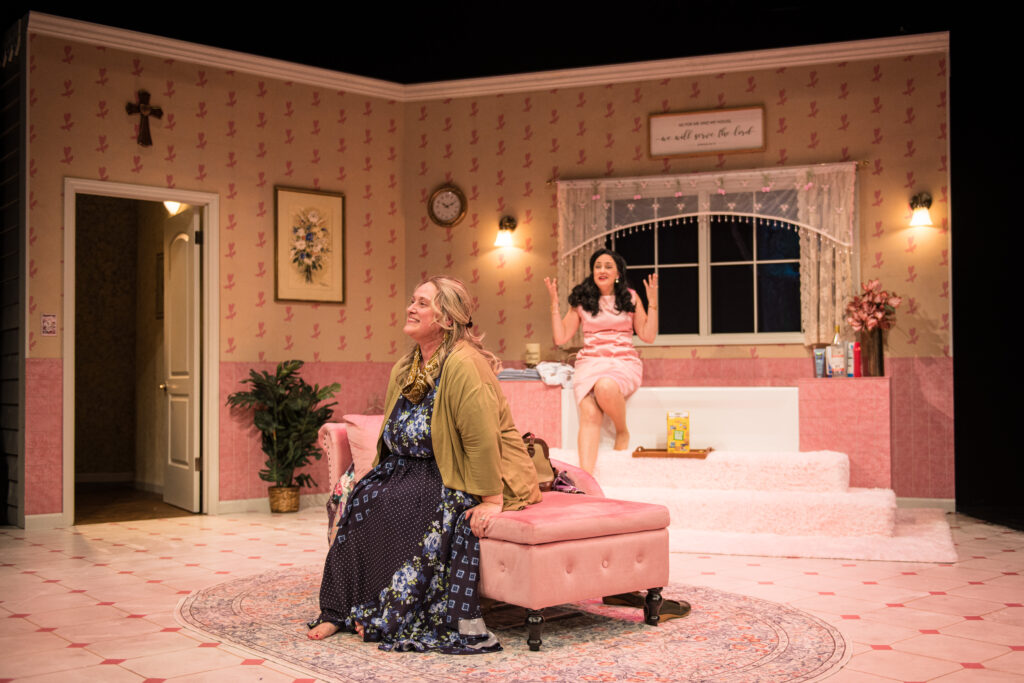
Marcella Kearns (foreground) and Libby Amato (background).

Kearns’ is just a live wire even in the role of a new found supportive friend. Her ability to listen and relate and just express the angst and concern for the moment can be exceptionally compelling. And Kearns’ Deacon’s Wife is clearly comfortable in her own skin. Her nearly polar opposite is Amato’s Pastor’s Wife. Amato plays to the hysteria built into the character and clearly expresses a brittle existence but then slowly reaches out for that AHA moment when she realizes that she needs to care for herself. Both women clearly understand the plight of women in their society, each have dealt with it in different ways, ways they thought suited themselves. And in the Pastor’s Wife case, what she thought duty demanded. At times these conversations are uncomfortable and in modern vernacular might be TMI to share with a virtual stranger. It can be difficult to listen to at times even when the dark humor is bubbling there just under the surface.

So yes, the is that AHA moment, but we are never going to be sure exactly what form it finally takes because it ends with a big slam.

Great White Throne runs from now through November 8, 2026 at the home of Renaissance Theaterworks at their theater on South Water St in Milwaukee.

And I don’t envy the props guy or stage staff having to put the set back together each night.

Marcella Kearns. Photo by Ross Zentner and courtesy of the Renaissance Theaterworks.

5 Lesbians Eating A Quiche: No Men, No Meat, All Manners!

Editor’s note 10/13/2026: When I originally published, I hadn’t received the production photos from the Contructivists. But now that I have them, I am just going to intersperse them and keep the original logo and head shots that I used.

With a title like 5 Lesbians Eating a Quiche, you aren’t quite sure whether to expect a heartfelt drama or a delightful comedy. I am here to report, that you will be delighted. And yes, I had a clue that this was going to be an over the top comedy from the cheeky advertising and promotional bits.

The Susan B. Anthony Society for the Sister of Gertrude Stein proudly welcomes you to The 1956 Annual Quiche Breakfast, and you are all members in good standing and thank you for bringing your quiche. And the organization’s motto is? No Men, No Meat, All Manners! Don’t forget to put on your name tag, it may be of importance as we celebrate. A little side note, it’s all about the eggs!

Writers Evan Linder and Andrew Hobgood have written a non-stop farce of hysterical comedy and director Joe Lino pushes it as far as it will go, getting over the top excitability, manic chaos, and crises responses from his cast.

Our story opens as we are sitting in the society’s hall and four of the officers enter in a boisterous anticipatory gaggle. They greet the membership and take notes and photos. And they twitter and shout and shriek their conversations in their excitement, as the quiche breakfast is really a thing for them. It would be an understatement to say the excitement is palpable because it is actually tangible. The energy expended here is off the charts crazy. Why are they milling about waiting for something?

L to R: Emily Harris (Dale), Bree Kazinski (Vern), Kellie Wambold (Lulie), Aly Rader (Ginny), and Anya Palmer (Wren). Photos by Kłamię Studios and courtesy of the Constructivists.

Well, that something, is the prize winning best quiche which society president, Lulie Stanwyck, is warming up. When it is ready, she brings it to the table mid-set with great fanfare and dignity. Kellie Wambold presents Lulie as a woman in control and comfortable with her authority. And Wambold’s Lulie can also be a bit vindictive and has a long term memory about a quiche sin committed by another member. She enjoys making that member, Marjory, an audience member, uncomfortable, always. Later Wambold sheds that authoritative stance when she is forced to reveal a secret that goes against the theme of the society.

Emily Harris, as secretary Dale Prist, is one of the most excitable characters on stage. She presents a Dale who is both direct and curious at times. Dale has found a photo in the archives of the society founder and hangs it in the meeting room. The accomplished rough cut woman in the photo is stern and proud and looks remarkably like executive producer and Contructivists founder Jaimelyn Gray. When Lulie discovers the portrait, Wambold pulls herself to her full height and in a demanding tone, asks, who did this? And all of the others cower until Dale meekly admits her transgression and Lulie goes all sentimental and applause and back slaps are shared around the room. This is just the first example of the impulsive nature that Harris portrays for Dale.

L to R: Emily Harris (Dale), Bree Kazinski (Vern), Kellie Wambold (Lulie), Aly Rader (Ginny), and Anya Palmer (Wren). Photos by Kłamię Studios and courtesy of the Constructivists.

And now it’s time to taste the winning quiche. Four of the officers grab their forks and surround the table. And Aly Rader, as secretary Ginny Cadbury is boxed out. Rader has been playing Ginny as a bit excitable in person but with a prim and proper side when she is taking notes or updating the meeting agenda, doing her secretarial stuff. But she takes her disappointment in hand and Rader just shoves everyone else aside and leaps onto the table and just goes face down in the quiche. All of the rest of us are appalled particularly given the all manners mantra. But there may be a bit of a hmmm to consider too.

Bree Kazinski plays a very organized and get it done Vern Schultz, who is the building and grounds official. Kazinski loves explaining the security measures she has taken to protect their clubhouse. Remember, it’s 1956 and we are in the middle of the Cold War…and Vern has built an effective fall out shelter. But as you hear the different features you have to wonder if all of them are good ideas. Given her initial calm and decorum, when things start to go south, Kazinski seems to take charge…seems to. And Wren Robin is the events chairwoman and played by Anya Palmer. Palmer is just one of the excitable women at first but takes on a more studied persona until she finally comes out to all of us in the room. But I am jumping ahead in the story.

L to R: Emily Harris (Dale) and Anya Palmer (Wren). Photos by Kłamię Studios and courtesy of the Constructivists.

Yes, it is 1956 and all of the members of the society are ‘widows’, closeted lesbians. Until all hell breaks loose. That actual event that Vern was preparing for occurs during their breakfast and they are now trapped in their bunker for four years. It is at this point that they can cast aside their pretense. Considering themselves to be the only survivors in the U.S, they one by one take up the process of admitting their actual sexual identities. And four of our stalwarts, the original four to enter the stage, affirm that they are lesbians…but Lulie hangs behind until she admits that she may be bi and is three months pregnant by a man. This starts an entirely new train of thought and concerns and tragedy strikes. I will leave it at that.

Beyond being a bit of absurdist comedy at times, the play also breaks the normal play vs. audience fourth wall as actors interact with the audience, asking questions, telling stories, etc, etc, etc. We are all, after all, also members of The Susan B. Anthony Society for the Sister of Gertrude Stein, and your name tag will have your society name. I am Nancy, it’s a pleasure to meet you. And we will be asked to chant the society name at times and clap for society activities and speeches. You will find it difficult to remain passive here.

L to R: Anya Palmer (Wren), Emily Harris (Dale), Bree Kazinski (Vern), and Aly Rader (Ginny). Photos by Kłamię Studios and courtesy of the Constructivists.

5 Lesbians Eating A Quiche will be presented by The Contructivists from now through October 24, 2026 at PATH (Pink’s Accessible Theater Home), 1104 Historic W Mitchell St, Milwaukee. There is plenty of on street parking. I don’t see a run time on the website but it is about 90 minutes and there is no intermission.

More Information Here. And Tickets Here!

And next time, mimosas?

TRAYF. Next Act Theatre Explores Identity and Friendship.

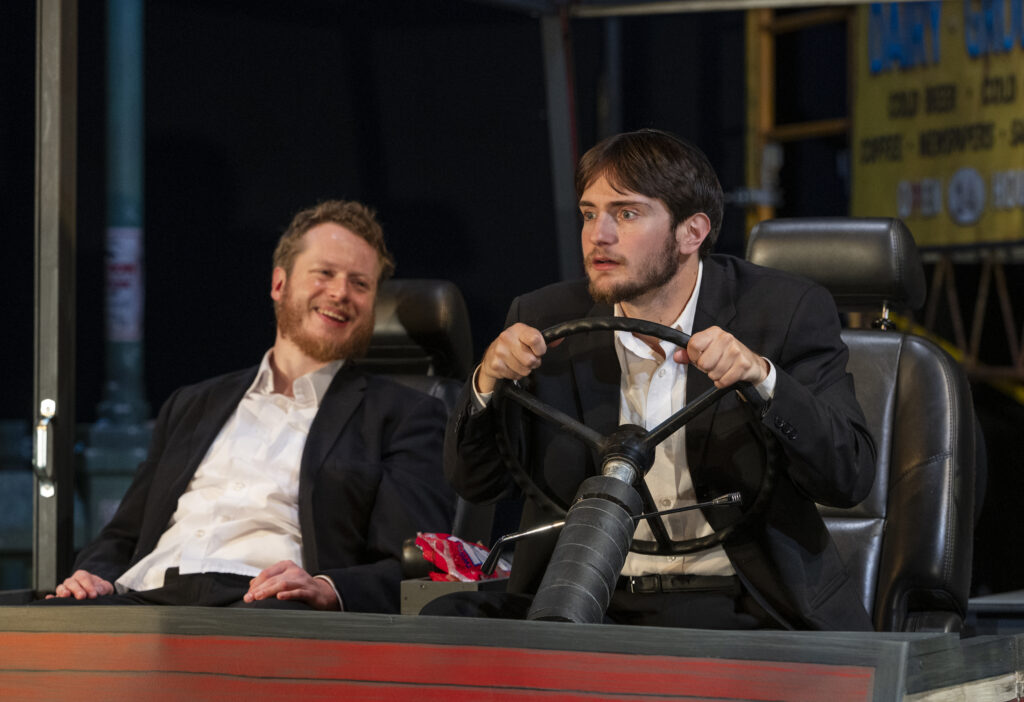
It’s 1991 and we are in Brooklyn. And we are confronted with a Hertz rental van or RV with Mitzvah Tank emblazoned on its side. A Brooklyn looking a bit tired in Jeffrey Kmiec’s and Bianca Gonzalez memorable period set design…with a very sad vehicle that they have cobbled together as well. The Mitzvah Tank will put on some miles figuratively as it is driven around town and literally as it is pushed forefront and later to stage left as the story line requires. And the Tank will be utilized by two young eighteen year-old Orthodox Jewish men to light the lamp in the Jewish souls of other Jews as influenced to do by their spiritual leader known by the nickname Rebbe. Our two new friends are Zalmy and Shmuel

Left to right: A.J. Magoon, Alex Mitchell. Photo by Michael Brosilow and courtesy of Next Act Theatre.

Shmuel gets to be the driver of the Mitzvah Tank because his father rented it. But there is more to it than that. In Alex Mitchell’s portrayal of Shmuel, he is direct, sure of himself, thoughtful, and a planner. And Mitchell shows us a man very focused on his goal and his faith. But don’t think for a moment that he is an emotionless individual. He can and does get angry and is personally hurt when Zalmy’s allegiance to their friendship seems to waiver. But even Zalmy states that Shmuel was always admired as the smart one. And Mitchell maintains something of a scholarly air about him…but he let’s some suspicions in as well.

A.J. Magoon’s Zalmy is just as committed to their project but he’s more curious and lighthearted than Shmuel. Yes, he is more curious and this ignites some of the conflict that is about to arise. Zalmy is the navigator and DJ in the tank. And he likes to play little guessing games at times…trying to guess how many Rebbe tapes that Shmuel has along. These are tapes of Rebbe’s speeches and such. Shmuel plays along but teases Zalmy a bit. But no secular music is allowed! Magoon marvels at the 322 tapes and is visibly excited in his role as DJ to the point of totally ignoring Shmuel’s request for help in parking the Tank. Magoon exhibits a special exuberance and excitement in his gestures and voice.

Zalmy and Shmuel are certainly committed and prepared (they plan for snacks) but they may be a bit naive all at the same time. They’ve never been out of their community and are so sure of their project they aren’t quite ready for the rejection. Their fervor doesn’t waiver but at times a sense of disappointment does set in. But they are beyond their community even venturing into Wall Street, offering their brochures and asking the people that they meet, Are You Jewish? And then we meet Jonathan.

Left to right: Alex Mitchell, A.J. Magoon, Lucas Prizant. Photo by Michael Brosilow and courtesy of Next Act Theatre.

Lucas Prizant presents a Jonathan of a care free nature and practiced nonchalance. We meet him as he approaches Zalmy at the Tank. But he has apparently talked with Shmuel previously, as Shmuel warns Zalmy that he doesn’t think that Jonathan is Jewish because he hesitated too long when asked Are You Jewish before saying yes. But Jonathan presses them into conversation. And Prizant changes tone as he becomes a bit sad and confused when recounting the discovery that his late father was Jewish and had escaped Nazi Germany. As this conversation progresses, Zalmy’s curiosity slips into high and he invites Jonathan for Shabbos dinner. This becomes a common occurrence and Jonathan gifts some secular music to Zalmy which affects him a great deal. And although he hides the music from Shmuel, Shmuel suspects and some other things become inflection points and Zalmy and Shmuel start to drift apart. Not unusual for young adults but quite a surprise given the backgrounds here. Well Jonathan begins his conversion to Judaism and Prizant starts to drop the care-free attitudes and takes on a similar persona to Zalmy and Shmuel. And besides being a wedge between our heroes here, it is a problem elsewhere:

Left to right: A.J. Magoon, Alex Mitchell. Photo by Michael Brosilow and courtesy of Next Act Theatre.

Rachel Zientek bursts onto the scene as Leah when only Shmuel is present at the tank. Zientek is forceful, direct, and full of indignation. She is Jonathan’s girl friend and a reformed Jew and wants her Catholic boyfriend back. She is clearly upset about Jonathan’s new trends as a Jewish convert and didn’t sign up for this. And she makes some revelations about Jonathan’s and Zalmy’s activities that include planning and doing things that Shmuel had designed to do with Zalmy. So the rift widens and the friendship seems doomed.

But friendship does in fact win out. Identities are examined and reaffirmed for Zalmy and Shmuel, but are newly discovered for Jonathan. For our characters that seems to be a good thing.

Left to right: A.J. Magoon, Alex Mitchell. Photo by Michael Brosilow and courtesy of Next Act Theatre.

This is a comedy but there are serious topics underlying the story. Director Elyse Edelman has done an exemplary job of maintaining the humor while enriching the serious stories being told here. I love her directing work but I hope it doesn’t keep her off stage in the future.

Yes, this is set in a Jewish enclave in New York. But you don’t have to be Jewish to enjoy the questions we all ask ourselves about our identities or who we choose to be friends with. We just have to remember what it was like to transition from youth into adulthood. Attend willing and ready to remember those things in your life and you will enjoy Trayf a great deal.

Trayf runs from now through October 4, 2026 at their theater at 255 South Water Street in Milwaukee, Wisconsin. Tickets Here and More Information Here. TRAYF is 1 hour and 25 minutes with no intermission.

Extra Credit Reading: The Playbill or The Enrichment Guide. Reading the enrichment guide before you attend may help in understanding some of the terms and cultural references made during the play.