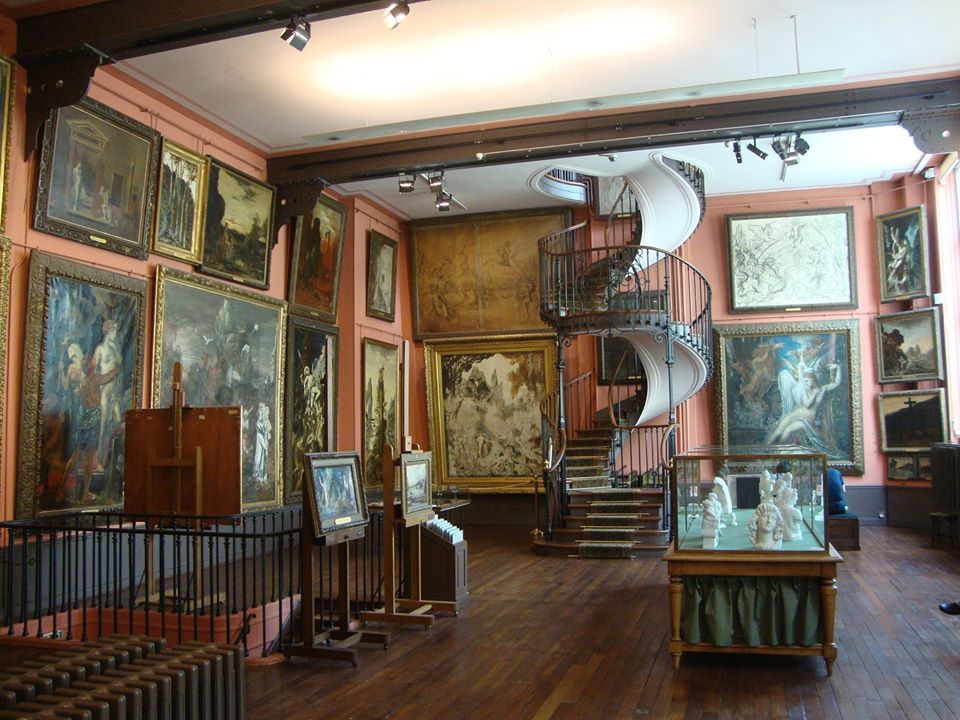
Jesus Rafael Soto: PENETRABLE sculpture and beyond:

I am not going to actually write about Jesus Rafael Soto because he is an artist that I just came across as a result of auditing a class in Latin American Art History. And this isn’t the type of art that generally appeals to me but the videos show the appeal of the actual work in situ and the audience and their interaction with his work. It is really quite compelling how it makes people happy and adventurous. So here are three videos, all a bit different. The first two discuss his Penetrable series which is what caught my attention. The third is an interview with Mr. Soto who is speaking in Spanish but it has English subtitles. It gives us insight into his work, his history and his legacy beyond the Penetrable. So I hope you enjoy:

Surprisingly Jesus Soto is well known in most of the world but a virtual stranger in the United States. There are a lot of videos on YouTube that describe or portray his art…and there are several longer documentaries as well…so enjoy getting lost in his work!

The Four States of Music In Contemporary Dance

Let’s start with disclosures and disclaimers! LOL!

[This is the first time that I have gone in and edited/updated an article that has already been published. But after some on line discussions and a lot more thought, I have made a few changes to state three. I am surprised that I changed my mind because this whole article has been floating in my brain for a couple of years at least. But I think I am adding some precision to my ideas with these changes. They are minor but…]

As I’ve mentioned elsewhere I earned a Bachelor of Fine Arts degree…many many moons ago…in art education of the visual arts. And part of our base requirements was to take one class in each of the other art disciplines. Now being a bit reserved at the time, I wasn’t sure how to satisfy my dance requirement. I didn’t take dance theory or dance history…and was afraid to take dance in performance despite feeling that I should…I compromised and took a course in eurythmics which was a bit daring for me but very rewarding. I don’t remember much about it other that trying physical movement around a dance studio to the prof playing piano or listening to odd snippets of music or even Gregorian chant. Whether that decades old experience contributes to my thoughts here is beyond knowing.

Also, most of my actual live/life experience with dance in performance was the occasional Nutcracker. And then a major life change event opened the opportunity to attend dance concerts and I took advantage of that. Fortunately Milwaukee has a number of very talented companies performing their own contemporary works, a very decent professional ballet company, and an exciting dance program at the University of Wisconsin – Milwaukee. I was enthralled.

Now, as I said, I have never studied dance theory or dance history. So am calling my dance experience with contemporary companies as contemporary dance. I don’t know if dance has had the movements that visual art has experienced…whether there is a period of modern or post-modern dance or dozens of ‘isms’ in the meantime. So it’s just going to be contemporary dance today!

And with no theory training…this is just an intuitive perspective article…I am just making this up! To paraphrase a paraphrase by John Cale of a quote attributed to Mark Twain and others: “I don’t know much about dance, but I like what I know”!

Now on with my meanderings: The Four States of Music in Contemporary Dance:

Our first state: we have the relationship of dance and music, just as we expect it to be. Whether classical ballet, Fred Astaire or Gene Kelly, The Twist, or the flailing around we did as youths to impress our partners…dance movements working in time to the music. Foot steps, spins, twists, lifts, marches across the stage all occur in sync with the music. Not only do we find this pleasing visually but since we too can feel that rhythm, it enhances our experience with the dance. It is an enthralling thing of beauty, visually, aurally, and emotionally.

And our second state: we have dance against the music. This is just as exciting and rewarding as our first state of music and dance once you get used to it. The music is just as important here but the movement, the footfalls, the spins, all seem to be filling in the spaces between the beats of the music. This is certainly disconcerting at first but once your heart and head pick up the nuance, it too is a thing of beauty. But I imagine that this is difficult to choreograph and even more difficult to perform.

The third state: this may seem obvious once you accept my premise of there being that state one and two above…and that is dance in defiance of the music. And what exactly do I mean? The dance is being performed, there is music playing, but the dance bears no apparent relationship to the music. It’s as if the music is a necessity to fill our ears and fill our expectation that dance be accompanied by music. And so it is, although the dance itself is ignoring the presence of the music entirely…or as entirely as possible. And no this isn’t just bad performance…when you focus on the performers you see their determined dance movements and sense that they aren’t at all relevant to the music…but this requires as much effort from the audience as from the dancers (well not quite). I know I have experienced this at least once…but my mind wants to say twice. It isn’t very frequent. But the fear here is you may lose the audience with this state.

(“…and that is dance in spite of the music”…is what I originally wrote. and in the comment below a friend of mine who has been involved with dance suggested ‘indifference’. I toyed with that for a while because of its elegance but threw it out and intended to keep ‘in spite’. From the comment: “…in the case of a contemporary dance concert, the choreographer selected the music specifically…for a reason…and is programming against it or around it…or in spite of it.” But after three weeks of wrestling with this, ‘indifference’ seems particularly passive…and ‘in spite’, not precise enough. So tossing around words at 2 AM while intending to sleep, the word ‘defiance’ became the defining word for me! And then I made every effort to memorize that before I succumbed to sleep so that I could recall it in the morning. YES! Defiance is the more appropriate word to describe what I sense in the third state.)

And the fourth state: An obvious remainder, dance without music. That doesn’t mean that there is no sound or no rhythm. It means the dance movements are emphasized by the sounds of footfalls, the sway of arms, the swoosh of costumes, and timely claps or slaps. Well done, this too can draw the audience into the performance because there is no actual music to feel…you lean forward to actually see the footfalls and claps and twirls in order to anticipate and appreciate the sounds. Now I have seen dance without musical accompaniment where the dancers enhance their efforts using canes or staves or other percussive devices. To me that’s a gray area and moves the dance back into the first state above…just that the music is self accompanied and not really dance without music.

So those are my four states of music in contemporary dance…is that a wrap? Well, no, not quite, there’s this little corollary:

Dancing with/to noise. Yes, music is noise but with rules and accepted sounds and expected rhythms. So maybe this noise is non-traditional music for our purposes! LOL!

So when dance is presented with noise…if the noise has a beat, wave, thrum, throb, or rhythm that is consistent or identifiable, then I suggest that we are actually in state one or two above depending on the dancers’ reaction to the noise. If we simply have an ambient noise or white noise for accompaniment, then I suggest we have state three above, dance in spite of the music.

Well, there you have it, my crazy little ruminations on music and it’s use with dance!

[original publication April 24, 2021. additional content and edits May 18, 2021]
Red Bull Theater Reads John Lyly’s Gallathea

Love conquers all things but itself

and ladies all hearts but their own

from the coda in Gallathea

The Red Bull Theater managed to confound me once again with their outstanding reading of a classic play that I was totally unaware of…and all the while I am wondering how to write about it without spoilers! Spoilers? The play was written by John Lyly in 1585 and first performed New Year’s Day 1588. How could there possibly be spoilers? So spoil on I will!

This play comes across as incredibly contemporary and Red Bull plays into that feeling. I will admit I was a bit suspicious by that aspect at first given the age of the play…but it is true to its history. The one issue modern viewers may suffer from is out lack of a robust classical education. We will recognize the Roman gods who are primary characters here but won’t necessarily know their interpersonal histories or relationships…and that may inhibit some of our understanding of the underlying humor. But Mr. Lyly does an admirable job of explaining their attributes as they are introduced, so we do understand why they are resident to the play.

And our story: Through its history, a small waterfront town has angered Neptune by destroying his temple. His retribution is that every five years the fairest maiden is to be tied to an oak tree dedicated to him and she is taken away by the monster Agar. Well the fifth year is upon us and it is time to select the maiden. So our opening scenes are two fathers with fair young daughters who are determined to protect them from Neptune.

First we encounter Tityrus and his daughter Gallathea clad in boy’s clothing. Tityrus had brought Gallathea to Neptune’s tree and explains the situation and his intention to protect her by hiding her gender. Gallathea objects that this goes against her body and mind and it would be better to consent to the sacrifice and die honorably to protect the village than live a lie. But eventually consent she does and is sent out into the woods to hide until the fateful day has passed.

And then we meet Melebeus with a similar scheme and he presents his plan to his daughter, Phillida, who is also dressed as a boy. She too protests a bit but quickly acquiesces to the will of her father. And then she too is sent into the woods to hide until it is safe to return.

Now, we are all familiar with women who assume male personas in Elizabethan plays and it usually results in a bit of playful mayhem and a great deal of comedy, and Lyly gives us exactly that in spades.

Of course Gallathea and Phillada meet in the wood and are drawn to each other…mainly they state because they are unsure how to act like boys and want to use the other for a role model. Of course that breaks down almost immediately as they realize how ‘fair’ the other appears and would take them for a maiden if they in fact weren’t a boy. And of course they start to develop feelings for each other assured that it is okay since they are a maiden and the other is a boy. But as we listen in on their conversations, they aren’t quite sure.

And here is one of the best parts of the play as Gallathea and Phillida question each other on their backgrounds and gender and history. Olivia Rose Barresi plays Gallathea and Layla Khoshnoudi plays Phillida and these two actors display the coy, the flirt, the doubt, and the growing affection in the scene very clearly…it is surprising that they don’t understand the truth of the matter as it is clear to us as the audience. And Barresi and Khoshnoudi also hit all of the humor high notes and the swing and sway of the poetry in their lines and play off each other in just an assured and amazing way. And by the time we are done here they are clearly in love with each other.

There are two sub-plots here…the first quite necessary…brings Cupid to the fore as he causes anguish amongst the chaste nymphs of Diana by causing them to fall in love. This brings an angry Diana to enslave Cupid and she destroys his bows and arrows. The will bring Venus to appear a bit later in the amazing conclusion.

The other sub-plot isn’t as obvious to me as a 21st Century denizen. We have three brothers shipwrecked nearby who set off to make their fortunes in the woods and instead have misadventures with a number of masters of dubious arts. Now they may simply be comic relief and their lines would certainly lend credence to that. They may be proof that the lads of the period are NOT worthy of our two female protagonists. Or they may have been a necessary device to employ as many actors as possible in the play. (If you have ideas, I’d like to hear them)

Now the play gets dark. Tityrus and Melebeus deny having fair daughters and without Gallathea nor Phillida about, no one can prove otherwise…so the forlorn Haebe is selected as the sacrifice. And Haebe has a lot to say about her plight in the highest drama soliloquy this side of the Avon. She decries her fate in the most direct and dire fashion and denies…denies being the fairest. And then apparently Agar doesn’t accept her as the sacrifice because she isn’t fair enough? OH talk about woman scorned. Helen Cespedes gives us all of the drama and humor resident in Haebe.

And then Deus et Deus et Deus ex machina. And we have the denouement as all of our major characters appear…Neptune to wreak havoc on the town for their trying to fool him and the still angry Diana and Venus in search of her Cupid and of course all of our mortals to suffer their fates. But Venus takes the lead here. When the ruse around Gallathea and Phillida is exposed and it is discovered that they love each other…she is willing to accept that. The other gods maybe not so much nor the fathers…but Venus brokers a peace between Neptune and the town and Diana and Cupid and gets Cupid released. And promises to allow Gallathea and Phillida to marry but she will change one to a boy at the church. And despite their earlier protestations when being dressed in boy’s clothing, each is readily accepting of that given the opportunity to stay with the other while each father objects to his daughter being changed. But Venus wins out and as Tityrus eventually shrugs, what can you do, they’re gods. But guess what, that transformation never happens.

Now, I have certainly gone on too long about the play itself…and given you all the spoilers to be had. But on to the presentation of the reading.

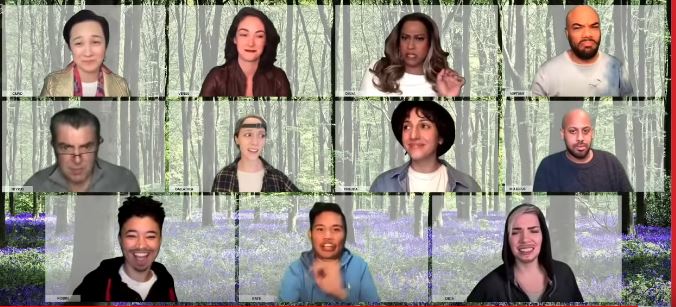
screen shot from the Red Bull Theater Zoom reading of Gallathea captured by AIP

From a cast standpoint, RBT has perfectly selected actors who understand and play to the strengths of Zoom. Facial expressions and voice inflections are more important here that on the big stage. That is probably not an easy skill to pick up in a hurry but the RBT casts are now masters of that. Love you all!!!

And as you see from the screen shot, the technical staff has done wonders with tying the background together and presenting the cast clearly. During the play, the movement from one act to the next and one group of speaking roles to the next was fluid and seamless. Thank you for letting the audience get lost in the words and not notice the infrastructure! RBT is one of the best troupes at getting this right.

So what to do next? Well…starting tomorrow Red Bull Theater will be presenting a modern take on Gallathea with a reading of MJ Kaufman’s GALATEA, based on the play that I just described. Want to see it? It premieres live tomorrow evening and will be available to stream through Friday evening…Details HERE!

Presented in collaboration with WP THEATERGalatea is written by WP Playwrights Lab Alum MJ Kaufman (Chilling Adventures of Sabrina, How to Live on Earth), and directed by Will Davis (India Pale Ale, Men on Boats). The cast includes Grammy Award-winner Ty DefoeEsco Jouléy (High Maintenance), Jo Lampert (Hundred DaysJoan of Arc), Aneesh Sheth (Netflix’s Jessica Jones), Futaba Shioda (Rent 20th Anniversary tour), and TL Thompson (Is This a Room) and more.

I have some thoughts on the future of virtual theater rattling around in the recesses of my brain…I’ve mentioned that before…but this company is one of the reasons I feel there is a change coming!!