PSA: Milwaukee Chamber Theatre Announces Their 2026/2027 Season.

Yes, I know that I am late again. That seems to be my theme this spring! But read on and remind yourself to schedule your visits. Or, if you haven’t seen this yet, imagine what next year’s theater season is going to be like.

We’re thrilled to share MCT’s 2026-2027 season: five exceptional productions centering the excellence of Milwaukee and Wisconsin’s artists in stories that will open your heart, expand your thoughts, and leave you feeling more connected to your community.

MAYBE WE’LL FLY
A New Play with Music Inspired by the Life of Mary Nohl
By Marie Kohler
Music by Josh Schmidt


September 18 – October 11, 2026
BTC Studio Theatre

From renowned Milwaukee artists award-winning playwright Marie Kohler (BOSWELL, MIDNIGHT AND MOLL FLANDERS), and Tony-nominated composer Josh Schmidt (The End, THE ADDING MACHINE, THE MINISTER’S WIFE), comes this wildly theatrical and richly poetic world premiere play with music exploring the life and work of legendary Wisconsin outsider artist Mary Nohl. Propelled by an evocative score for solo cello as well as a contemporary approach to movement from award-winning director Elizabeth Margolius, MAYBE WE’LL FLY will captivate and inspire as it celebrates outsiders everywhere.

A GIFT OF THE MAGI
A Musical Inspired by the Short Story by O. Henry
Music by Josh Schmidt
Lyrics by James DeVita & Josh Schmidt
Book by James DeVita


November 13 – December 6, 2026
BTC Studio Theatre

Hailed as “a Christmas delight” (The Isthmus), James DeVita and Josh Schimdt’s original musical based on O. Henry’s classic tale of love and generosity rings in the holidays in its Milwaukee debut. Newlyweds Della and Jim—accompanied by a beautiful live violin and cello score—search turn-of-the-20th-Century New York with full hearts and empty pockets for the perfect gift for one another.

SONGS WITHOUT WORDS
(Or, The Mendelssohn Play)
by Jennifer Vosters
A Locally-Grown New Play 

January 22 – February 7, 2027
BTC Studio Theatre

Musical genius siblings Fanny and Felix Mendelssohn were each other’s chief supporters, deepest inspirations, and best friends—but a rigid world immortalized only one in the canon. Featuring a tour de force solo performance from Jennifer Vosters (A DOLL’S HOUSE) and presented for the first time with live music in this full-length world premiere, SONGS WITHOUT WORDS wrestles enduring questions of gender and genius, family and fame, and siblinghood and the power of art.​

SKELETON CREW
by Dominique Morisseau

2022 Tony Award Nomination for Best Play 

March 19 – April 4, 2027
BTC Studio Theatre

One of Detroit’s last auto stamping plants stands on shaky ground, and a close-knit crew of four factory workers must face a future without the steadiest employment they’ve ever known. Milwaukee’s own Dimonte Henning—Director of MCT smash hits THE MOUNTAINTOP and CLYDE’S—brings to life this poetic, powerful, and profoundly American play described by The Financial Times as “not so much state-of-the-nation as state-of-the-world.”

LIBERATION
by Bess Wohl

2026 Pulitzer Prize Winner

May 7 – May 23, 2027
BTC Cabot Theatre

1970. Ohio. Six women determined to shake up their lives and change the world form a consciousness-raising group in a community center gym. Fifty years later, one of their daughters tries to understand where things fell apart. Fresh from a celebrated 2025 Broadway run, this provocative, funny, refreshingly irreverent, and intensely relevant powerhouse of a production poses vital questions about what we inherit, what we forget, and what we’re still fighting to understand.​

This production includes nudity. 

SKELETON CREW and LIBERATION are presented by arrangement with Concord Theatricals on behalf of Samuel French, Inc.

Ticket and Subscription Information is Available Here

Milwaukee Chamber Present’s Lorraine Hansberry’s Classic: A Raisin In The Sun

Lorraine Hansberry’s A Raisin In The Sun is certainly a classic American play in the manner of say, Our Town. It is vital, it is focused, and it clearly positions us in a particular identifiable era in 20th Century America. Both plays examine the gender conflicts, generational conflicts, societal conflicts, and racial attitudes of their respective eras. Raisin is a more complex story as it contrasts the hope invested in the American Dream as opposed the actual experience of life in America for Black Americans.

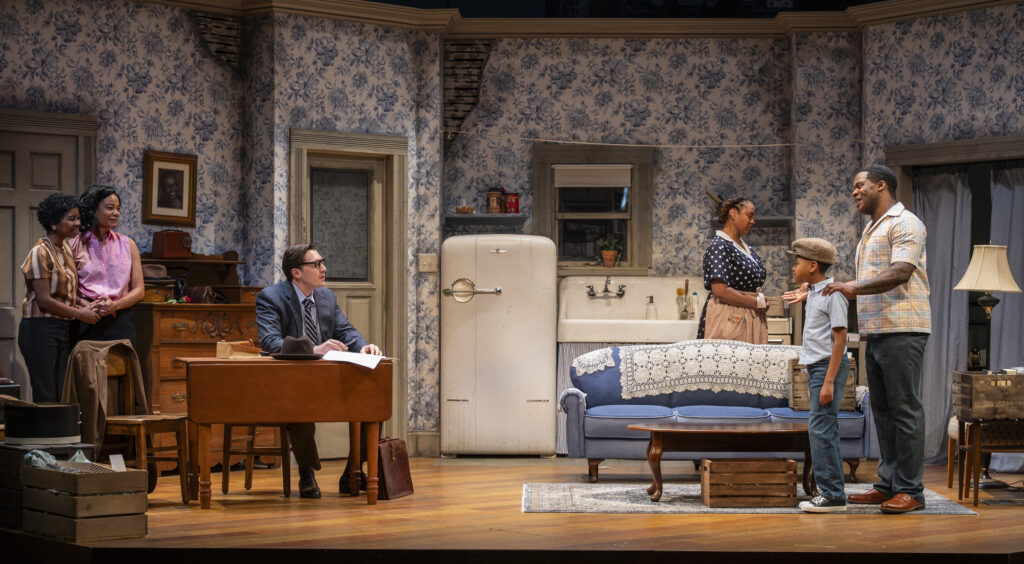
The cast of A Raisin In The Sun. Photo by Michael Brosilow and courtesy of the Milwaukee Chamber Theatre.

I don’t think we need to say anything about spoiler alerts given the stature of this play. But here is a short synopsis. Before the play begins, the patriarch of the Younger family has passed away and his life insurance pay out will provide some economic relief and opportunities that the family has not had in the past. But there is the rub. Several different family members have dreams and aspirations that this money could help them reach but that often puts them in opposition to one another during the course of the play. The money literally belongs to Mama, Lena Younger, the deceased’s widow. And her children state that is true during the play but there always seems to be a ‘but’ implied in the statement. Walter Lee Younger is frustrated with his lot as a chauffeur and wants to invest in a liquor store while his sister wants to continue her college career and become a doctor. Mama has other ideas and supports Beneatha’s college plan but given her religious beliefs, finds Walter’s liquor store idea objectionable. Lena takes her own lead and puts down a deposit on a home with the intention of moving her entire family out of the cramped squalid apartment where they currently are living. There are some mishaps, interventions, arguments, and third party disruptions…that provide a decent amount of turmoil, an interesting, deeply moving drama, and eventually, a satisfying ending.

Dimonte Henning. Photo by Michael Brosilow and courtesy of the Milwaukee Chamber Theatre.

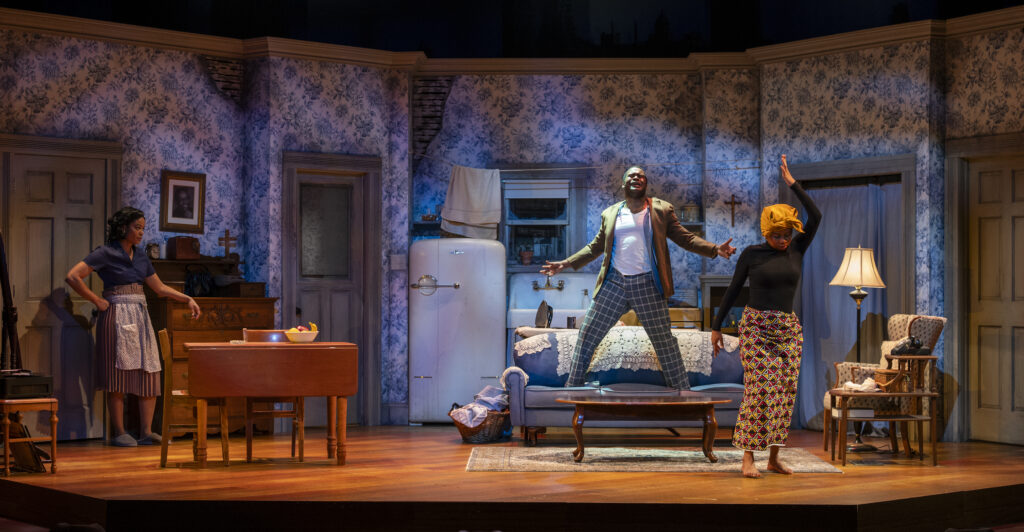
Dimonte Henning has developed into an intriguing and important member of the area theater scene both as a remarkable director and dramatic actor. So I was excited to see that he had signed on to play the very challenging role of Walter Lee Younger in the Chamber’s version of Raisin. Particularly when I realized that like many other presentations, director Kimille Howard was focusing on Walter as the lead character. This is not an easy role by any means and Henning realizes that and grabs it by the throat with both hands. Henning will make you feel Walter’s anger and frustration at his situation and you will recoil from the scenes of drunken behavior. And during one of Walter’s rages, Henning rails on about the lack of respect and understanding he feels he is getting from his family but he never exhibits a lick of empathy for their positions for a single moment. And I couldn’t quite discern the transition in his attitude when he comes into the room to find his sister dancing an ethnic folk dance…initially he is copying her moves to mock her but he seems to dissolve into an actual participant before too long. Just a bit of catharsis? Denning takes a surprising twist when he loses everything…and the expected rant and drinking…give way to the pain and a deadly quiet until he forges a new presence and new sense of manhood for Walter. And I have no idea how Henning maintains this level of intensity in the role for the entire two plus hours of the play.

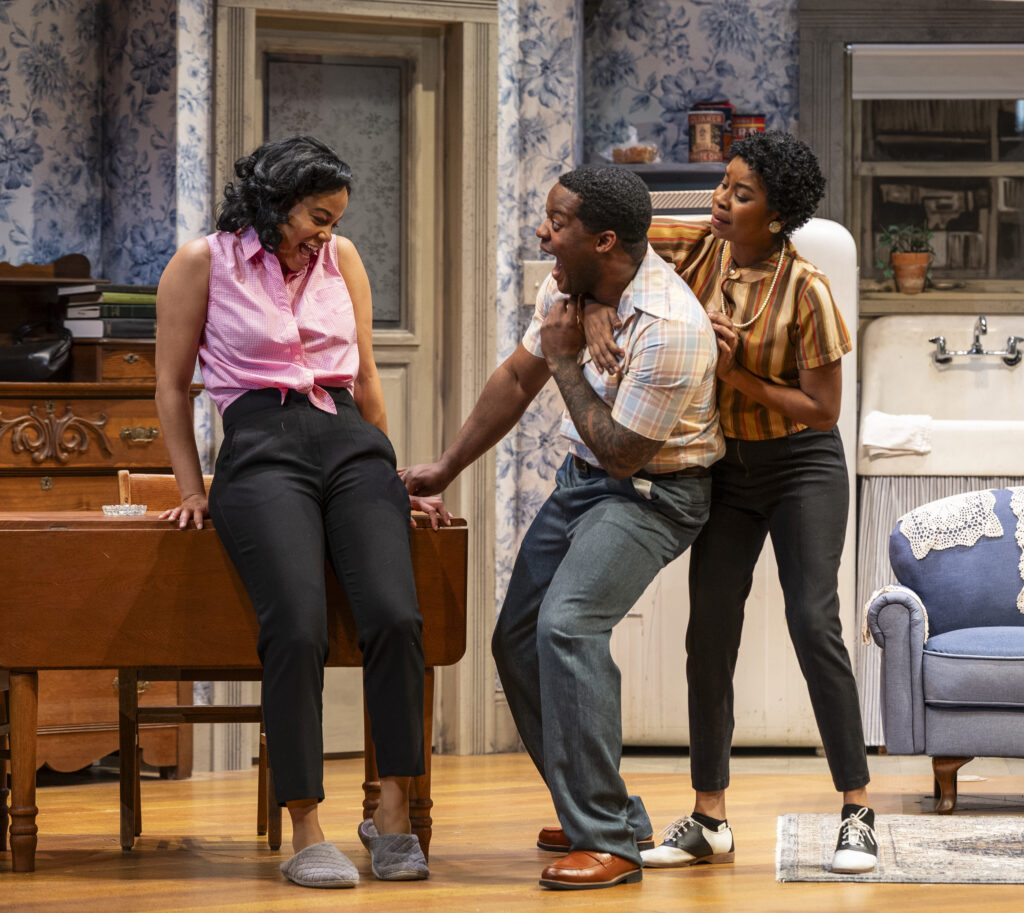
Left to Right: Paulina Lule, Dimonte Henning, and Malaina Moore. Photo by Michael Brosilow and courtesy of the Milwaukee Chamber Theatre.

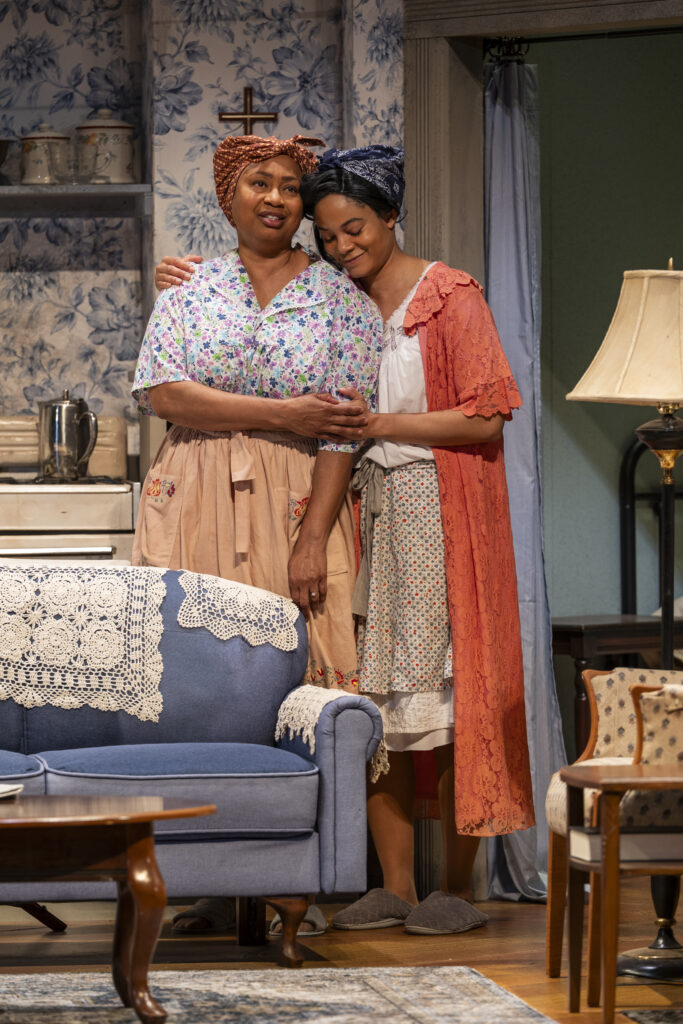
It is remarkable how Paulina Lule maintains the composure called for in playing Walter’s wife, Ruth Younger. With any number of trials of her own, Lule presents us with one of the stable forces in the household despite having to mother a young son and an erratic husband and at times play peacekeeper between her in-laws. Lule has just the right resignation in their voice and actions to display Ruth’s own sadness even as Ruth feels the need to press on. As Lena, Olivia Dawson exerts her own sense of determination and makes some very dramatic decisions for her family. But she doesn’t always see eye to eye with her children and Dawson displays just the right amount of sadness and regret as Walter lets her down without losing her composure. Dawson conveys that outward calm of motherhood even when she is probably roiling inside. And Malaina Moore is just jubilant as Beneatha Younger, balancing beaus who couldn’t be more different to establishing her dream in everyone’s mind including hers. But Moore also effortlessly presents a young woman who is trying to find her own mind and set her own path for the future. Moore catches the in-between moments as well as the most apparent in her journey. And here too, Moore is amazingly calm as her brother confesses to losing her college nest egg too. Another under story in Hansberry’s grand scheme of things is the love of family will win out in adversity.

Left to Right: Paulina Lule, Dimonte Henning, and Malaina Moore. Photo by Michael Brosilow and courtesy of the Milwaukee Chamber Theatre.

And two other featured characters around the Younger family? Kamani Graham plays a cocksure young man who is convinced of his own sophistication as George Murchison. And when George is listing the things that are important, Graham sells us on George’s knowing what he should do, what he has to do, and what he is doing but he has absolutely no idea why. Not sure who he thinks he is convincing, but he’s not getting to Beneatha. And Joseph Asagai is Beneatha’s other beau, a Nigerian student, he is self assured in an entirely different sense. Ethan Hightower’s Joseph is rooted in his own power and his dream for his people and the influence he hopes to bring home on the completion of his college sojourn in the US. The energy Hightower brings to the role certainly is attractive to Beneatha and the audience.

Then there is Karl Lindner. Lindner is played by Ken Miller and Miller brings just the right amount of trepidation to his character. He knows what he is doing isn’t right but societal pressure is putting him into this unfortunate and uncomfortable position. The role must be nearly as stressful for Miller to play as it would have been for a real life Lindner.

Left to Right: Olivia Dawson and Paulina Lule. Photo by Michael Brosilow and courtesy of the Milwaukee Chamber Theatre.

A quick shout out to Jordan Doidge for his portrayal of Travis Younger, the young son of Walter Lee and Ruth Younger. But I don’t think that sleepy act in the first act would have fooled my mother either. Nicely Done! Doidge alternates with Amari DeBerry as Travis. So if you are hoping to see Doidge or DeBerry, plan you visit to MCT carefully. The times and dates for their performances can be found in the links below.

This is a true classic American play and director Kimille Howard has voiced it in the proper classical perspective: a forceful performance that should be experienced on their live stage.

A Raisin In The Sun is playing at the Milwaukee Chamber Theatre from now through May 24, 2026. For those familiar with MCT, please note that they are presenting Raisin in the companion stage next door where the Skylight Music Theatre usually performs at 158 N. Broadway.

The play runs 2 hours and 45 minutes including one intermission.

Additional information HERE and Ticket information HERE.

Is This A Room: A Surprisingly Intense Drama From A Real Life Text

I have never attended a play where any of the dialogue was….REDACTED. Welcome to the 21st Century.

Left to Right: Rasell Holt, Jonathan Wainwright and Isabelle Muthiah. Photo by Michael Brosilow and courtesy of the Milwaukee Chamber Theatre.

Is This A Room is an original concept put together by Tina Satter and the Milwaukee Chamber Theatre is fortunate to be able to bring this to Milwaukee. Satter has built this play on the actual transcript of the interrogation of whistleblower Reality Winner by the FBI on June 3, 2017. Winner was arrested for leaking an intelligence report related to Russian interference in the 2016 U.S. elections. She was later convicted and sentenced to over five years in prison. The fact that the transcript alone makes intense dramatic dialogue is amazing.

First, let’s consider the set, or in this case, lack of set for Is This A Room. Instead we have an industrial strength gray carpet mid-theater with the Chamber Theatre’s seating split with a portion on either side of our stage. Not quite theater in the round but not Chamber’s usual layout either. As we move into the action, we understand why this is important. The transcript/dialogue clearly indicates our location and describes how the action moves from one site to another. AND, as the cast thrusts and parries through their conversations, they intensify those moods and feelings with agitated pacing around the space/room. And there are times where director Brent Hazelton has the cast move about in obvious stalking or moves to make advantage in their physical relationship to the other characters. When many observers or critics talk about directors choreographing the action on stage, it tends to be more metaphor than fact, but in Is This A Room, Hazelton has choreographed an actual dance here. And Hazelton’s facility in crafting this text into an engaging play on stage is equally satisfying.

Left to right: Isabelle Muthiah, Jonathan Wainwright, and Rasell Holt. Photo by Michael Brosilow and courtesy of the Milwaukee Chamber Theatre.

Isabelle Muthiah is Reality Leigh Winner. Muthiah is ingenious as Winner. Initially playing a naivety card, she is cool and coy and intentionally slow to understand what is going on until the FBI plays their cards. And even as events start going against her, Muthiah never loses her cool or her control and sometimes leads the agents down a tangential path. Jonathan Wainwright plays Special Agent Justin C. Garrick, the bad cop in our pair of special agents? Well, not the bad cop in a forceful threatening way, but the bad cop in asking most of the questions and always the most direct questions, and the holder of the facts at hand. Wainwright tries to project something of a wise fatherly figure, trying to put Winner at ease. And Special Agent R. Wallace Taylor is played by Rasell Holt. Holt’s Taylor shows more empathy for Winner and I guess, he would be considered the good cop. He asks questions, but not the direct type we get from Garrick, but follow up questions or clarification questions which do show his empathy.

Left to right: Jonathan Wainwright, Isabelle Muthiah, and Rasell Holt. Photo by Michael Brosilow and courtesy of the Milwaukee Chamber Theatre.

And then there is the Unknown Male! Well, well not exactly unknown. While Garrick and Taylor are both plainclothes special agents, the Unknown Male is in full FBI regalia and armed to the teeth. And Unknown Male is played by one of my favorite actors, Mark Corkins. It was great to see him on a local stage again outside of his annual appearances in the Christmas Carol. Well, Corkins gives us an officer who is something of a doofus. Wandering around seemingly aimlessly, often unaware of his surroundings, generally unaware of those around him, constantly distracted, but absolutely sinister! And he gets to deliver the line that gives the play its name, Is This A Room?

Mark Corkins and Isabelle Muthiah. Photo by Michael Brosilow and courtesy of the Milwaukee Chamber Theatre.

When working with a minimal set, other technical items become far more important. Like lighting: Jason Fassl is the Scenic & Lighting Designer here and the mood and direction on stage is clearly emphasized by Fassl’s lighting. And Stephanie K. Brownell’s costumes set us in the right place and atmosphere as well. The special agents and Winner are dressed in casual clothes which supports the initial casual conversations in the text. But as I said, Corkins is absolutely sinister in his role as an FBI agent and that is enhanced by Brownell’s custom FBI costume.

Foreground kneeling: Mark Corkins, behind him left to right, Rasell Holt. Isabelle Muthiah, and Jonathan Wainwright. Photo by Michael Brosilow and courtesy of the Milwaukee Chamber Theatre.

Is This A Room continues through April 5, 2026 at the Broadway Theatre Center’s Studio Theatre. Run time: approximately 75 minutes with no intermissions.

Additional information and ticket info can be found here. When ordering tickets, please note the changes in seating for this play.