American Players Theatre to Receive 2026 Regional Theatre Tony Award

APT is first company in Wisconsin to be awarded theatre’s highest honor.

This is an incredible honor for one of the elite theater’s from Wisconsin. American Players Theatre is remarkable…in their play selection, their cast selection, their director selection, and of course the full presentations we all are able to experience in their stunning theater setting. Congratulations to their actors, directors, stage support staff, and office support staff. Now on with the PR statement with the full details (and again I am late, this was released May 19th, 2026).

SPRING GREEN, WIS. — Today, the Tony Awards® Administration Committee announced that the 2026 Regional Theatre Tony Award will be awarded to American Players Theatre (APT) in Spring Green, WI, in the following statement:  

The Tony Awards Administration Committee announced today that, based on the recommendation of the American Theatre Critics Association, American Players Theatre in Spring Green, Wisconsin, will be the recipient of the 2026 Regional Theatre Tony Award. The honor, recognizing a regional theatre company that has displayed a continuous level of artistic achievement contributing to the growth of theatre nationally, is accompanied by a grant of $25,000, made possible by City National Bank’s generous support.

“American Players Theatre is a one-of-a-kind institution, delivering world-class theatre presentations to the Midwest for decades, and we are thrilled to recognize the team there with this award,” said Heather Hitchens, President and CEO of the American Theatre Wing and Jason Laks, President of The Broadway League. “By illuminating the shared human experience through timeless classics, they have broadened the theatre-going audience in their community and beyond.”

“As the official bank of the Tony Awards, City National Bank is honored to celebrate the extraordinary achievements of American Players Theatre, a standard of excellence in live performance,” said JaHan Wang, executive vice president and head of Entertainment & Sports Banking, City National Bank. “We are proud to support the dramatic arts, both on Broadway and across the nation, and to help ensure that the transformative power of theater continues to inspire audiences for generations to come.”

In a statement, APT’s Artistic Director Brenda DeVita and Managing Director Sara Young wrote “On behalf of APT, we are honored and overwhelmed to receive the 2026 Regional Theatre Tony Award. This award is for the whole APT community: the artists, artisans and staff who work so hard to bring stories to life on our Hill, who believe their work is special and that it matters — because it does matter. This award is also for our extraordinary audience, who come back year after year, sharing this theater with friends and family, because it is their theater. We are grateful to The Broadway League, The American Theater Wing, City National Bank and The American Theatre Critics Association for their faith in APT and in the promise of regional theater.”

Founded in 1979, APT’s mission is to perform timeless, challenging, poetic texts, with Shakespeare at the center, to the broadest audience possible. From June through November, APT produces nine plays and welcomes nearly 100,000 guests seeking a world-class performance in their outdoor Hill Theatre (1,075 seats) and indoor Touchstone Theatre (201 seats). 

This year’s Tony Awards will return to the legendary Radio City Music Hall in New York City on Sunday, June 7. Hosted by music superstar and global icon P!NK, The American Theatre Wing’s Tony Awards will broadcast LIVE to both coasts on the CBS Television Network, and streaming on Paramount+* (8:00 – 11:00 PM ET/5:00 – 8:00 PM PT).

A full list of this year’s Tony nominees and additional honorees is available here. The full announcement from the Tony Awards is available here.

And I pulled this out of the regular PR, but you will want to have this info handy:

APT will kick off its 47th season on Saturday, June 6, with William Shakespeare’s  As You Like It . Also playing this season in the Hill Theatre: The Matchmaker by Thornton Wilder; Uncle Vanya by Anton Chekhov and adapted by Nate Burger; The Two “Gentlemen” of Verona by William Shakespeare and adapted by Aaron Posner with music by Greg Kotis; and Sueño, translated and adapted by José Rivera from the play by Pedro Calderón de la Barca. Playing in the Touchstone Theatre: The Chairs by Eugène Ionesco and translated by Martin Crimp; Casey and Diana by Nick Green; Dontrell, Who Kissed the Sea by Nathan Alan Davis; and Witch by Jen Silverman.

Tickets for American Players Theatre’s 2026 season are on sale now at americanplayers.org, or by calling the APT Box Office at (608) 588-2361.

Once again, Congratulations to APT!

Of Thread and Thorn: A Shakespeare Shakeup. Don’t Judge This Book By Its Cover

Kith & Kin Theatre describes Of Thread and Thorn as “A brand-new, contemporary play inspired by the women of William Shakespeare’s works. Sisters, Portia, Imogen, and Celia, contend with who they have become and who they once dreamed they would be. This tight-knit ensemble explores the dynamics and individual struggles of the three women in their teens, thirties, and fifties as they each seek to build true friendships with one another and find peace between the lives they were handed, and those they have created for themselves.

L to R, front row Hailey Kanderski, Sarah Jo Martens, and Autumn Green. L to R, second row Nicole McCarty, Dajanae Williams, and Sandra Renick. Photographer: Adam Laberge and photos courtesy of Kith & Kin Theatre.

Yes, I read the contemporary play part but I focused on the inspired by the women of Shakespeare’s works and thought this would be a marvelous Shakespearean style comedy. So I was caught completely flat-footed by the incredible contemporary family drama that I experienced. Yes, playwright R.M. Laberge has given some thoughtfulness around the character of our characters by giving all six women names taken from the bard. And she has cleverly woven in familiar bits of quotations from his work to propel the story. So every theater buff and Shakespeare scholar in attendance will be poised on the edge of their seats trying to identify them. Spoiler Alert: for instance, when Portia discovers that her husband has left a baby bottle on the wood of the dining room table instead of on a coaster, as she wipes up the water ring, she exclaims: Out Damn Spot! Not really a spoiler, everyone will get that one.

So not the comedy that I was expecting…something far better. Of Thread and Thorn is an intimately drawn family drama of our contemporary era that may actually be closer to a Shakespeare tragedy than just a drama. As described, there are three women, sisters, who “contend with who they have become and who they once dreamed they would be”. But even that sells the story short as there are three other female characters who share their dilemma and have explorations of their own to contend with. The full story is their intersection and sense of self and family and place…and spoiler alert…a search for love that they all genuinely have but maybe don’t actually recognize. Yes, at times this is closer to a tragedy and I will admit to crying twice during the second act and there may have been a moment during the first.

L to R: Sara Jo Martens, Hailey Kanderski, Autumn Green, and Sandra Renick. Photographer: Adam Laberge and photos courtesy of Kith & Kin Theatre.

All of the visible activity in Of Thread and Thorn takes place in the family living/dining room. We first meet the three sisters, there as teens, seated around the dining room table just after their parents have died in a car accident. Their maternal Aunt Roz had been granted guardianship over the girls and is going over how she sees the future. She really isn’t mother material and admits as much and is willing to allow the girls to set their own courses…with Portia, the oldest at 17, the apparent head of household. This scene sets the tone as you would expect and all four characters are clearly defined and their relationships outlined and this sets the stage, so to speak, for what will follow.

Portia lives in a world focused and planned. Sarah Jo Martens’ Portia embraces those traits and more to the point we all feel that she is a little bit anal…well at first and maybe later. But as Portia ages, Martens gives us the feeling that she is clinging to those things for assurance and even late in the play when she realizes that she should let go, Martens shows us a woman who just can’t do that. Autumn Green is the middle sister, Celia. And being stuck in the middle she tends to be the arbiter or middle man in her sister’s arguments. Green does that well but she also clearly explodes when she get exasperated when Portia and Imogen just won’t listen. And her desire to mother or save others takes on other sad appearances in her non-family personal life. Imogen is a free spirit and Haley Kanderski plays her as a human dynamo from the git go. She is only 13 at the intro but already a fireball that I am not sure even Kanderski quite appreciates at first. And Aunt Roz, who is their guardian (of sorts) played to the tipsy hilt by Sandra Renick. Renick sports a larger than life persona here. Not quite sure if Roz is a dreamer, an optimist, an opportunist, or a lost soul. Renick could lead us in any of those directions depending on how the text plays out. These four personalities are distinct and all in their own ways pained. Since we only know them from the time of the accident onward, how much of their exceptionalism is from angst or their environment or their souls.

Sandra Renick. Photographer: Adam Laberge and photos courtesy of Kith & Kin Theatre.

Two other characters hold sway in this drama and play major parts as the eras pass by. Nicole McCarty plays the nanny, Hermione. McCarty is the actual adult in the room at all times. She depicts Hermione as cool, collected, and in charge until a critical pivot point late in the play. McCarty never gives up her sense of self or purpose, but finally shows a new sensitive side of Hermione to Portia. And Portia’s daughter, Regan, is a lightning bolt (as described by Imogene). At times Dajanae Williams is just a blur across the set but as Regan grows and matures, Williams continues to portray Regan as a boundless mass of kinetic energy.

L to R: Sara Jo Martens, Hailey Kanderski, and Autumn Green. Photographer: Adam Laberge and photos courtesy of Kith & Kin Theatre.

There is one other character but he is without portfolio…and that is Portia’s husband. He is only referenced in conversation but his ‘presence’ in the family has significant impact.

R.M.Laberge has written a masterpiece here and her daughter director Kimberly Laberge has given it a full throated presence. Of Thread and Thorns deserves to be on a bigger stage and seen by a larger audience. I am sure that will happen. And no I am not taking anything away from the Laberges by saying that. In the meantime, you should take advantage of seeing this up close and personal in its current intimate setting.

L to R: Nicole McCarty and Sara Jo Martens. Photographer: Adam Laberge and photos courtesy of Kith & Kin Theatre.

Of Thread and Thorn: A Shakespeare Shakeup is being presented by Kith & Kin Theatre from now through May 24, 2026 at Inspiration Studios at 1500 S 73rd St, West Allis WI. There is plenty of on street parking in the neighborhood.

Seating is general admission so get there early for your choice of seating. Ticket information here.

And extra credit reading is HERE in the Playbill. Of particular interest is R.M.Laberge’s note on how she developed the play.

Editor’s Note 5/19/2026. Two things I forgot to include yesterday. One a housekeeping item and the other an observation.

“Of Thread and Thorn is part of World Premiere Wisconsin, a statewide
festival celebrating new plays and musicals running January-December 2026.” More into on World Premiere Wisconsin can be found here.

And, listen to the music being played in the theater before curtain, during intermission, and during the stage resets and black-outs between scenes. They too tell the story in a different but just as powerful way. Some theaters excel at setting the tone with the incidental music, and Kith & Kin has done it very well here. But I just don’t know who to credit this time.

Milwaukee Chamber Present’s Lorraine Hansberry’s Classic: A Raisin In The Sun

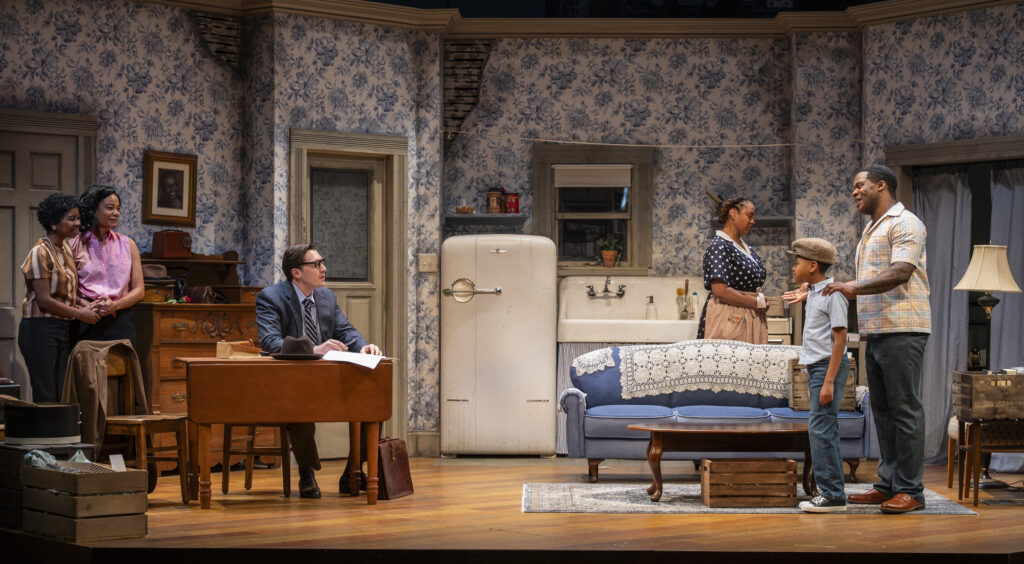
Lorraine Hansberry’s A Raisin In The Sun is certainly a classic American play in the manner of say, Our Town. It is vital, it is focused, and it clearly positions us in a particular identifiable era in 20th Century America. Both plays examine the gender conflicts, generational conflicts, societal conflicts, and racial attitudes of their respective eras. Raisin is a more complex story as it contrasts the hope invested in the American Dream as opposed the actual experience of life in America for Black Americans.

The cast of A Raisin In The Sun. Photo by Michael Brosilow and courtesy of the Milwaukee Chamber Theatre.

I don’t think we need to say anything about spoiler alerts given the stature of this play. But here is a short synopsis. Before the play begins, the patriarch of the Younger family has passed away and his life insurance pay out will provide some economic relief and opportunities that the family has not had in the past. But there is the rub. Several different family members have dreams and aspirations that this money could help them reach but that often puts them in opposition to one another during the course of the play. The money literally belongs to Mama, Lena Younger, the deceased’s widow. And her children state that is true during the play but there always seems to be a ‘but’ implied in the statement. Walter Lee Younger is frustrated with his lot as a chauffeur and wants to invest in a liquor store while his sister wants to continue her college career and become a doctor. Mama has other ideas and supports Beneatha’s college plan but given her religious beliefs, finds Walter’s liquor store idea objectionable. Lena takes her own lead and puts down a deposit on a home with the intention of moving her entire family out of the cramped squalid apartment where they currently are living. There are some mishaps, interventions, arguments, and third party disruptions…that provide a decent amount of turmoil, an interesting, deeply moving drama, and eventually, a satisfying ending.

Dimonte Henning. Photo by Michael Brosilow and courtesy of the Milwaukee Chamber Theatre.

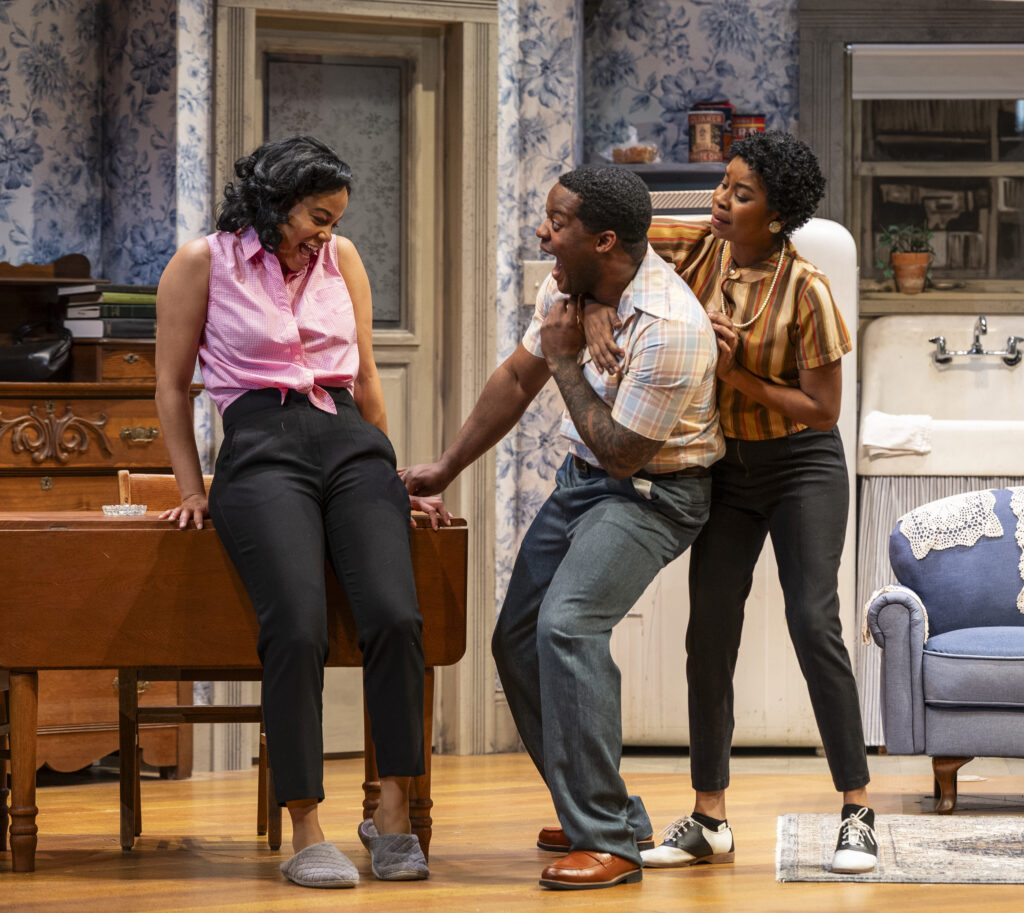
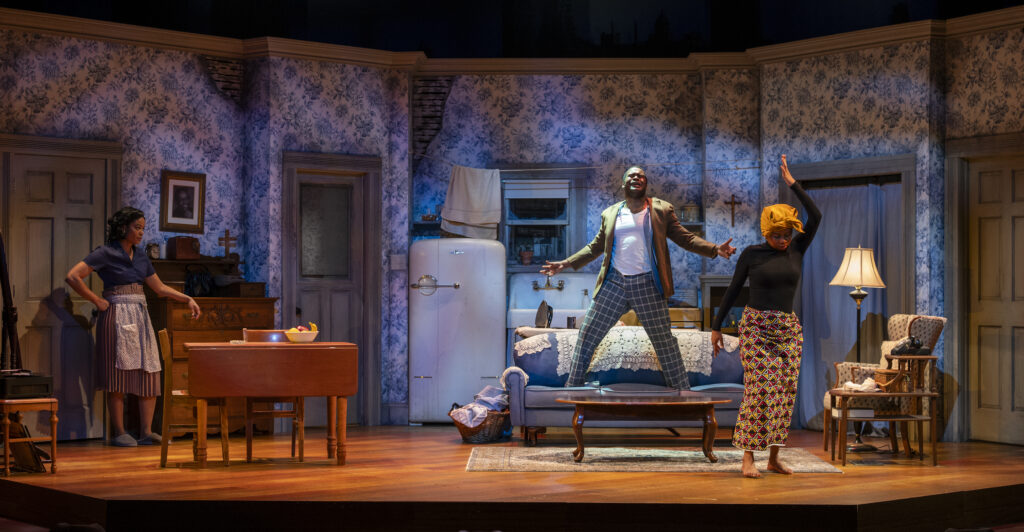
Dimonte Henning has developed into an intriguing and important member of the area theater scene both as a remarkable director and dramatic actor. So I was excited to see that he had signed on to play the very challenging role of Walter Lee Younger in the Chamber’s version of Raisin. Particularly when I realized that like many other presentations, director Kimille Howard was focusing on Walter as the lead character. This is not an easy role by any means and Henning realizes that and grabs it by the throat with both hands. Henning will make you feel Walter’s anger and frustration at his situation and you will recoil from the scenes of drunken behavior. And during one of Walter’s rages, Henning rails on about the lack of respect and understanding he feels he is getting from his family but he never exhibits a lick of empathy for their positions for a single moment. And I couldn’t quite discern the transition in his attitude when he comes into the room to find his sister dancing an ethnic folk dance…initially he is copying her moves to mock her but he seems to dissolve into an actual participant before too long. Just a bit of catharsis? Denning takes a surprising twist when he loses everything…and the expected rant and drinking…give way to the pain and a deadly quiet until he forges a new presence and new sense of manhood for Walter. And I have no idea how Henning maintains this level of intensity in the role for the entire two plus hours of the play.

Left to Right: Paulina Lule, Dimonte Henning, and Malaina Moore. Photo by Michael Brosilow and courtesy of the Milwaukee Chamber Theatre.

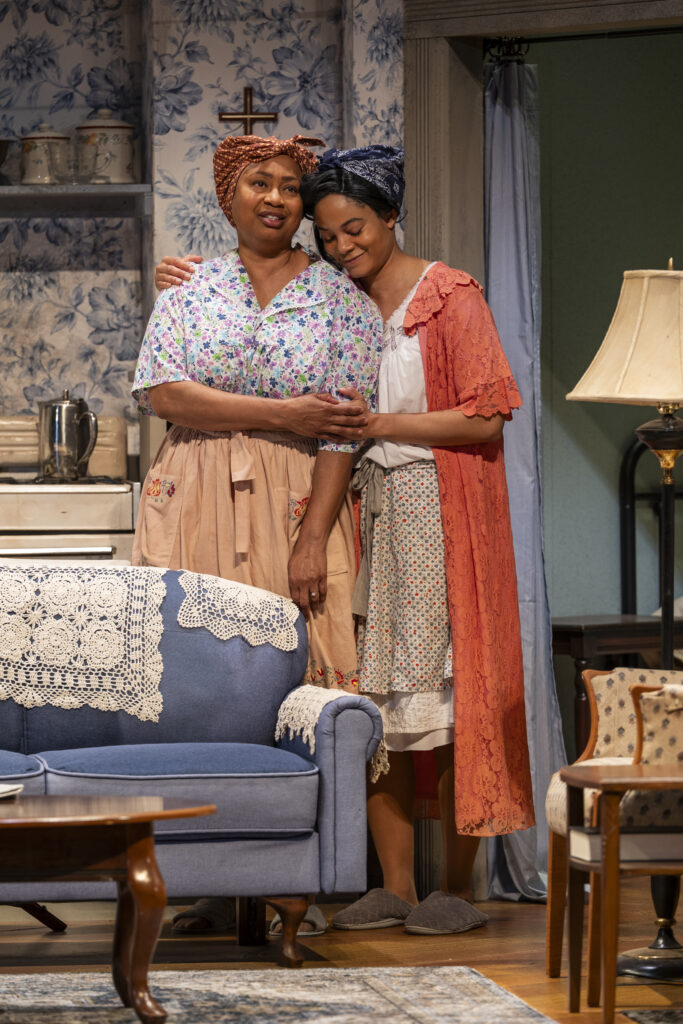
It is remarkable how Paulina Lule maintains the composure called for in playing Walter’s wife, Ruth Younger. With any number of trials of her own, Lule presents us with one of the stable forces in the household despite having to mother a young son and an erratic husband and at times play peacekeeper between her in-laws. Lule has just the right resignation in their voice and actions to display Ruth’s own sadness even as Ruth feels the need to press on. As Lena, Olivia Dawson exerts her own sense of determination and makes some very dramatic decisions for her family. But she doesn’t always see eye to eye with her children and Dawson displays just the right amount of sadness and regret as Walter lets her down without losing her composure. Dawson conveys that outward calm of motherhood even when she is probably roiling inside. And Malaina Moore is just jubilant as Beneatha Younger, balancing beaus who couldn’t be more different to establishing her dream in everyone’s mind including hers. But Moore also effortlessly presents a young woman who is trying to find her own mind and set her own path for the future. Moore catches the in-between moments as well as the most apparent in her journey. And here too, Moore is amazingly calm as her brother confesses to losing her college nest egg too. Another under story in Hansberry’s grand scheme of things is the love of family will win out in adversity.

Left to Right: Paulina Lule, Dimonte Henning, and Malaina Moore. Photo by Michael Brosilow and courtesy of the Milwaukee Chamber Theatre.

And two other featured characters around the Younger family? Kamani Graham plays a cocksure young man who is convinced of his own sophistication as George Murchison. And when George is listing the things that are important, Graham sells us on George’s knowing what he should do, what he has to do, and what he is doing but he has absolutely no idea why. Not sure who he thinks he is convincing, but he’s not getting to Beneatha. And Joseph Asagai is Beneatha’s other beau, a Nigerian student, he is self assured in an entirely different sense. Ethan Hightower’s Joseph is rooted in his own power and his dream for his people and the influence he hopes to bring home on the completion of his college sojourn in the US. The energy Hightower brings to the role certainly is attractive to Beneatha and the audience.

Then there is Karl Lindner. Lindner is played by Ken Miller and Miller brings just the right amount of trepidation to his character. He knows what he is doing isn’t right but societal pressure is putting him into this unfortunate and uncomfortable position. The role must be nearly as stressful for Miller to play as it would have been for a real life Lindner.

Left to Right: Olivia Dawson and Paulina Lule. Photo by Michael Brosilow and courtesy of the Milwaukee Chamber Theatre.

A quick shout out to Jordan Doidge for his portrayal of Travis Younger, the young son of Walter Lee and Ruth Younger. But I don’t think that sleepy act in the first act would have fooled my mother either. Nicely Done! Doidge alternates with Amari DeBerry as Travis. So if you are hoping to see Doidge or DeBerry, plan you visit to MCT carefully. The times and dates for their performances can be found in the links below.

This is a true classic American play and director Kimille Howard has voiced it in the proper classical perspective: a forceful performance that should be experienced on their live stage.

A Raisin In The Sun is playing at the Milwaukee Chamber Theatre from now through May 24, 2026. For those familiar with MCT, please note that they are presenting Raisin in the companion stage next door where the Skylight Music Theatre usually performs at 158 N. Broadway.

The play runs 2 hours and 45 minutes including one intermission.

Additional information HERE and Ticket information HERE.