August Wilson’s The Piano Lesson At Milwaukee Rep

Pulitzer Prize winner August Wilson is certainly one of the preeminent American playwrights of the 20th Century. Particularly his ten play Pittsburgh Cycle (aka the Century Cycle). One play was written for each decade of the century and represents the Black experience and culture for that time. The stories are told in great detail through the interactions and daily lives of typical Black Americans. They are all set in Wilson’s home town of Pittsburgh PA. The Milwaukee Rep has been presenting one of the cycle every few seasons and now, one of his Pulitizer Prize winning plays, The Piano Lesson is gracing the new Checota Powerhouse Theater.

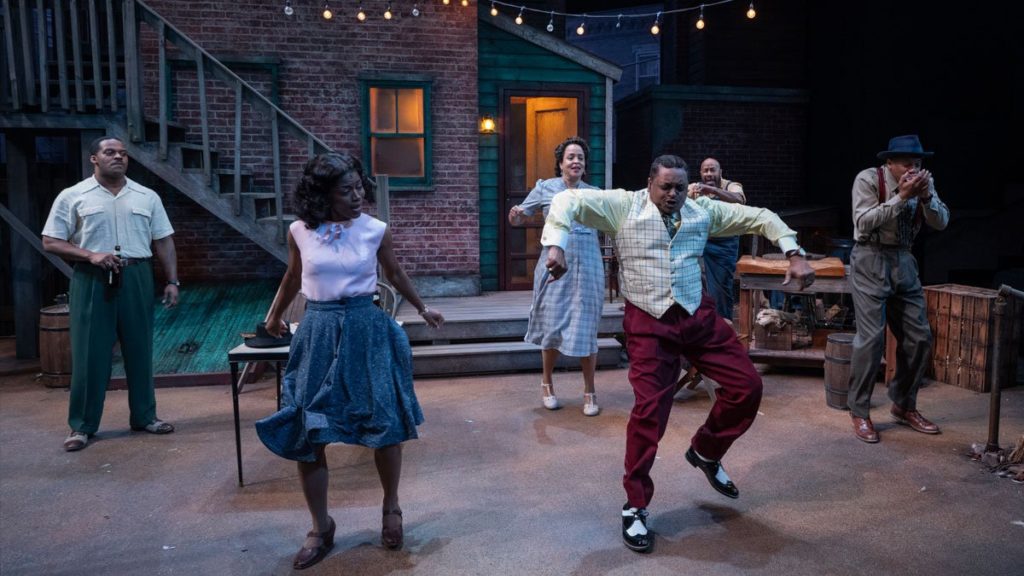
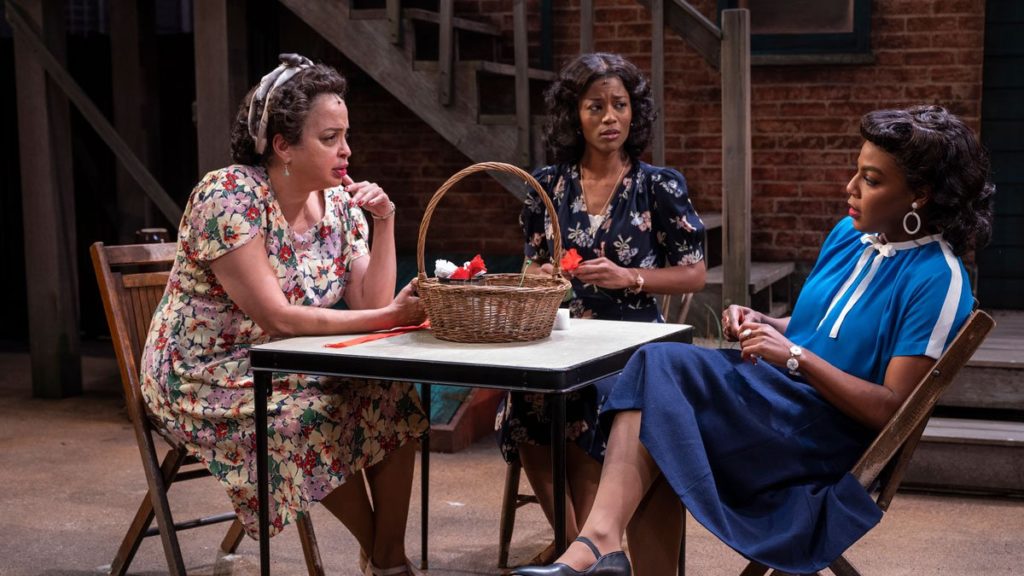
The set of August Wilson’s The Piano Lesson. Photo by Michael Brosilow and courtesy of the Milwaukee Repertory Theater.

It is 1936 and we are in the home of Doaker Charles in Pittsburgh. He shares the home with his niece, Berniece, and her daughter, Maretha. It is a comfortable home, not lavish, but comfortable. Doaker has worked for the railroad for decades and is currently a porter. So his home has a lovely couch and matching chair, a fairly modern refrigerator and stove, and a magnificently carved upright piano. And this lovely piano will be the focus of The Piano Lesson.

It is 1936. It is just over 70 years since the Civil War has ended. All of our characters, of course, are the descendants of enslaved people. Many of the adults most likely knew relatives who had actually been enslaved people. And that piano has a long and storied history. The elaborate carvings were done by an enslaved grandparent. The carvings represent enslaved family members of that time. And it belonged to the land owner who held their ancestors in slavery. But now the Charles family owns it (Doaker has a great long story about that,that you need to hear from him) and the question is what to do with it. How do you honor the past and how can that past provide for the future. The family dynamic differs in opinion in dramatic fashion and that drives Wilson’s narrative here.

L to R: Nubia Monks, Lester Purry, James T. Alfred, La’Tevin Alexander, Ny’ajai Ellison. Photo by Michael Brosilow and courtesy of the Milwaukee Repertory Theater.

Yes, Doaker and Berniece are comfortable in their home until Berniece’s brother Boy Willie bursts in at 5 AM and insists on waking the entire household. Boy Willie has just arrived from Mississippi with his buddy Lyman with a truckload of watermelons which they intend to sell on the street. Lyman, along with Doaker and Berniece, are examples of the diaspora of Black Americans migrating from the South to the industrialized North. Lyman wants to use his money to stay and find his way in Pittsburgh…but for Boy Willie, it’s another story. Boy Willie wants to sell the heirloom piano and add it to the watermelon proceeds and return home to purchase a portion of the land where his family was enslaved, becoming a landowning farmer rather than continue as a sharecropper. And here is the rub between the members of the family…what to do with the piano…and how do you honor the family legacy?

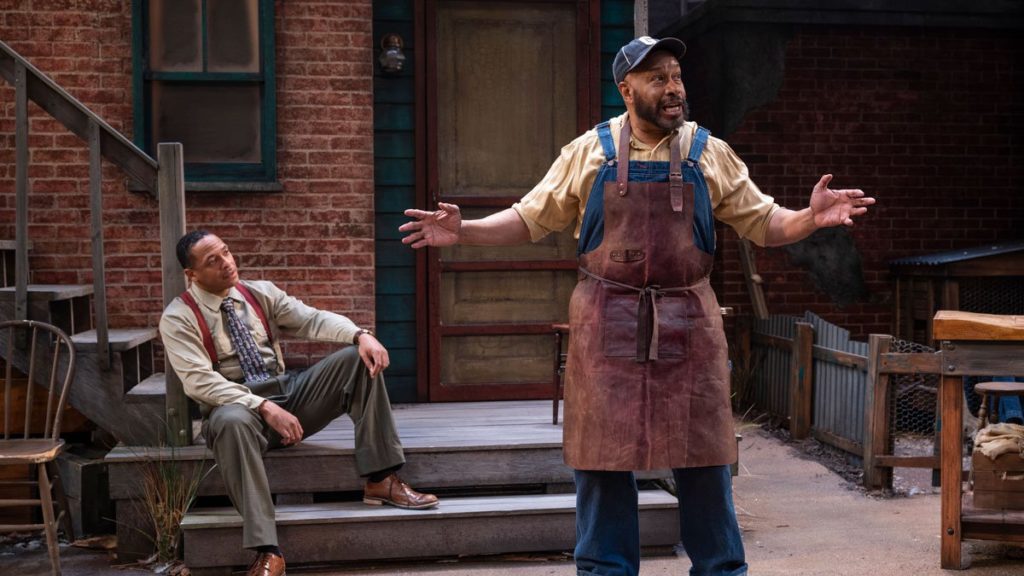
Pictured James Craven. Photo by Michael Brosilow and courtesy of the Milwaukee Repertory Theater.

Doaker Charles has worked on the railroad for decades and is now a porter. James Craven gives us a Doaker who has dignity and gravitas and acts as the nominal head of the family. But he also can show a man at wit’s end at times and just backs away to keep his own counsel. Nubia Monks presents initially, a strong and in control young woman as Berniece. A loving and a bit stern mother, she is certainly intent on bringing up Maretha right. But Monks also brings an edge and sometimes a brittleness to Berniece when Boy Willie pushes her buttons just the wrong way. Berniece is a bit superstitious though and maybe with good reason…it seems that the piano may actually be haunted and the spirit of the dead plantation owner may have followed Boy Willie to Pittsburgh or came to seek out the piano. Monks tries to keep her cool while sensing these spirits but eventually overcomes her fears and takes on her future head on!!

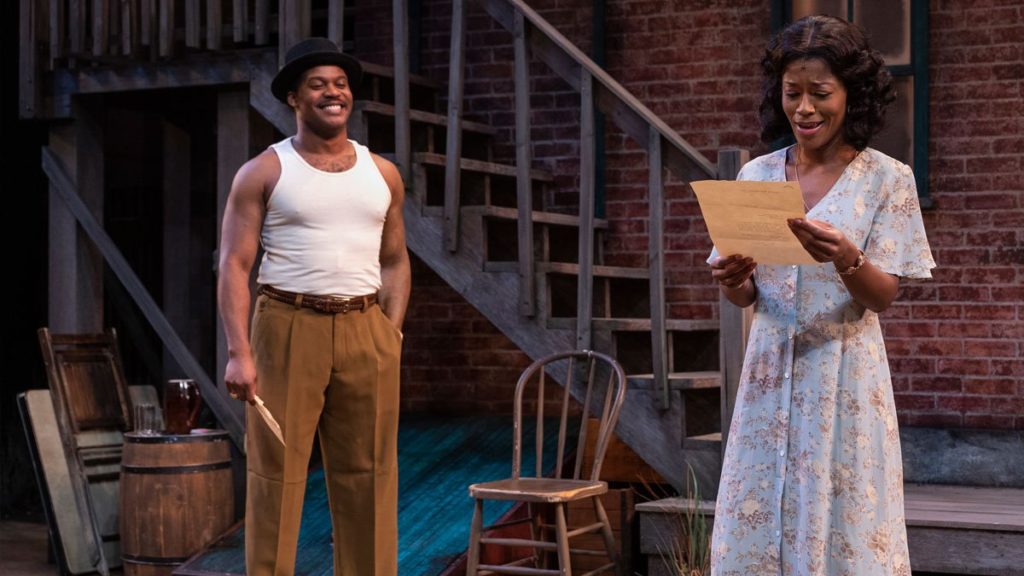
L to R: James T. Alfred and La’Tevin Alexander. Photo by Michael Brosilow and courtesy of the Milwaukee Repertory Theater.

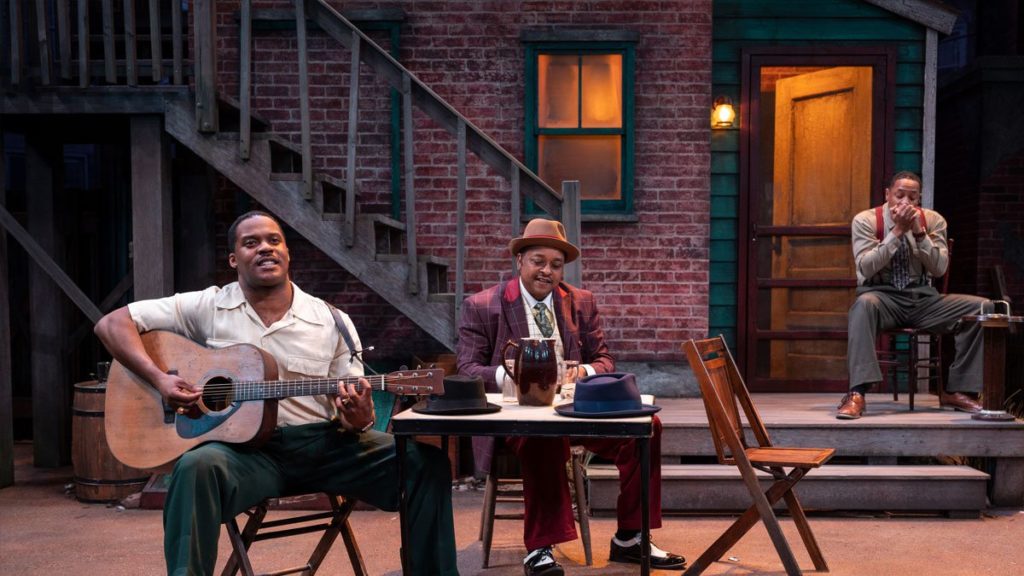
Boy Willie is a loud self interested obsessive man. James T. Alfred plays him loud and obnoxious and self-centered and just moving all of the time…at full voice! How Alfred maintains that intensity and activity level is truly a wonder. His friend Lyman is played by La’Tevin Alexander as a quiet easily swayed young man. Alexander wants to listen to everyone without taking sides but is too often distracted by the last person he’s spoken to and that too often is Boy Willie. Anthony Irons’ Avery is a thoughtful, quiet, and patient man who is trying to become a preacher and start his own congregation. He too is from Mississippi and his newly arrived friends tease him a bit but also show him some respect. He is trying to woo Berniece but she is not quite ready to give up her mourning for her late husband. And the last Charles family member is Wining Boy, who is Doaker’s brother. Lester Purry plays him as a player…a piano player too…and a gambler who it seems could be something but instead is something of a ne’er do well. Purry certainly finds his braggart ways to be the pivotal personality trait for Wining Boy.

L to R: James T. Alfred, La’Tevin Alexander, Lester Purry Photo by Michael Brosilow and courtesy of the Milwaukee Repertory Theater.

Director Lou Bellamy certainly has a fundamental feeling for Wilson’s play here. It can’t be easy to put all of these aspects and characters together when the period is, on the one hand nearly 90 years ago, but on the other all too real, fresh, and contemporary at times. And with a run time of about three hours it must be hard to keep the flows going from start to finish.

The Piano Lesson runs at the Checota Powerhouse Theater in the Associated Bank Theater Center from now through March 22, 2026.

More information and tickets can be found here.

Extra Credit Reading: Program

August Wilson’s Seven Guitars at the Milwaukee Rep

Over the past few decades, as I’ve witnessed the Milwaukee Repertory Theater’s presentations of plays from August Wilson’s Pittsburgh Cycle, aka Century Cycle, I have reached the conclusion that Wilson is the most important and most significant American playwright of the 20th Century. With a play set in each decade of the 20th Century, most of which occur in Pittsburgh, Wilson shows us how much has changed in America over that one hundred years while how little has changed around race relations and civil rights. Set in 1948, Seven Guitars represents the status of race and hope and poverty and desperation in post war America for its black citizens. And this is a very accurate and direct portrayal. But Wilson’s plays go beyond that and all of us will recognize the humanity in the characters and the longing for love and family and community that Wilson invites us to understand. And there is one other item here as well…how those with mental illness were/are treated in America, particularly if they are people of color.

Photo courtesy of Milwaukee Repertory Theater. Photo by Michael Brosilow. Pictured Dimonte Henning, Kierra Bunch, Marsha Estell, Bryan Bentley, Vincent Jordan and Kevin Brown

And those of us who live in mid-size cities in America will probably feel the urban environment that Wilson provides for us in his description of Pittsburgh. And we will certainly recognize the back yard of the probably turn of the 20th Century apartment building so accurately portrayed by scenic designer Shaun Motley and the Rep’s crew.

Seven Guitars opens and closes with his friends and neighbors discussing his funeral…he being blues musician, Floyd ‘Schoolboy’ Barton…with the central play presenting his hopes and dreams, his frustrations, and his untimely death as he works to being a famous and successful blues musician. His desire will be familiar to a great number of us who ran out to buy our first guitar after seeing the Beatles on The Ed Sullivan Show (which ironically started in 1948). And the music will be very familiar to much of the same cohort who discovered American blues music through the likes of the Rolling Stones, the Animals, John Mayall, Cream, and Jimi Hendrix, But Barton has indeed released a hit record and has a letter from the record company requesting that he record additional tunes!

Photo courtesy of Milwaukee Repertory Theater. Photo by Michael Brosilow. Pictured Dimonte Henning, Bryant Bentley, and Vincent Jordan.

So, Dimonte Henning, portrays Barton on his return to Pittsburgh from the great recording Mecca of Chicago. He’s here to round up his musician partners, Canewell, an incredible blues harp (harmonica) player, played by Vincent Jordan, always with his harmonica at the ready, and drummer Red Carter, played by Bryant Bentley, who can tap out a rhythm almost anywhere.

But his main goal is to coax his former girlfriend, Vera Dotson, to also accompany him to Chicago…an idea that, Kierra Bunch, as Vera, admirably and strongly resists at first until Barton finally wears her down with his charm and determination.

Photo courtesy of Milwaukee Repertory Theater. Photo by Michael Brosilow. Pictured Dimonte Henning and Kierra Bunch.

But there are any number of set backs. Barton spends some time in jail for vagrancy. Despite having a hit record…he hasn’t been paid hit record type royalties. And there are problems getting his electric guitar out of pawn and issues with his would be manager and of course getting everyone to agree with his dream! But he works through the issues and seems set on his way…except the real and an imagined world get in the way…resulting in his death.

Photo courtesy of Milwaukee Repertory Theater. Photo by Michael Brosilow. Pictured Vincent Jordan and Kevin Brown.

The other characters here are Louise, the apparent landlady, and neighborhood anchor played with calm and wisdom by Marsha Estell. Her in trouble niece, Ruby, Saran Bakari, who shows up to stay with Louise for ‘a while’. And Hedley, played by Kevin Brown, another resident of the building who is suffering from tuberculosis and has some mental health issues. All three contribute to the understanding of how race impacts the lives of average Americans in so many negative ways and round out a vibrant neighborhood.

Photo courtesy of Milwaukee Repertory Theater. Photo by Michael Brosilow. Pictured: Marsha Estell, Kierra Bunch, and Saran Bakari

Director Ron OJ Parson, insists on having the characters tell the story front and center and he has done a masterful job here. And it certainly wasn’t easy, given seven major characters, and what seems to me, to be Wilson’s wordiest play (running time is three hours plus an intermission).

And I won’t go into detail, but you will put a glamorous job as stage hand out of your mind as you watch the stage reset during intermission. When you attend you will understand!

Seven Guitars is running through April 2, 2023, at the Rep’s Quadracci Powerhouse Theater. More information about the production and ticket ordering info is here:

Extra Credit Reading: Program.

If you are not familiar with August Wilson yet, this is worth the peek before you go: Play Guide.

Designing August Wilson’s Seven Guitars