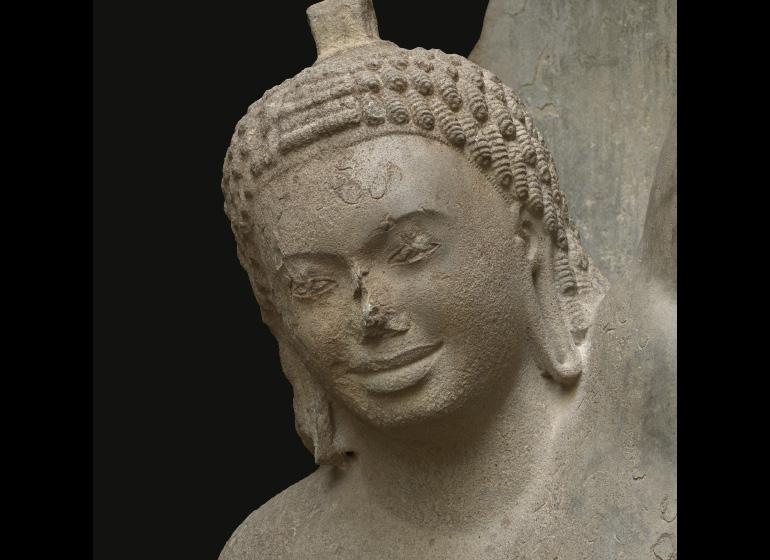
Revealing Krishna is one of the current highlights at the Cleveland Museum of Art. It tells the story of the circuitous route that their Cambodian Krishna carving took to arrive at the museum as well as the several attempts to restore it and connect it with it’s correct pieces.
One of the gratifying parts of the story is the co-operation between the National Museum of Cambodia in Phnom Penh and the Cleveland Museum. Earlier attempts to restore the Cleveland statue resulting in mismatched pieces…which eventually led to swaps of statue fragments with the National Museum to get the statue in Cleveland and another in Phnom Penh matched with their correct pieces.
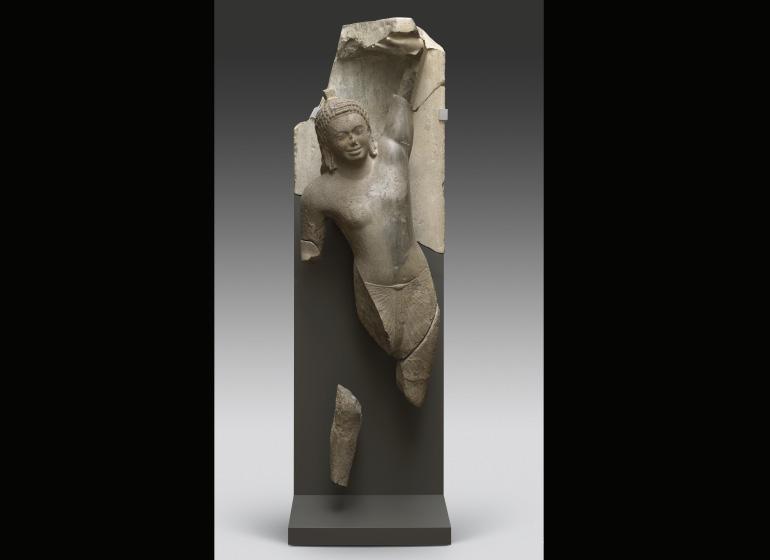
Krishna Lifting Mount Govardhan after 2020 restoration, c. 600. Southern Cambodia, Takeo Province, Phnom Da. Sandstone; 203.1 x 68 x 55.5 cm. The Cleveland Museum of Art, John L. Severance Fund, 1973.106
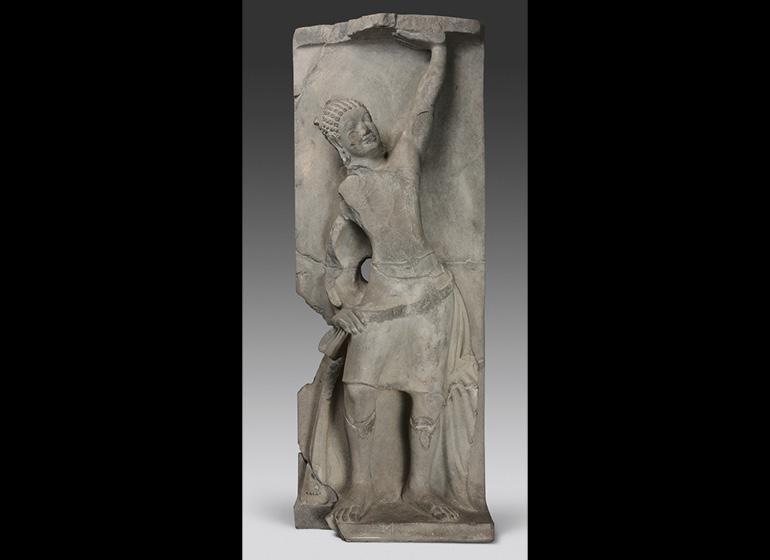
In addition to Cleveland’s Krishna Lifting Mount Govardhan, the exhibit includes a number of other CMA holdings of Cambodian sculpture plus this stunning carving of the same subject on loan from the National Museum in Phnom Penh:
Krishna Lifting Mount Govardhan, c. 700. Southern Cambodia, Takeo Province, Wat Koh. Sandstone; 161 (without 27 cm tenon) x 65.5 x 35.2 cm. National Museum of Cambodia, Ka.1625. Photo: Konstanty Kulik
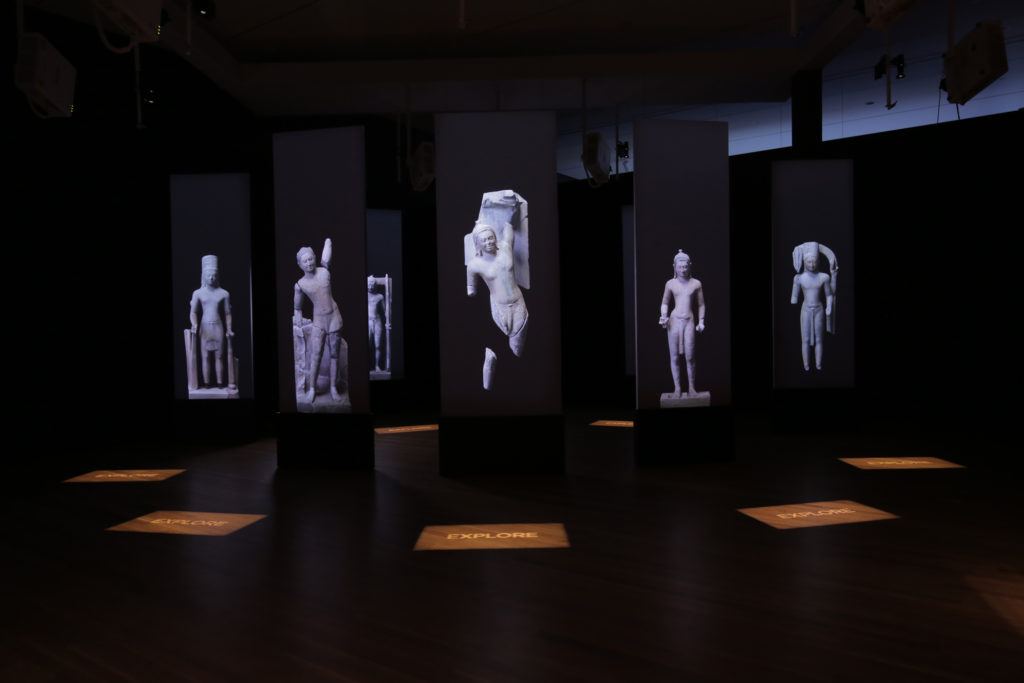
But this exhibit goes beyond the wall cards and wall text that is standard signage in any museum. There is also a visual component that uses a visor and holograms to present details of the restoration process, original site in Cambodia, and the trek that the statue made on its journey to Cleveland. And the exhibit ends with a number of interactive videos that present three dimensional representations of the eight sculptures of gods from the original site along with text explaining who they are and how they are significant to the site and the story! Beyond the ‘in the flesh statues’ this last bit was the most informative and for me at least the next most useful piece of the exhibit.
The “Gods of Phnom Da” digital gallery displays life-size 3-D models of the eight gods of Phnom Da, from c. 600, with motion-activated animations exploring details and iconographic elements. Photo: The Cleveland Museum of Art
More info: Revealing Krishna: Journey to Cambodia’s Sacred Mountain runs until January 30, 2022. There is an entrance fee for this exhibit of $15 but there are discounts for seniors and students and others. Tickets are timed and can be ordered at the link above.
Krishna Lifting Mount Govardhan(detail), c. 600. Southern Cambodia, Takeo Province, Phnom Da. Sandstone; 203.1 x 68 x 55.5 cm. The Cleveland Museum of Art, John L. Severance Fund, 1973.106
Most of my adult life as an artist and follower of artists, Odilon Redon was my favorite (until I visited Gustave Moreau’s house museum in Paris that is. My front page photo may be a give away on my current favorite). So whenever I visit a new museum I search to see if they have any of his work. I have been rewarded a number of times and the Musee D’orsay has a number of more obscure treasure by Redon.
So when I saw an ad on social media for Collecting Dreams: Odilon Redon at the Cleveland Museum of Art it was time for a road trip!
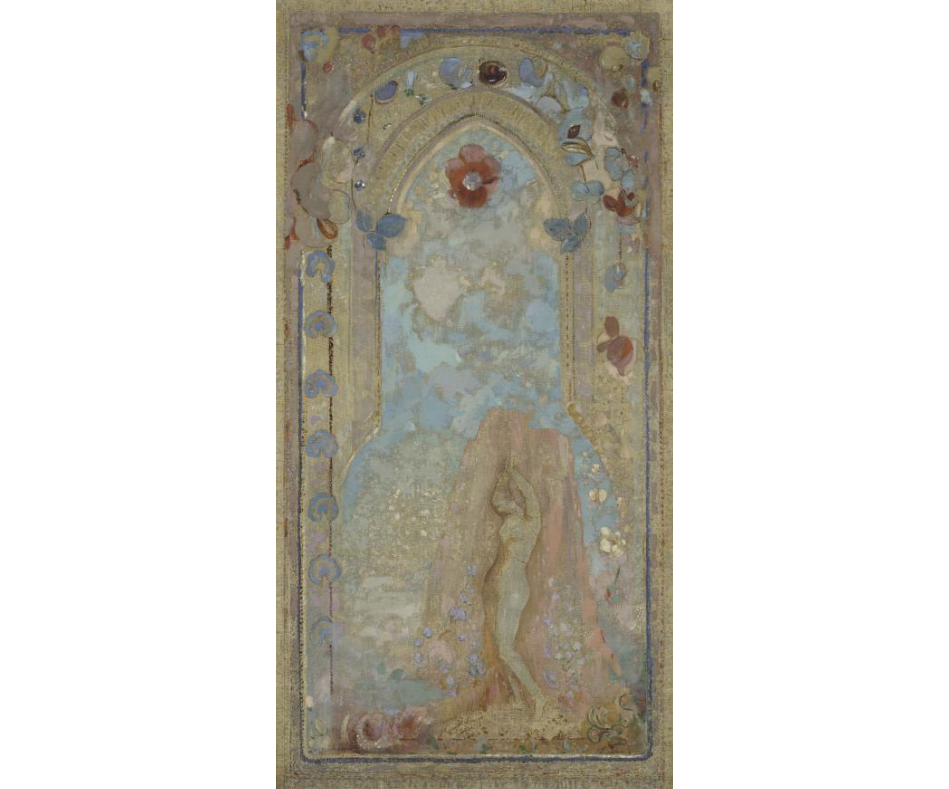
CMA has a pretty significant holding of various Redon noirs (black drawings and prints). Reportedly the largest holdings in the United States. So this is a significant show for Redon fans. There are four color pieces, three of them in the CMA collection and one on loan. This oil painting on unprimed canvas of Andromeda is on loan from the Arkansas Museum of Fine Arts Foundation Collection. A stunning work that is 65 inches tall!
Andromeda, Arkansas Museum of Fine Arts Foundation Collection: Gift of David Rockefeller
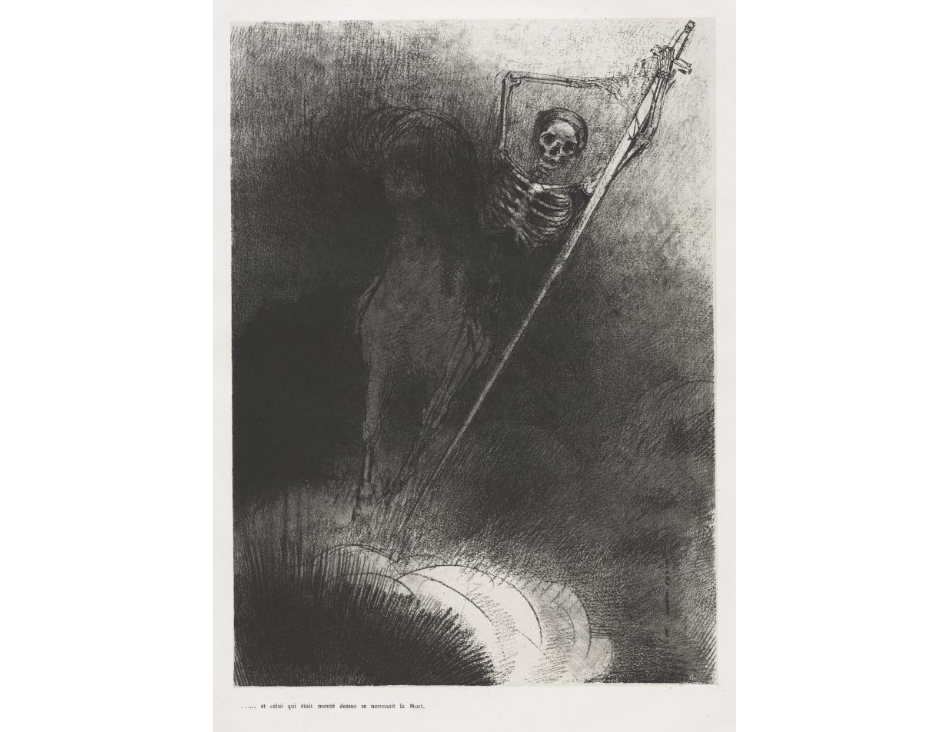
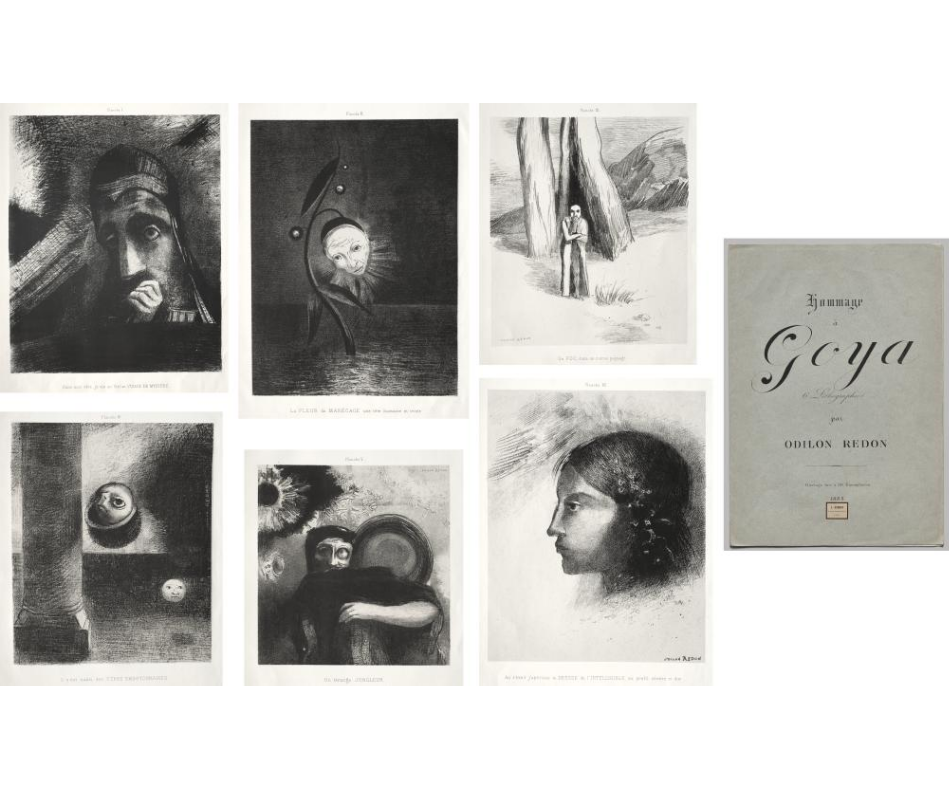
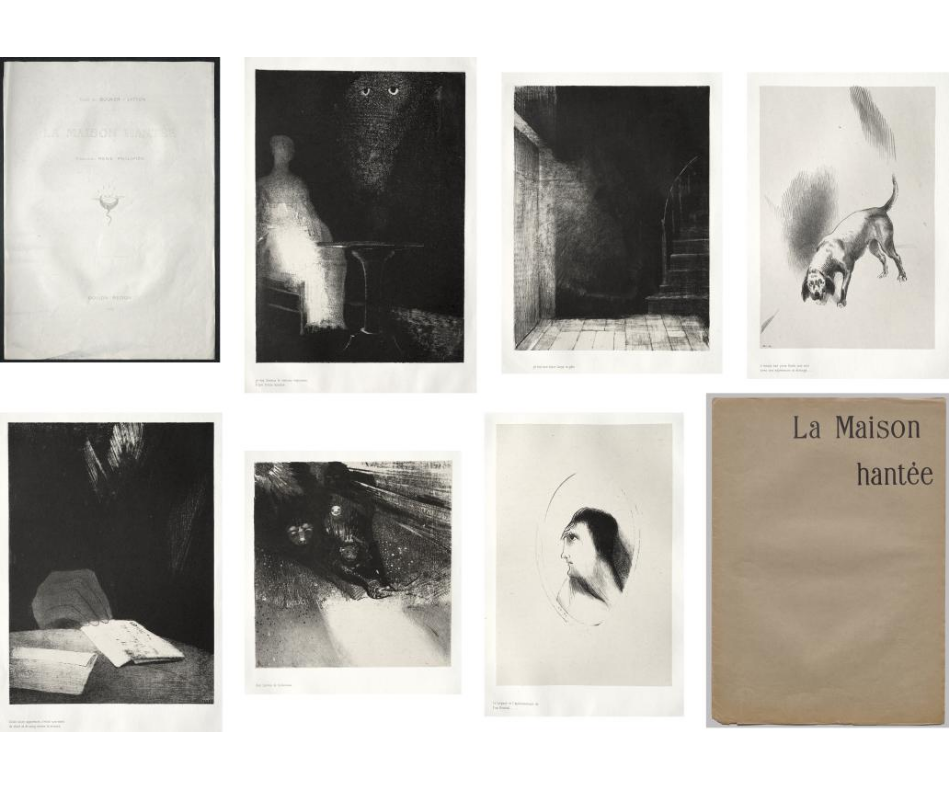
And one of the stand out displays is the wall containing the complete sets of the Apocalypse of Saint John, the Homage to Goya, The Haunted House, and the Temptation of Saint Anthony lithographic portfolios. And to see them side by side was quite a treat!
And His Name That Sat on Him Was Death (THE APOCALYPSE OF SAINT JOHN), Cleveland Museum of Art.
Homage to Goya, Cleveland Museum of Art
I spent a lot of hours in this show, it’s on the main floor just inside the front entrance in a quiet room dedicated to just this exhibit at the moment. So for those of us in love with Redon’s work, it is an essential spiritual experience. A most rewarding investment!
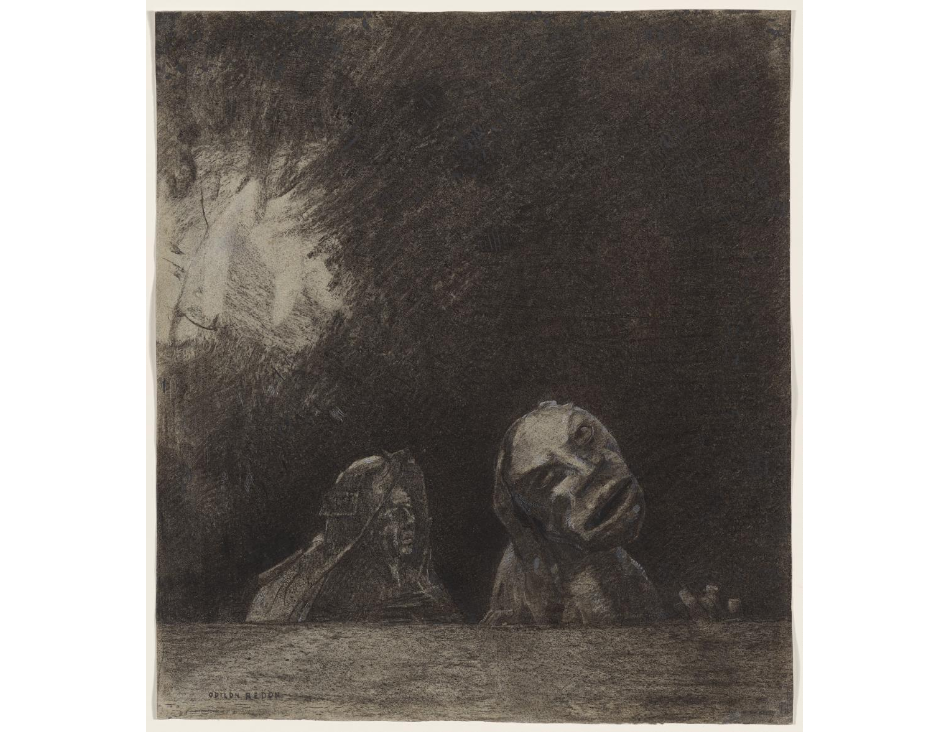
Now, the CMA’s newest Redon acquisition and one they apparently are very proud of is this charcoal and black chalk rendition of Quasimodo (since two different guards pointed it out). But it certainly is one of the stand out pieces in the show.
Quasimodo, Cleveland Museum of Art
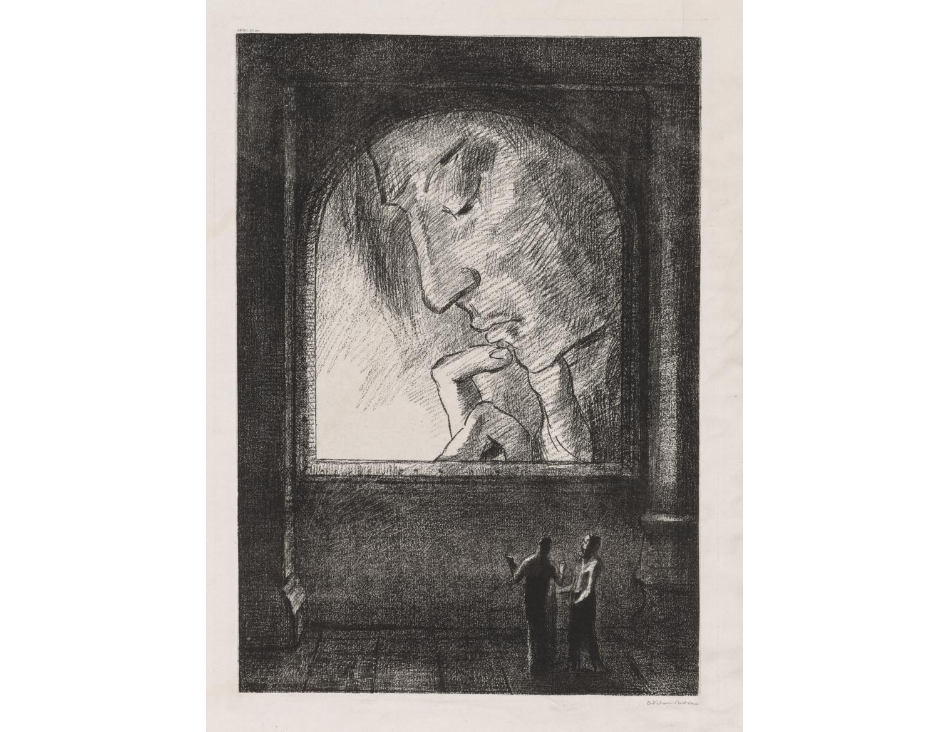
And let’s go with one of my favorites…from the noirs, the very first piece that I encountered when entering the gallery, Another lithograph entitled Light. I love the line both in defining the face and head and the line that defines the volumes and shadow. The piece alone highlights Redon’s skill in the use of lithography and maybe lays claim to Redon being one of the best in his use of the medium!
Light, Cleveland Museum of Art
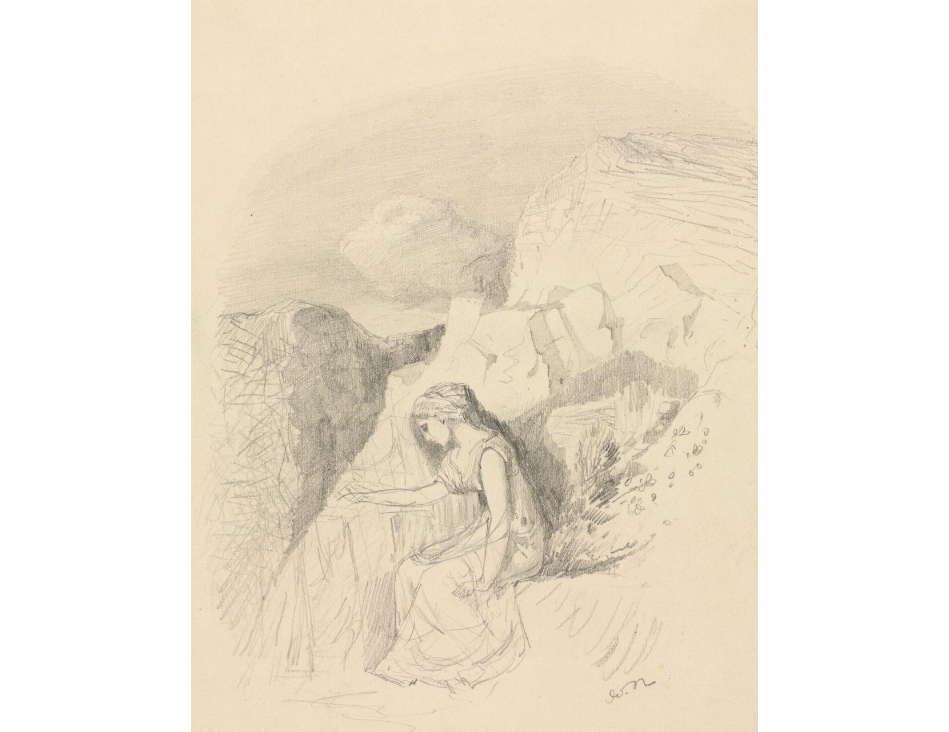
And here is one other selection from the CMA collection that is rather unusual. Not for the subject matter but for the medium. I don’t remember seeing anyone else exhibit a Redon pencil drawing…but here we have one at CMA, Melancholy.
Melancholy, Cleveland Museum of Art
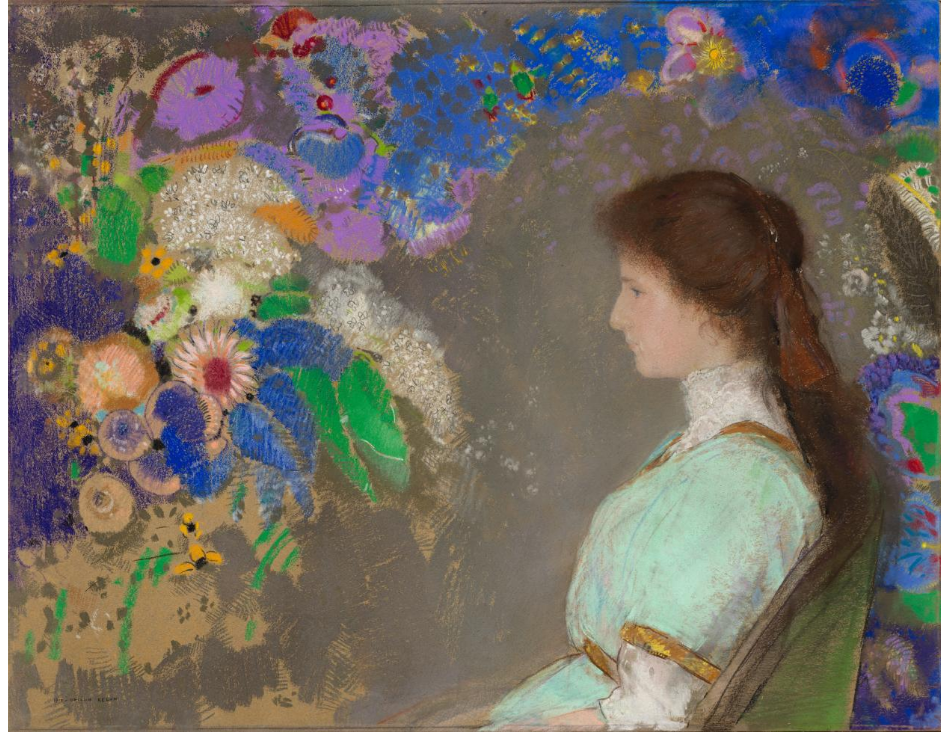
And then my personal favorite ‘painting’, one of his works where he is portraying an actual sitter as opposed to his imagined or dreamed images as shown in the other pieces. This is a pastel on paper of Viollette Heymann shown in profile with just simply amazing limning skills against a neutral gray/brown background opposed to a jungle of colored flora. And it doesn’t quite come across in this image as it does in person, but his handling of the shades and gradations in her hair is simply stunning. It can often be mind boggling to compare his more common noirs with the absolutely color bursts in his pastels or oils. Or his portraits vs. his imaginings.
Violette Heymann, Cleveland Museum of Art
Ok, just one more image…the lithographic portfolio, Haunted House:
The Haunted House, Cleveland Museum of Art
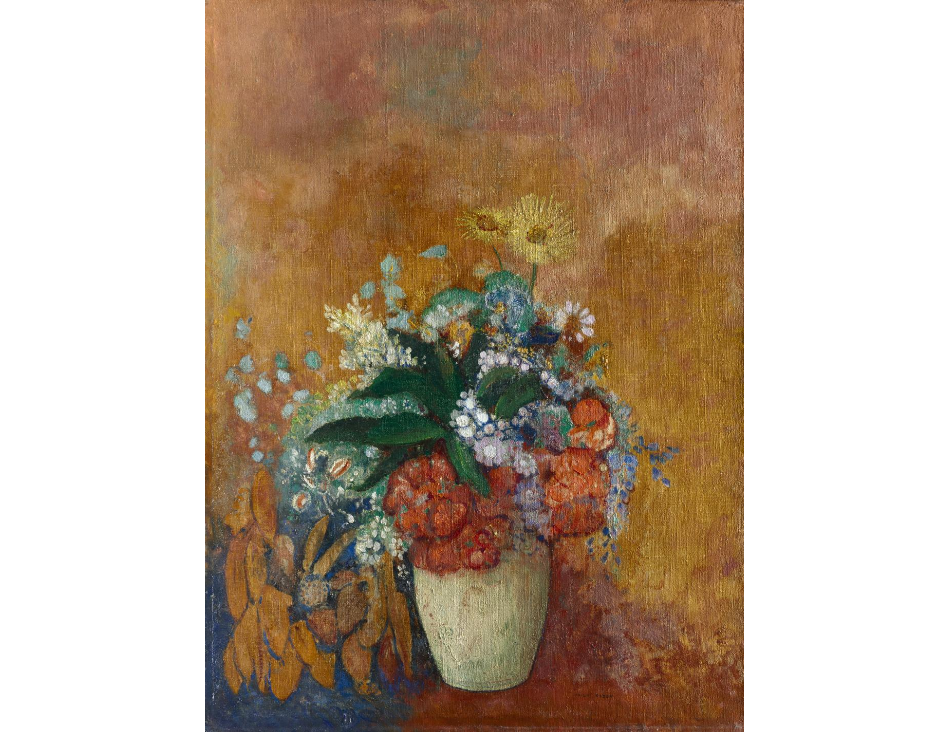
One more hint…there is an oil painting in the permanent collection that wasn’t brought into this show. But in Gallery 222 with the Monet and Picassos is another beautiul work.. I am stunned going through the photos that I took, that I didn’t snap one…sigh. So here is another download from the CMA site but if you go don’t miss this!
Vase of Flowers, Cleveland Museum of Art
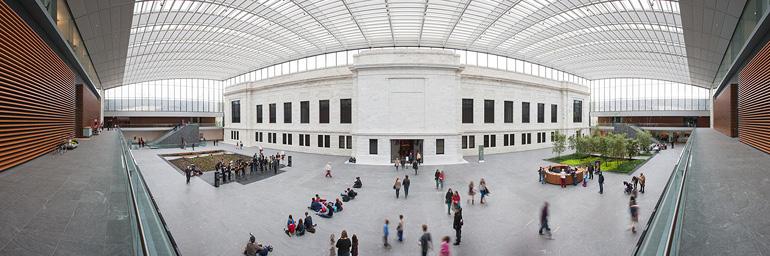
The show is free as is admission to the Cleveland Museum of Art! And the show continues through January 23, 2022. Face masks and social distancing are required. But check their website for current requirements before you go. And a quick shout out to their cafeteria…great people and very good food! The menu is a bit limited during the pandemic however but make a day of it (it can take a day so see the entire collection) and enjoy an affordable leisurely lunch in the atrium!
wide angle photo of the atrium at CMA facing the 1916 building by David Brichford
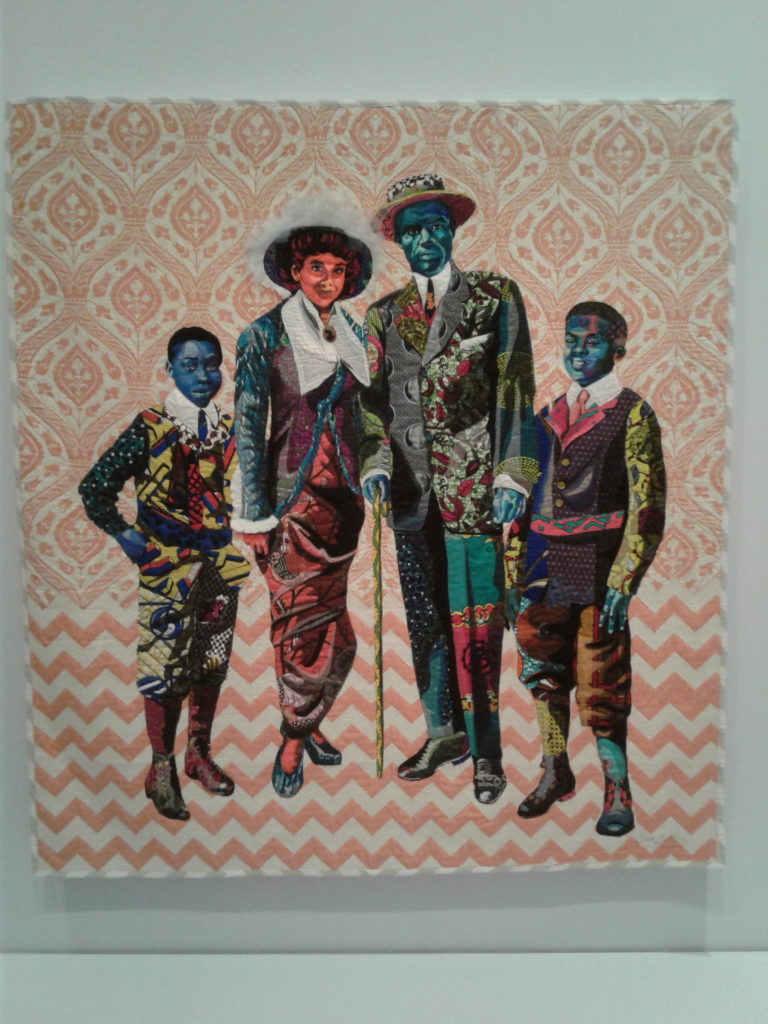
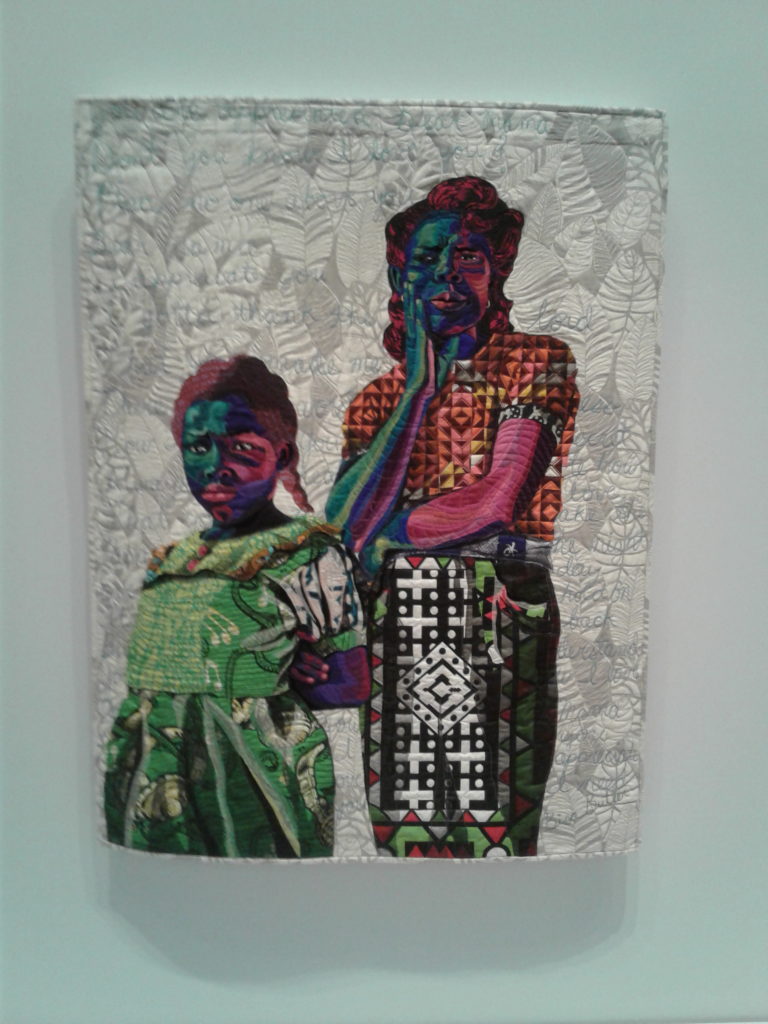
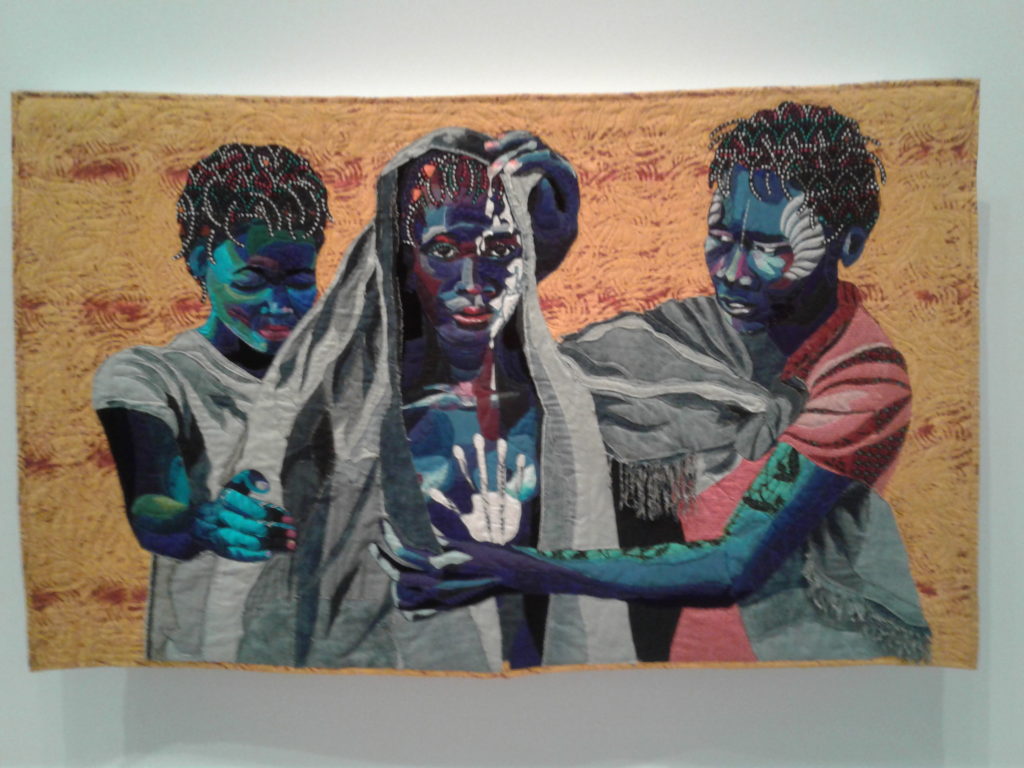
This exhibition threw me for a loop. The photos and promotional lit for the show simply don’t do justice to the vibrant colors or the tactile sensation that quilting imbues on these portraits. And Ms. Butler’s subtle (yes subtle) color transitions from one shade/value to another are extremely effective, particularly in the faces, as we see the bright light highlights of certain features quietly shift into darker shadow as we move our view across a face.
I wasn’t familiar with Ms. Butler before this show and I am sorry that I hadn’t seen her work before now. She works with textiles and in this show of portraits, primarily quilts. This is an incredibly effective medium for her style of story telling and these portraits certainly do tell a story. We see and hear clear stories about family and community told with a personal warmth and pride that just feels so very very refreshing. And quilts allow her to work with these vivid colors probably more easily than paint and certainly on a larger scale as well. And the quilting technique allows her to build layers of color without having to think out exactly how to lay in that next vibrant color adjacent to the first.
And as I’ve said, the quilting process provides a certain tactile sensation. Far more interesting than painting while being more subtle and reflective than sculpture. And the colors and techniques here are just totally apropos to Ms. Butler’s vision. Simply amazing…this is an unforgettable show.
Bisa Butler’s portrait quilts vividly capture personal and historical narratives of Black life.
She strategically uses textiles—a traditionally marginalized medium—to interrogate the historical marginalization of her subjects while using scale and subtle detail to convey her subjects’ complex individuality. Together, Butler’s quilts present an expansive view of history through their engagement with themes such as family, community, migration, the promise of youth, and artistic and intellectual legacies.
and again here is the link to the AIC…this includes a six minute interview with Bisa Butler…more than worth those few minutes! And now, after telling you that the photos that I’ve seen don’t do justice to the physical works, I am going to share three of my favorite pieces from the show!
Black Star Family, First Class Tickets to LiberiaDear MamaSurvivor
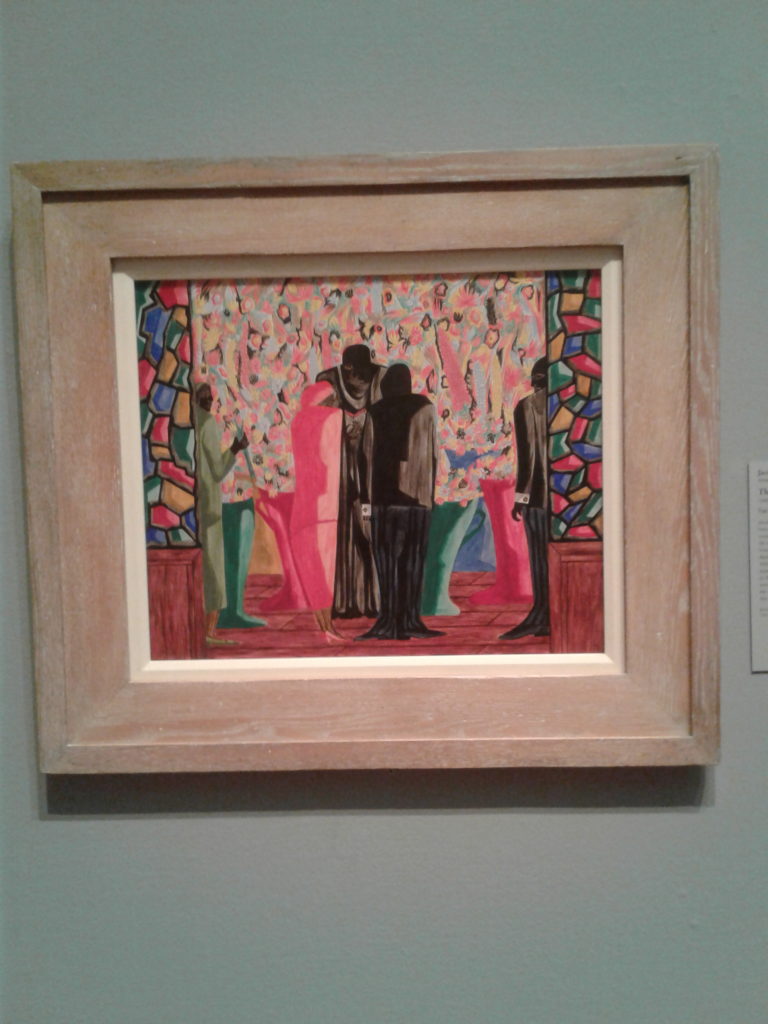
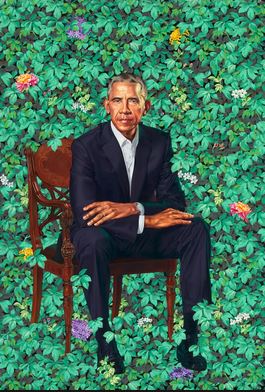
Bia Butler states that her major influences are family photo albums, the philosophies of AfriCOBRA (the African Commune of Bad Relevant Artists), Romare Bearden’s collages, Faith Ringgold’s quilts, and Gordon Parks’s photographs. And although they may not be direct influences, to my eyes there is a similarity in the use of background ‘textures’ to another contemporary artist, Kehinde Wiley, who painted President Obama’s portrait, and even Jacob Lawrence, who is best known for his migration series. I have examples of each below.
The Bisa Butler: Portraits show continues at the Art Institute until September 6, 2021. It is free with general admission to the museum. Currently the AIC is open limited hours, 11 AM to 6 PM Thursday through Monday with early openings each day at 10 AM for members. As of this writing, masks are required and social distancing enforced as best as they can. So I highly recommend seeing this show!!
Jacob Lawrence, The Wedding, 1948, the collection of the Art Institute of Chicago