Next Act Theatre didn’t hesitate a moment about starting their new season with a compelling and hard hitting drama. Yes, with a name like Sanctuary City, it does deal with two stories about two undocumented young adults whose paths cross in their adopted land. And they were brought to the United States as children so they really know no other culture or life style than America.
Now in the current sociopolitical environment, sanctuary city may invoke thoughts about safe haven but the 2006 version of Newark, where the play takes place, isn’t such a place. Instead, to me, the play supports the relationship built between our two protagonists, as sanctuary cities. I hope I can fill that idea in without giving too much of the story away. But, yes, much of the undercurrent of this story has to do with the struggles and fears and stresses experienced here, so in a very meaningful way it is of the day. But there are a few scenes and conversations that are more of their time, insects stuck in amber as it were. But we will all understand the angst that we see here.
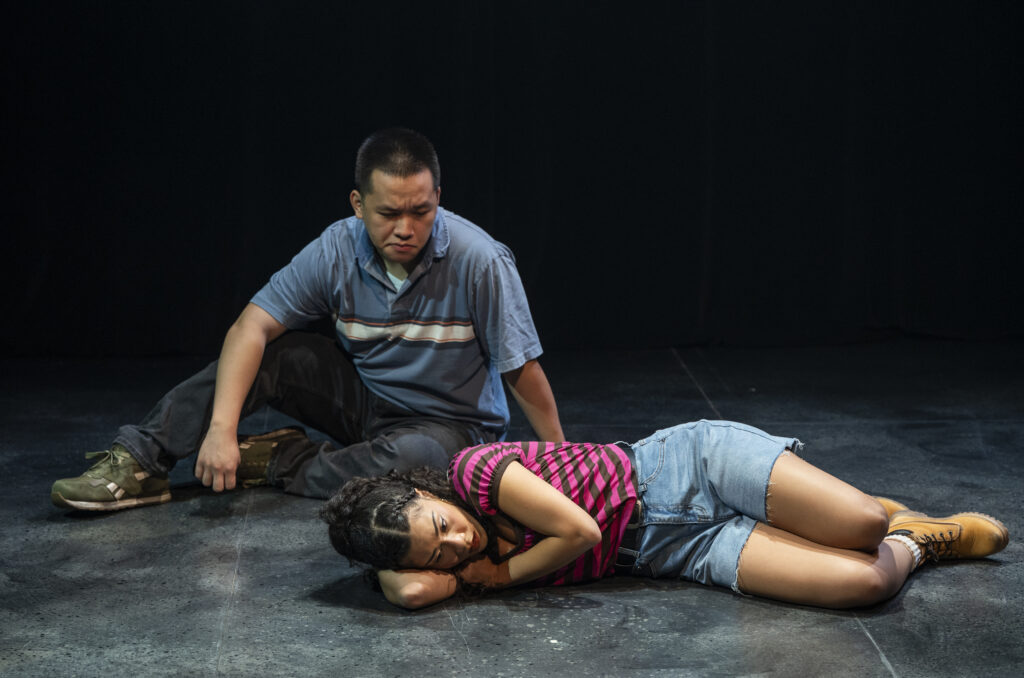
We meet G, played with incredible grace and determination by Ashley Oviedo, when she climbs the fire escape to B’s bedroom to escape from her home situation. B is played by King Hang as a conflicted young man who isn’t sure which way to turn as his world is coming apart. So, here are our sanctuary moments. B physically shelters G in his home while G shelters B’s mind and confusion with her empathy and compassion. When we meet them, they are young adults still attending high school. And this scene is confusing at first because it seems to be repeating in an endless loop with slight shifts in the dialogue and differences in inflection. These resets are cleverly delimited by a click track, so you know when they restart. I don’t know who thought that click thing up but director Jake Penner put it to amazing use here. Eventually you realize that the story is actually in something of an endless loop. I don’t know how Oviedo and Hang keep track of the changes in what is nearly identical dialogue.
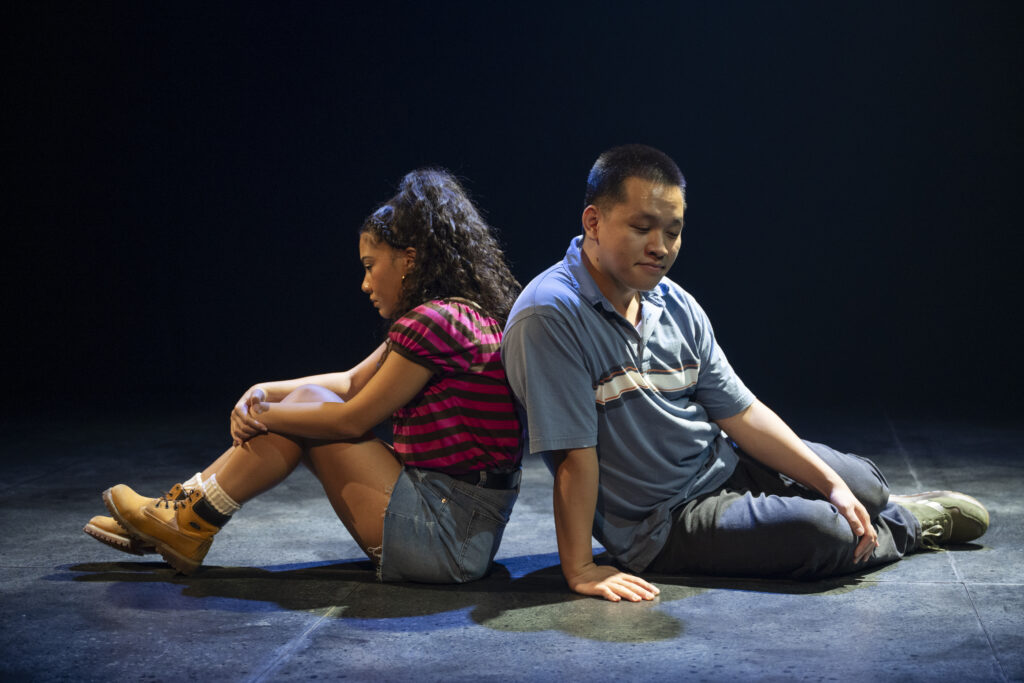
The issue? G is beaten by her step father and her mother is unable to do anything about it because they are undocumented. So B allows her to shelter in his home. B is conflicted because his mother is determined to return to their country of origin but leave B to his new life in America. G supports his efforts to stay and succeed. And this series is repeated and repeated until surprisingly, G’s mother achieves citizenship and G does as well as a minor, and then leaves her husband, and B’s mother actually does return home leaving him to fend for himself.
They both finish high school, but the original dynamic has been shattered. And G proposes to use her new found citizen status to protect B by getting married. And we encounter a wholly new repeated dialogue as G and B rehearse their responses to imagined immigration questions…and then the world changes again as G goes off to Boston on a college scholarship and B becomes a bartender in their home town. And although they keep in touch by phone their world changes…
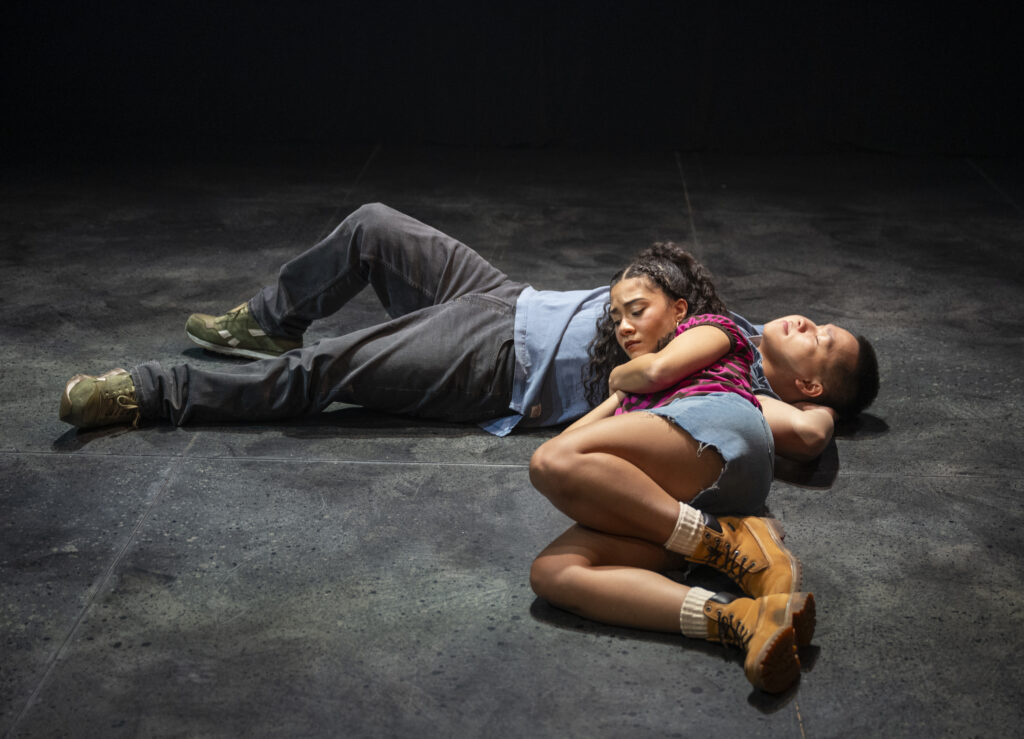
Ovieda is a force to be reckoned with…presenting a G angry over her mistreatment but able to focus on how to move forward instead of languish in despair. And her G is also sharp witted and quick to take advantage of situations and events that come her way. Hang presents a very resilient B although he isn’t aware of it. So he often exhibits his stress through layers of doubt and indecision.
After intermission, we find that B is still in what had been the family apartment and G shows up but they haven’t seen each other for over three years. I won’t provide any spoilers if I can help it, but we now have a third character, Henry, played as a very confident and maybe a bit smug law student by Joe Lino. He is a catalyst in the final scenes of the play. And no, the play doesn’t end well for any of the characters, but probably not in the way you are picturing. You need to experience it…and feel the carpets pulled out from under while sitting in the audience. And there are questions about what love is and who loves and how much, that are never quite answered. There is a whole lot packed into this little play.

Kudos to Hang, Oviedo, director Jake Penner, and the production staff for the subtle but effective aging of B and G as they leave for intermission as teens and return for the climax as 20 somethings. It is an incredible transformation.
Now a note on why our characters are G and B. Playwright Martyna Majok has left the casting in Sanctuary City rather open ended. In her script she notes G is female and B is male and they are both 17 to 21 (depending on the scene, my note). And “The countries of origin can suit the actors chosen. These characters have grown up within working class multicultural America.” As a result, no country is ever mentioned, only discussion on ‘going back’.
A final word from G: “I’m from here.”
Extra Credit Reading: The Audience Guide and the Playbill!
SANCTUARY CITY contains strong language, descriptions of emotional abuse and domestic violence and themes related to deportation and family separation. The play also includes moments of heightened emotional intensity.
Sanctuary City runs from now through October 5, 2025 and runs one hour and 30 minutes without intermission. Additional information and tickets here!