Wisconsin Premiere of Ayad Akhtar’s McNeal. A.I.A.I. Oh.

Ayad Akhtar’s McNeal is ostensibly about artificial intelligence. But I am here to suggest it was written with artificial intelligence. There are a number of intimations and subtexts that might suggest so. Some of them apparent by the queries fed into an AI app as displayed across the top of the set and the replies then received. All very realistic and wholly believable for the current state of AI.

The Cast of McNeal. Photo by Michael Brosilow. Photo courtesy of the Milwaukee Rep.

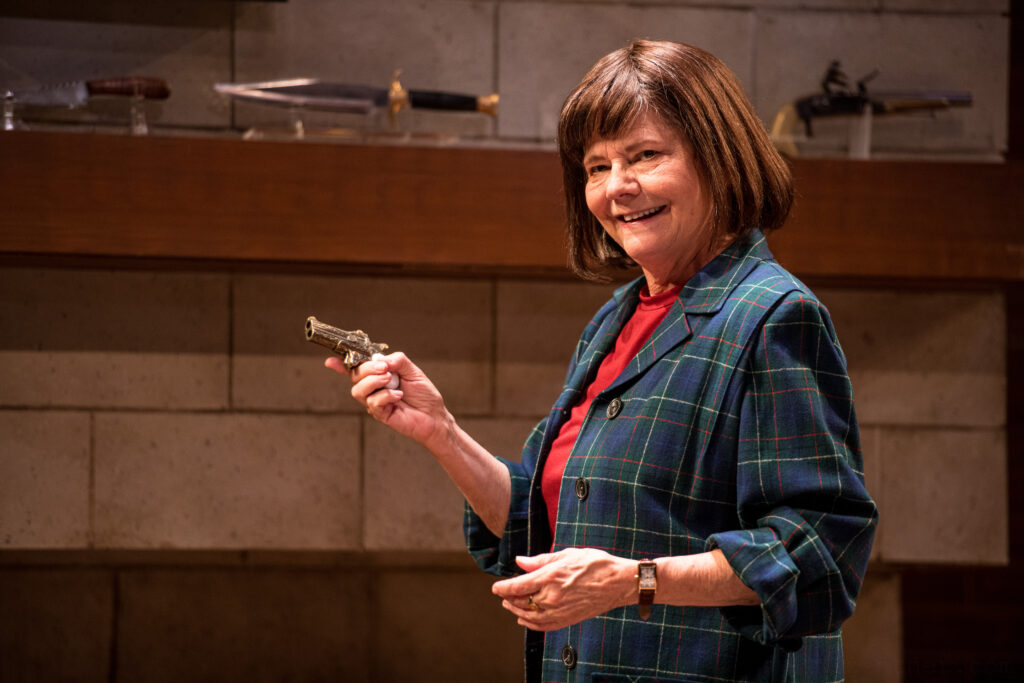
We know that Jacob McNeal’s latest novel is written by AI. He admits as much after telling his agent that it only took two days to write. And we know it is true since we saw his prompts along the top of the set and the volumes and volumes of output that he received back. What is the novel about? Well I have a guess and I suggest that Akhtar fed it back into his AI app and got the play McNeal out of it. SPOILER ALERT: A sad, twisted, retelling of Hedda Gabler with the genders re-assigned and relationships altered…but there are tell tale signs (well other than the queries into AI which are blatantly displayed), like the ‘missing’ and burned manuscript, the wish to ‘recreate’ it from scratch, and finally when a major female character eats her pistol after waving it around at McNeal, all in a hallucination, yet.

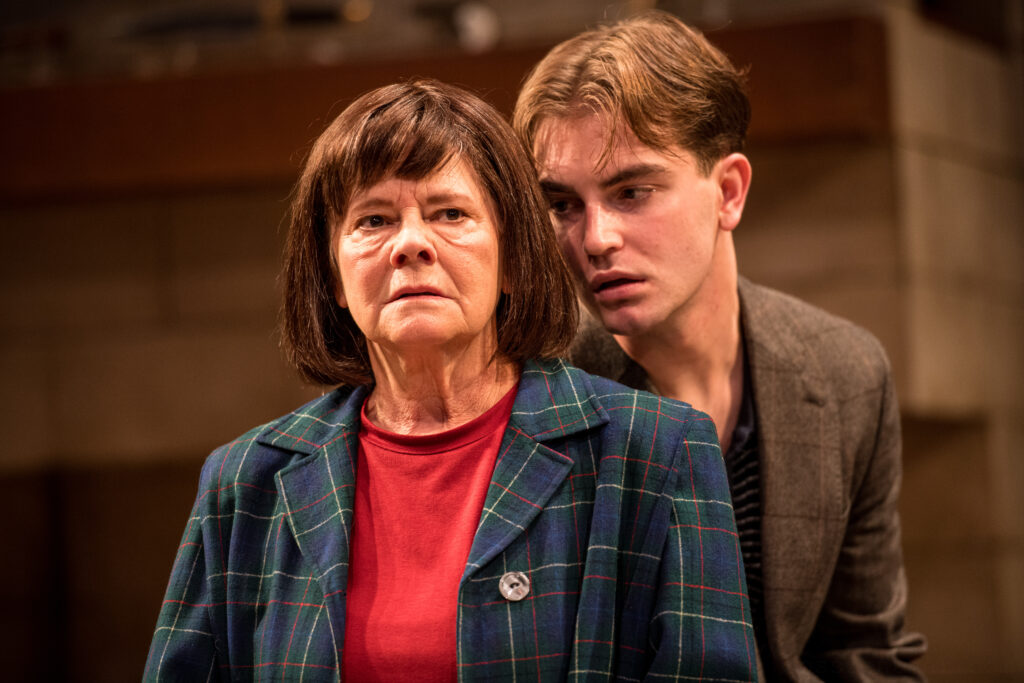
Jeanne Paulsen, Peter Bradbury. Photo by Michael Brosilow. Photo courtesy of the Milwaukee Rep.

And this feels like a one character play…yes I know there are six other characters…but the focus is so intensely on McNeal and his feelings and actions are so focused on McNeal that all other characters seem to fade away (which is also much like Hedda Gabler). And given the computer based nature of our discourse, where computers work via the manipulations of ones and zeroes, lets just say that Jacob McNeal is a ONE and everyone else is a ZERO.

There is something else here that speaks to today. We first meet McNeal as he is using AI to determine his place in the pecking order for winning a Nobel Prize in Literature. Not getting the responses he wants, he keeps editing his prompts until they give him what he is looking for. It is clearly an obsession. Unlike that other guy you are thinking about, McNeal eventually wins. And that starts a whole new set of experiences for the audience as director Mark Clements and his production staff cosplay with AI and project McNeal into a reward ceremony and later morph his face into Ronald Regan and Barry Goldwater and back. Certainly very equivalent to videos we often see on social media and maybe a little reminiscent of certain Forrest Gump experiences some thirty years ago?

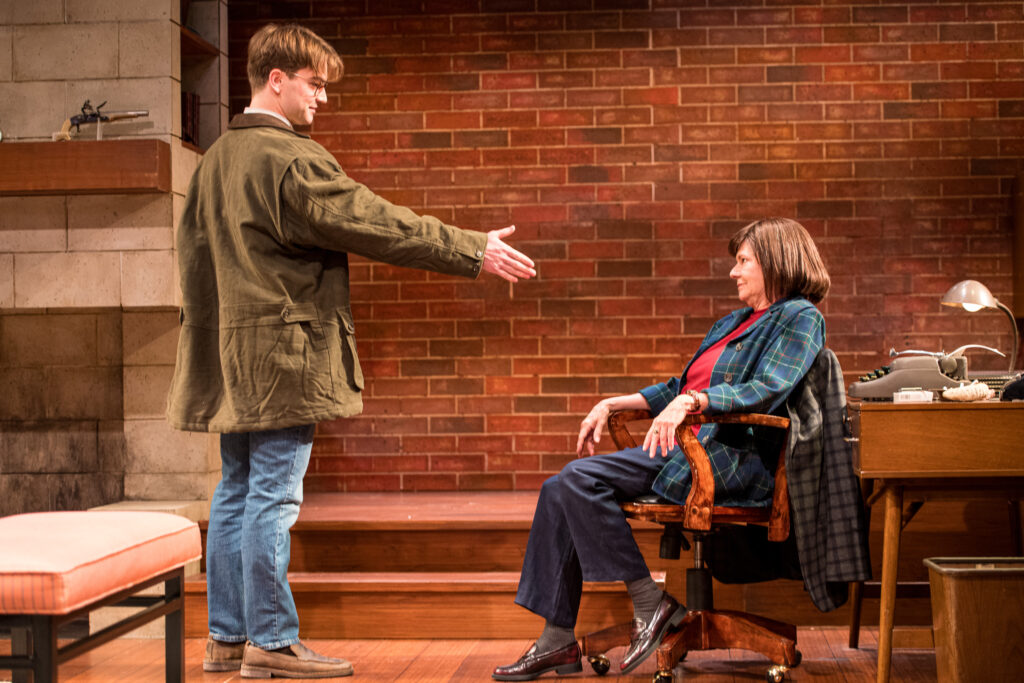
N’Jameh Camara, Peter Bradbury. Photo by Michael Brosilow. Photo courtesy of the Milwaukee Rep.

But yes, the play revolves around the myriad questions we all hold about AI. So plagiarism, influences, truth, disclosure, what is art, what is an artist, and what is art making. However, you will not find any answers here.

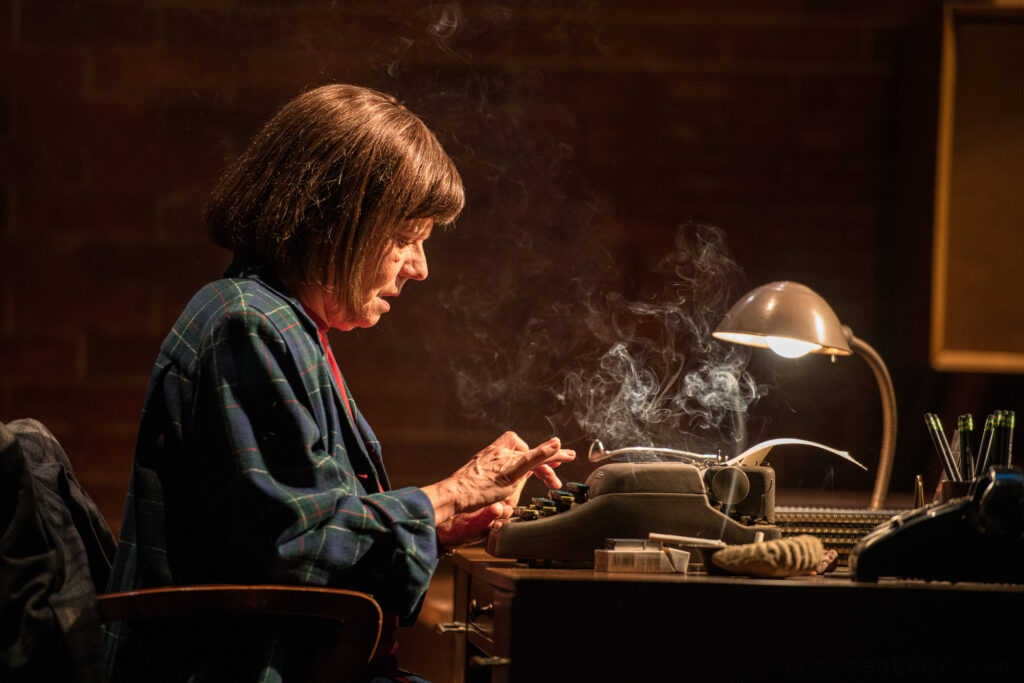
Interestingly, Akhtar delineates McNeal with the stereotypes we have accumulated around male novelists: moody, depressive, brilliant, reclusive, grouchy, compulsive, anti-social, misogynistic, suicidal, and alcoholic. Chekhov is rolling over in is grave. Amazingly Peter Bradbury takes that all in stride and makes it too very real on stage. From orator to falling down drunk to troubled spouse and parent, Bradbury is wholly believable and makes us feel McNeal. I am not sure if we have any empathy for him or not…I don’t think that I can find that in me…but I know Bradbury’s McNeal is real. I know it!

Peter Bradbury. Photo by Michael Brosilow. Photo courtesy of the Milwaukee Rep.

Jeanne Paulsen plays McNeal’s agent Stephie Banic, as an appealing tough cookie who takes care of her client professionally but has a soft spot as well that Paulsen shows the audience in her questions and care of McNeal…but something, I think, McNeal remains unaware of even when he’s doing something she urged him to do and he stoutly refused to do initially (I assure you that this run on sentence wasn’t written my AI). She’s impressed with the Nobel but more interested in the commercial opportunities it may provide. Paulsen stays cool under fire. The other character who provides some push back is Natasha Brathwaite, played by N’Jameh Camara. Camara comes on like the NY Times special feature reporter she portrays here, but she softens as her interview with McNeal continues even admitting she liked his books more than she expected. Camara knows when to be direct and knows when to shift to coy in playing Brathwaite. Bridget Ann White is feisty and intense as Francine Blake but this part isn’t big enough to showcase her whole talent. Hopefully we will see her here on a Rep stage again!

Sara Sadjadi, Peter Bradbury, Jeanne Paulsen. Photo by Michael Brosilow. Photo courtesy of the Milwaukee Rep.

McNeal is more than just a play premiere. It also celebrates the grand opening of the Herro-Franke Studio Theater. It replaces the Stiemke Studio Theater. And it is a major improvement…better seating (comfy!)…better and additional restrooms…and a real bar and better traffic flow through the lobby. And for this very first show, the seating bowl is shaped in a L-shape with the stage occupying one corner of the studio. And for McNeal the gnomes and elves in the Rep shops have created a rotating stage that facilitates the change in scenes and moods and environments. And they are breaking the third and fourth wall. I don’t want to leave out the lighting and sound crew who project and highlight the action but project scenic backgrounds with our change of locales…some of it AI generated since I recognized some buildings but they didn’t seem to be where they actually reside…and city noises in city scenes and rustic noises in rural ones. Sounds easy to miss given the concentration required to fully appreciate the story…but marvelous attention to detail.

and finally, to paraphrase Akhtar’s AI conjured ‘Prospero’ in his closing soliloquy: “Is it real or is it not real?” Well, I can’t tell you.

McNeal continues from now until March 22nd, 2026 at he Herro-Franke Studio Theater in the Associated Theater Center. More information and Tickets Here!

Running Time: Approximately 1 hour and 45 minutes with no intermission.
Recommended Age: 16 and up

Extra Credit Reading: The Program

Peter Bradbury. Photo by Michael Brosilow. Photo courtesy of the Milwaukee Rep.

Waukesha Civic Theatre Presents Sense And Sensibility

This was my first visit to Waukesha Civic Theatre. And, no, they are not a new theater, they’ve been providing quality theater in Waukesha since 1957. And it was something of a homecoming for me since I grew up in Pewaukee in the 1950s and 1960s because WCT is located in the Pix movie theater on Main Street in downtown Waukesha. So I saw a few pictures there as a child and later in my teen age dating years. That little bit of coincidence added a little warm feeling for a brisk February afternoon.

So, what is my first encounter with WCT? Kate Hamill’s unique adaptation of Jane Austen’s Sense and Sensibility. It isn’t the drama that you might expect but: Is it a Comedy of Errors? A Comedy of Manners? A Comedy of 18th Century Society? Or all of the above? I vote for that latter. And yes it is a comedy here, but not the laugh out loud comedy we often experience in our contemporary era. No, this is on the lighter side…the kind of humor that makes you peek at your neighbor what was that? Or roll your eyes in a dramatic, I get it, fashion. Or maybe a titter behind the palm of your hand quickly raised to your face. But it is still a serious play and stays true to the events in Austen’s original novel. But sometimes the acting is just a wee bit exaggerated and over the top…much to the audience’s and my delight.

Oh, Henry Dashwood, how little we knew ye. Henry Dashwood dies within the first few minutes of the play. And his passing is the very pivot point that launches all of the stories and sub stories that co-directors Ashley Levells-Riemer and Patrice L Hood are about to tell in a fast moving series of vignettes, black outs, and quick set changes. Henry left behind a wife, three daughters, and an adult son from a previous marriage. And because of the vagaries of 18th Century law, only the son could inherit Henry’s estate. So his son John, promises to support his step-mother and half-sisters from his inheritance. So we are off!

John Dashwood is played by Mark Thompson who establishes John as an earnest and resolute man determined to respect his fathers wishes. Unfortunately he has married into wealth. Thompson’s John is obviously enamored of his wife, Fanny, but is clearly in fear of her as well. But Amy Wickland’s Fanny is clearly a shrew and a manipulator and has John wrapped around her finger. And after John proposes a fair financial support for the four women, Fanny coyly and coldly and openly, negotiates the terms down to just paying for their moving fees as they are evicted from their home. Fortunately they are able to move to a cottage on the estate of another relative and are also invited to ‘visit’ a number of other notables and relatives.

Mrs Jennings (Bre Brennan) sharing gossip with Elinor (Del Lovejoy, left) and Marianne
(Amelie Davis-Quiroz). Photo by Anne Kenny Creative

I am not going to go into too many details of the story. All of you Austen fans know this one by heart and for the rest of us, let’s not spoil the surprise. But you will certainly glean any number of details as I outline some of the characters in the play and the characters who play them.

Mack Bates certainly has a presence on stage as he plays Sir John Middleton with a certain sense of pomp and a certain sense of dignity, all supported by an awe inspiring sense of whimsy underneath. Such fun and Bates is obviously an audience favorite. And our youngest Miss Dashwood is played by Makayla Lloyd. Lloyd provides a saucy teenager who is curious, bored, overwrought, or just plain done with the goings on of the adults…just like you’d expect a teenager to behave. Angie Rodenkirch’s Mrs. Dashwood is a common sense go with the flow mother who just wants stability and the best for her daughters.

Sisters Elinor (Del Lovejoy) and Marianne (Amelie Davis-Quiroz) share a moment. Photo by Anne Kenny Creative

And the other two Miss Dashwood? Elinor is the eldest and she is played by Del Lovejoy. Lovejoy portrays a deep thinking rather stoic and quietly conservative young adult. Despite not having much more real world experience than many of the other young people, she seems to invite confidentialities and questions of advice. At times she is in deep pain but no one but Elinor knows it and Lovejoy maybe signals that a bit in her manner but never in her voice. And of course Marianne, the middle Dashwood. Attractive, outgoing, and interested in novels and theater, Amelie Davis-Quiroz plays her to a tee. Davis-Quiroz catches all of the excitement and all of the anguish involved in Marianne’s character as she is the magnet that draws in all of the eligible men.

Marianne (Amelie Davis-Quiroz) is charmed by Willoughby (Noah Merz) as her sisters
Elinor (Del Lovejoy) and Margaret (Makayla Lloyd) observe. Photo by Anne Kenny Creative

And the suitors? Colonel Brandon is an older man…probably a bit out of the ordinary for what most would consider an appropriate suitor for Marianne. Stefan Kent’s Brandon is a seasoned military man who is kind and never overbearing. He sees what needs to be done and takes care of it without asking. Kent’s portrayal brings a real person to life, unlike many of the other characters who are a bit ‘over the top’ (and I do mean that in a delightful way). And Willoughby: he finds Marianne with a sprained ankle and carries her home and soon carries her heart. Noah Merz gives us a very worldly Willoughby but also exhibits his rather foppish demeanor. That very practiced doffing and donning of his top hat eliciting any number of titters and snickers from the audience. And Edward Ferrars is our last gentleman, played by Tyler Glor. Ferrars is a nervous nelly and shivers when reading aloud and often stutters when speaking. Glor’s management of these social stigmas is wondrous and explicit and again elicits responses from the audience. He plays them to the hilt. His early scenes are reading with Marianne so I was slow catching on that there was a growing connection between Ferrars and Elinor.

Caitlyn Nettesheim and Laura Kloser as the Steele sisters. Photo by Anne Kenny Creative

One other pair of characters help push Sense and Sensibility from a drama to a comedy…and they are the Steele Sisters, Anne and Lucy. Laura Kloser is Anne and Caitlyn Nettesheim is Lucy. They play well together. The sisters are silly, loud, and often obnoxious…ne’er do wells?? Well at least on the surface but they are a noisy counterpoint to much of the more ‘serious’ characters we’ve encountered. But Kloser and Nettesheim catch their sly and devious sides too when they don’t have a larger audience.

And there is a happy ending.

Edward Ferrars (Tyler Glor) and Elinor Dashwood (Del Lovejoy). Photo by Anne Kenny Creative

My guesstimation is the play runs about two hours plus a fifteen minute intermission.

Sense and Sensibility runs from now through February 22nd, 2026 at the Margaret Brate Bryant Civic Theatre, 264 West Main Street in downtown Waukesha.

More information tickets can be found here.

Extra credit reading: The Playbill!

UWM’s Peck School of the Arts: Winterdances 2026: Resilience

It’s that wonderful time of the year…a week or so after Groundhog’s Day and just a few days into the Spring semester…UWM’s Winterdances. I always find this to be a cheerer upper in the gloomy days of February. And the 2026 version, named Resilience, didn’t disappoint. We were graced with four world premiere dances, each unique and extremely expressive, and absolutely engaging.

The first dance would be an exhilarating start to any dance program. Be My Ground, When The World Lets Go was choreographed by Peck School of the Arts Associate Professor Mair Culbreth in movement collaboration with the cast. Opening with an ensemble front stage dancing in a great bit of fluidity…we slowly become aware of four more dancers hanging against the back wall from harnesses and cable who begin to move up, down, or across the wall, only to eventually join their colleagues on the floor. Fluidity! This piece is all about that…as individual dancers, or pairs of dancers, or small groups spin off or leap across the stage in very natural yet hyperactive motions that just simply personify fluidity. But then everything gets crazy fun and each dancer takes a turn locking into a rope and harness and takes a turn defining space and distance on their own terms…sometimes solo and other times in unison with another dancer. You may be excused if you sense chaos here because no one dancer or core group is center focus anymore and it is hard to decide where to look and whom to watch…but it looked like such fun! And the sense of confusion was enhanced by the selection of different pieces of music providing a variety of sensual moods and feeling. From her notes, Culbreth stated: “This work began with a kinesthetic investigation of vertigo—as both a bodily sensation and a condition of ambivalence.” Her cast certainly took on that investigation in full.

Next dance, Ghana Must Go, is a very different experience…more sober…but also an example of fluidity, but more human and less mother nature perhaps. Assistant Professor Ishmael Konney is the choreographer on Ghana Must Go in collaboration with the performers. Based on the 1983 expulsion of Ghanians from Nigeria, this is a very telling human story. We first encounter a troupe of eight dancers moving in unison carrying bundles on their heads. At first just seemingly marching together, each dancer eventually breaks out for a moment and performs a short solo performance before reentering the group. The music is beautiful and rhythmic allowing the dancers to keep in time with each other while still moving away to express their individual personas. And as the dance progresses there is some signs of distress and sadness for certain, but the group comes together as a community…certainly an expression of resilience.

And after intermission, we were instantly called to pay full attention, as PSOA faculty member, Dawn Springer’s Harps That Once, bursts out as loud and fast and athletic. Many opening moves involve running break neck across the stage and later the group is running place…this all certainly exhibits references to athleticism. And then it evolves into an organic matrix of arms stretching skyward and legs kicking toward the horizon, and then falling back in graceful arcs to perpendicular, while the dancers spin and swirl and form and reform like a flock of birds. Using a vast variety of music for the settings, things change, break down, and again take on different moods and feelings. There is also a bit of chaos here, but a sense of structure too…and resilience!

And the finale, Care, conceived by visiting choreographer David Roussève, was also choreographed by Roussève in collaboration with the performers including guest performers Richard ‘Buda’ Brasfield, Jacques Infiniti-Hall (Mizrahi), and DaCosta Martin. Care is a homage to Ballroom House dancing and the LGBTQIA+ community that developed it over the years and celebrates it today. In Care, we first experience a Debutante Ball, chaperoned by a very vigilant chaperone, PSOA Artistic Director, Maria Gillespie. With a keen eye and harsh whistle Gillespie keeps the dancers moving and separated at the ‘appropriate’ distance. UNTIL, Buda, Mizrahi, and Martin show up expecting a Ballroom House ball. “What kind of a ball is this?”, they ask. “A debutante ball”, Gillespie replies. And? “Not anymore it isn’t!”, is their reply. And the music shifts and our three guests start to vogue, making their own presence in turn, and starting to attract the younger dancers. Gillespie tries to maintain decorum and control and keep some of her charges in line but it is a losing battle. One by one the debutante ball participants move over to the voguing trio and urge them to continue and to show them how to do it. The dance continues as each guest teaches and encourages the new devotees on the dance floor and a whole new energy comes to life right there on stage. The victory is complete when Gillespie is gifted with a bright red pair of elbow high satin gloves and they are quickly put on and showcased. There was no end to the flash, glamour, and exuberance during Care, until it did finally come to an end. Care received the biggest applause and cheering of the evening…obviously a big hit with the mostly student audience.

There were a number of stand out performers over the evening, but I don’t know their names so I can’t go on in detail. But as I said in my opening, Winterdances 2026, is still the highlight art event at UWM’s Peck School of the Arts in the spring semester.

Extra Credit Reading: The Playbill with bios, choreographer notes, and complete music listings

Editors Note 2/12/2026. While listening to WUWM this morning, they said that they had some photos from this version of Winterdances…but in my search I only found a few for Care…so I stole two of them an inserted them here!