“Charming and Clever” : Anton Chekhov
So what have we here? Before he became a famous playwright, Anton Chekhov wrote a great many short stories and studied to become a doctor. And Neil Simon has taken a number of these short stories and adapted them to the stage. I imagine this new play is named The Good Doctor because Chekhov did in fact become a doctor and practiced medicine while he wrote his great plays.

And it makes a certain amount of sense that Simon would turn Chekhov into comedies because Chekhov himself fought with very serious directors to have them put more emphasis on the comedy in his writing…not often successfully. So who does win here in a Chekhov vs. Simon face off? Well it depends on which end of the absurd spectrum you enjoy more. I mean that sincerely. Certainly these stories are very much Chekhov and beyond the unpronounceable Russian names they focus on every day life, obsessions with trifles, dramatic but boring interludes, and surprisingly discouraging ends for the characters. Simon, it seems, stays true to those events, but certainly pulls out a modern comedic sensibility running almost to the silly at times and adds a fair amount of slapstick to the goings on. But too, Simon has added an alternate ending at times.

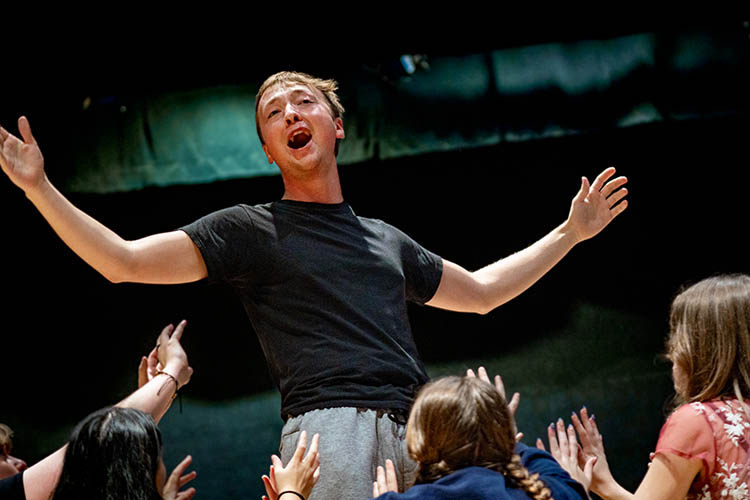
This is not an episodic play but a number of vignettes from the Chekhov stories only tied together by the writer, who looks remarkably like a young Anton Chekhov and played distinctively by Owen Foulds. We first meet the writer at his desk working and Foulds gives us a lively version of the writer providing a spontaneous tour of his home. We are also introduced to a motif that recurs throughout the play as the writer is accompanied by the ensemble representing a group of his characters. They play a bit like a Greek chorus enhancing the mood and pace of the scene while Folds addresses the audience. Foulds also easily transitions to a writer hard at work to later one with a serious case of writers block to finally a very busy and forward writer auditioning an actress for his new play. Foulds presence on stage in The Good Doctor is certainly a very dynamic focal point and keeps the whole endeavor on story.
Yes, Chekhov is often high drama and tragedy but yes, he did open the door to farce and Simon walked right in without announcing himself. Some highlights: ‘The Sneeze’ where a bureaucrat becomes a desperate obsessed individual after sneezing on his superior…from the program notes I am guessing this over the top performance was from Maverick Johnstone (if my attribution is incorrect, please let me know). But his attempts to apologize and apologize and apologize become the death of him. And it is Maverick Johnstone again in ‘The Seduction’ as a confident confidence man whose pleasure is found in the seduction of married women. Johnstone conducts a Ted Talk during this act and implores the men in attendance to take notes. It all goes swell until the shoe is on the other foot. And ‘The Surgery’ where Hector Esteban Rivera-Rodriquez plays an overly confident intern intent on removing an infected tooth belonging to a cleric played by Jozzlin Biddl. This is one of the major slapstick sessions as the intern and the cleric resist working together to remove the tooth and ease the pain. Both actors know good physical comedy. And one last one that I need to mention and it too involves some slapstick physical comedy along with a bit of psychological warfare if you will. Johannah Wiggins as a very desperate woman, despite having no claim against a bank, simply browbeats the bankers played by Maxwell Dane Coffrin and Brillan Gugel into giving her what she wants. Wiggins simply lurches from one silly demand to absurd another ignoring any facts or sense of decorum…Wiggins is a force of nature here.
And one last episode needs to be addressed…but it isn’t a farcical bit and may not even have Chekhovian roots. ‘Too Late for Happiness’ is a bit of a respite for the audience to take a breather…it is a musical piece with two characters, a older man played by Brillan Gugel and an older woman played by Mariah Kiefer. They apparently have often seen each other in a park but remained strangers until Gugel’s character approaches and suggests they share some tea. Both actors easily express doubt tinged with longing and sing an amazingly romantic and touching song.
One last actor needs to be mentioned. Appearing center stage in almost every scene or at least observing the actions off to the side, the desk plays itself.
This is a production of the Department of Theatre in the Peck School of the Arts at the University of Wisconsin-Milwaukee. Director Karen Estrada, who is a lecturer at UWM, has done an incredible job of pulling together a very disparate group of student actors and has fully staged a professional presentation from a difficult script.
Wait ! Stop ! There is an alternate ending, you may inherit two million rubles.
The Good Doctor continues from now until March 15, 2026 at UWM’s main stage theater in the Fines Arts building just north of Kenwood Blvd and East of Mitchell Hall. Tickets and more info here.
Extra credit reading: Play Bill