The Good Ship H.M.S. Pinafore Has Docked At UW – Milwaukee!

I have never seen a Gilbert and Sullivan operetta and I think that is still true. But I do remember way back in the late 1950s and early 1960s, show casts appearing on variety shows and doing a number or two. Or comedy variety shows exaggerating the pomp and circumstance and having a bit of fun. And of course serious or comic, they always performed a portion of “When I Was A Lad” and drove deeply into our memories: “He polished up that handle so carefullee, That now he is the ruler of the Queen’s Navee!”

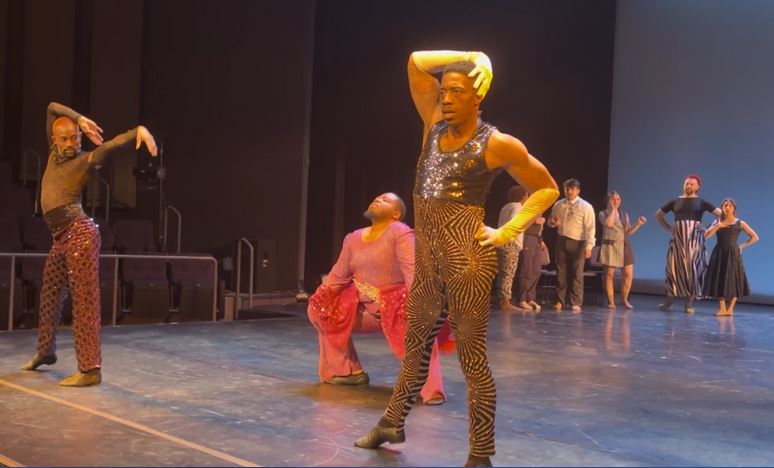
UWM’s Mainstage Theater’s thrust stage is the ideal venue for Pinafore, and scenic specialist Christopher Kurtz has made the most of every square inch. What an amazing deign of ship’s rigging, from fo’c’sle, to poop deck, to bridge, strewn cargo crates, coiled rope, and such give us the impression of a 19th Century British Royal Navy frigate. And there is plenty of room throughout of lively dance and chorus numbers plus the varieties of songs and interactions between the lead characters.

And very carefully nestled just to the rear of the main deck is the quartet of musicians who are supporting the cast. Here we have a string bass, accordion, a guitar, and a woodwind switching time between a clarinet and a horn pipe. What a marvelous nautical H.M.S. Pinafore musical touch is the horn pipe. Over the course of the play other cast members add a second clarinet and a violin…plus a supportive ukulele for/by Little Buttercup and a mournful English horn for/by Capt. Corcoran. And a bell choir!

But this isn’t just any presentation of Pinafore…instead a modern local adaptation created by Co-directors Jill Anna Ponasik, Milwaukee Opera Theatre Artistic Director, and Jeffrey Mosser, UWM Lecturer, in collaboration with the student cast and crew. A very popular and successful way to make contemporary theater. But what does this mean? From the background info from UWM’s website:

Originally set in the late 1870s, H.M.S. Pinafore explores timeless themes of love, status, and class. This new version reimagines the story in 2025 and relocates the action to Milwaukee, allowing the cast to connect the work directly to their own community. 

“For me, the most exciting, delightful aspect of this adaptation is working on a team that includes Jeff Mosser, Dana Rochester, James Zager, and 17 UWM students to devise this together,” Ponasik said. “The collaborative spirit of the project is what gets me out of bed in the morning.” 

That collaborative spirit extends directly to the student cast. As young adults living in the 21st century, their perspectives helped ground the adaptation in the realities of today. 

“We were asking for their collaboration throughout the entire process,” explained Mosser. “This play wouldn’t have been the same without the collaboration of the actors and their contributions to the play itself”. 

On stage that means we get date checked when the cast mentions that it is 2025! And then we do get local identifications with mentions of the Packers, Kopps, Door County, and other local contemporary landmarks. One crew member wants to retire to Door County and have goats on the roof. All the more amusing given we are hearing these words from an antique sailing vessel.

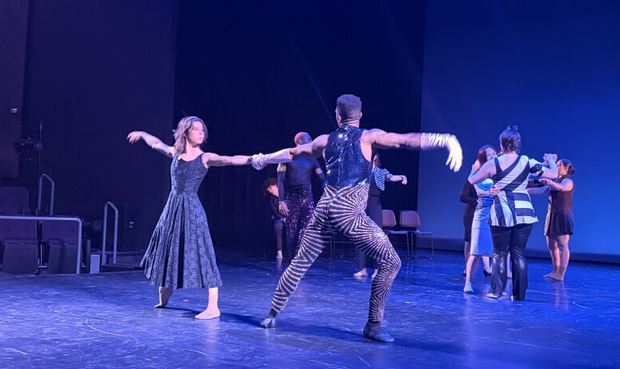
One of the key ‘characters’ is the ensemble. but which I am going to call the chorus…since they play a role very akin to the Greek chorus. At times being of one mind and voice, at others advancing the story, and others supporting the leads or opposing the leads depending on the which way the wind is blowing. And this is a marvelous chorus of full throated voices in boisterous and wondrous song. All the while moving about stage in some pretty intricate choreography interacting with each other or a variety of props. Wonderful visuals here. But the highlight is the adult sized and adult entangled cat’s cradle that they weave to start the second act…until it just devolves into a web! So Kudos to choreographer James Zager.

But we mustn’t forget that this is essentially a love story. As classic a love story as you could expect. So let’s get on with it.

Austin Franz is Captain Corcoran, the captain of the Pinafore. He is a calm and solid captain, empathetic with his crew and the doting father of daughter, Josephine. He thinks he has a match made in the admiralty when Sir Joseph Porter proposes to Josephine. But as you could guess Josephine is in love with another. Franz stands tall and sings with a full rich voice that is perfect for Corcoran.

Josephine is played by Serena Vasquez. And she’s perfect in this demanding role as she moves from weeping over her fate to acquiescing to marrying Porter for love of her father, to deciding to elope with the sailor of her dreams. Vasquez dwells in this role and even when not the focus of a scene, she remains in character and is just a pleasure to watch. She also puts the opera in operetta here (I originally typed hear, but that might work too) with a clear ringing voice that fills the room. I think that we will see her on professional Milwaukee stages after she completes her studies at UWM.

And who is Sir Joseph Porter? Well he is the “the ruler of the Queen’s Navee!” So you might expect him to be a pompous self-important ass. Well as Nathaniel Contreras plays him he certainly is self important but he is more buffoon, depicted as a stumbling character in loud clothing, Contreras presents the precise comic relief that the story demands. One delightful Porter shortcoming is his inability to remember Captain Corcoran’s name, calling him Capt. Carrot, Capt. Canary, and such until the final Capt. Crunch which got a big laugh. And a very appropriate sobriquet given that Captains Corcoran and Crunch, the cold cereal pitchman, wear the same style hat.

Oh, I haven’t forgotten Josephine’s love interest. He is Ralph Rackstraw, an ‘able seaman’, ably played by Josh Thone. A very agile young adult, Thone easily moves across stage in and out of the chorus and moves from emotion to emotion without effort. Part of his appeal here is he has one of the most expressive faces that I have seen on a Milwaukee stage this year.

And one last quick mention, is Ryder Ruck, a loose limbed dancer portraying Dick Deadeye. Some of Ruck’s dance moves incorporated Irish dance, the jigs often used in depictions of English sailors, and of course, a bit of modern dance. Ruck is also listed as assistant choreographer so should share in the praise for the overall choreography here.

Josh Thone being lifted by his costars during H.M.S. Pinafore rehearsal | Photo by Cameron Wise ’25 (BFA Film)

But how does it end? Most like a Shakespearean comedy as secrets are revealed, mistaken identities come to light, and love triumphs.

And one small quibble. Once again, despite being miked, some of the actors were hard to hear. Partly a technical issue but also from often speaking too quickly.

Extra Credit Reading: The Playbill and the announcement on the UWM site.

This is a short short run and ends Sunday October 12 but ticket info is here but tickets are generally available at the box office at show time.

H.M.S. Pinafore is being presented on UWM’s mainstage theater in the Fine Arts Building just off Kenwood Boulevard behind Mellencamp Hall.

UWM’s Peck School of the Arts: The Curious Incident of the Dog in the Night-Time

The Curious Incident of the Dog in the Night-Time is an award winning play by Simon Stephens based on a novel of the same name by Mark Haddon. It is a multi-faceted theatrical gem.

Christopher is the protagonist here, a 15 year old math genius who is somewhere on the autism spectrum. And one night just before midnight, he discovers that his neighbors dog has been killed by being stabbed with a pitchfork. While surveying the incident and mourning the loss of the dog, he is discovered by the neighbor who, of course, immediately suspects him. Christopher decides to become a detective for the moment in investigate Wellington’s death (that’s the dog) and discover the person who murdered him. His father forbids it. But Christopher determines that it is the right thing to do and continues on his quest anyway. And the drama begins…

The deeper subjects of the play are readily apparent in the text and actions on stage. Of course there are the stories around family and neighborhood and village…but we go on to get a glimpse into how people with autism perceive the world around them…and how the world around them reacts to them…there are myriads of subtle cues. But Christopher steps completely outside his comfort zone and shows remarkable focus and bravery, a positive message for all of us.

We have two Christophers here. Zane Kurs for the first half and then Skylar Staebler post intermission. Both young actors personified the goals and struggles that Christopher exhibited in his quest. The only quibble I have here is Kurs speech was lost or indecipherable at times in his efforts to adopt an English accent.

Despite not being the focus of the play, for me, I see Christopher’s dad, Ed, as the most dynamic character in the play. Played by Gabe Rodriguez, Ed swings from doting father, to demanding father, to angry spouse, to a confused and desperate adult in the just that moment’s notice that the play requires.

One other actor that I’d like to single out is Autumn G. Gill as Siobhan. Siobahn is Christopher’s personal support staff and mentor at the special school he attends. Gill is remarkable in providing the stable support and empathetic help he needs to find his way.

Christopher’s mother, Judy, is lovingly played by Mikaela Bowers. We don’t get to meet her directly until late in the play, but Bowers brings out a loving and protective mother who despite her feelings doesn’t quite always know how to react to Christopher’s needs.

The Curious Incident of the Dog in the Night-Time has dozens of other characters who a played by an ensemble of remarkable young actors. Each one of them has to assume a number of roles (that is the way the script is written), from policeman, to principal, to a number of neighbors, to strangers on the street and train, to train station staff.

Director Ralph Janes is presenting this play in the round, using the Mainstage Theatre’s thrust for most of the action. In addition, a fair amount of technology is involved. Large screens are set up around the theater and behind the proscenium, as well as a half dozen monitors just about the stage. These were used to project scenic bits at times, like the train station that Christopher is looking for, and other times, video shots taken by ensemble actors with handheld cameras in the pit or the camera mounted to Christopher’s chest. I found these a bit confusing and distracting. If they were meant to signal the confusion that Christopher experiences outside his normal world, well maybe. But I think the action that Janes choreographed on stage with the cast was far more effective and deserved our full attention.

A better use of technology here might have been mics on the actors.

As I write this there are only two more performances….tonight at 7:30 and tomorrow, May 4, 2025 for a 2 PM matinee. The Curious Incident of the Dog in the Night-Time is being performed on the Mainstage Theatre in the Theatre Building at 2400 E Kenwood Blvd (just west of Mitchell Hall and North of Mellencamp Hall).

Ticket Information Here!

Extra Credit Reading: The Program is here.

The Wood Engravers’ Network’s Fifth Triennial exhibition at the University of Wisconsin – Milwaukee

Everyone who has spent any time enjoying the visual arts is familiar with woodcuts. They are often very warm and tactile and inviting prints traditionally printed in black ink but often done in color in the last hundred years or so. Woodcuts are made by carving away the parts of a wood block that the artist wants to show as white, the negative spaces in the image. And the carving is done with any number of different knives or gouges or chisels in the plank grain or long grain of the wood…the softer side. And then the ink is applied to the remaining raised surface, a sheet of paper is laid over the block, and the entire thing is run through a press to transfer the ink from block to paper.

But now the Emil H. Mathis gallery at UWM is featuring the Wood Engravers’ Network’s Fifth Triennial exhibition. So this is a real opportunity to delve into wood engravings which are similar but they are not the same as a woodcut. A wood engraving is carved in the end grain of a piece of wood, the cross cut side for those carpenters out there. And then that piece is finished to a very fine surface and tinted before the drawing is transferred to the block or in some cases actually drawn on the block. The tools used in engraving are far smaller, far sharper, and very fine compared to those used in woodcuts. That is required because of the harder surface in the end grain wood. But the advantage of these fine tools and the harder wood surface is a medium that exhibits far more detail and far more possibilities for tints, shading, and other subtleties. Once completed the block is printed a similar fashion to a woodcut but the prints will generally be smaller because the end grain pieces of wood are smaller to start with.

The Wood Engravers’ Network’s Fifth Triennial exhibition was juried by Max Yela, the Head of Special Collections at the Golda Meir Library at UWM. He has selected a marvelous collection of 60 engravers from an international array of artists. So subject matter and technique and genre run the gamut of the possibilities of wood engraving. Now let’s step into the 21st Century a bit and realize that the woods most sought after for engraving have become more scarce and far more expensive. So there are now a number of synthetic surfaces in use including corian for example, a product similar to corian counter tops. So you will see a few prints using these new materials as well.

So if you are not familiar with wood engravings or not quite sure how they differ from woodcuts, this is the perfect opportunity to explore the medium. And as an extra bonus Yela has also included a few books and engravings from UWM’s Special Collections as a counterpoint. This is a rare chance to see some of these items as well.

The show is free and open to the public but the gallery has limited hours: 10:30 AM to 2:30 PM, Monday through Thursday. The show continues through May 1, 2025. The Emil H Mathis gallery is located on the ground floor of Mitchell Hall, room 170, at 3203 N Downer Avenue, the north west corner of Downer Ave. and Kenwood Ave.

And now a few of my favorites…and an attempt to lure you into the gallery. I apologize for some of the funny angles, I was trying my best to reduce glare (and the reflection of my red overcoat):

Rebecca Gilbert, The Widow (self portrait), wood engraving and letterpress, image 2.5 x 3 inches
Christoper Register, Gingrich from the Scoundrel’s Series, Resingrave, 5 x 5 inches
Abigail Rorer, The Madonna Tree, relief engraving, 6 5/8 x 5 inches
James Todd, Masters of War, wood engraving, 12 x 16 inches
Blaze Cyan, A Complicated Life, wood engraving, 5.9 x 3.9 inches

And here’s two from the UWM Special Collections:

Lewis Carroll’s Alice’s Adventures in Wonderland, wood engravings by artist Barry Moser
The Works of Geoffrey Chaucer, a facsimile of William Morris’ 1896 Kelmscott Press printing.