Of course I knew that William Inge’s Picnic is a major milestone in American theater but that is all that I knew. I mean it has a Pulitzer. But I had never seen it performed, not even the movie, nor read it or studied it. So when APT announced they were featuring it this season, it was my go to play for the summer. I was more than ready for APT to provide that coming of age experience for me.
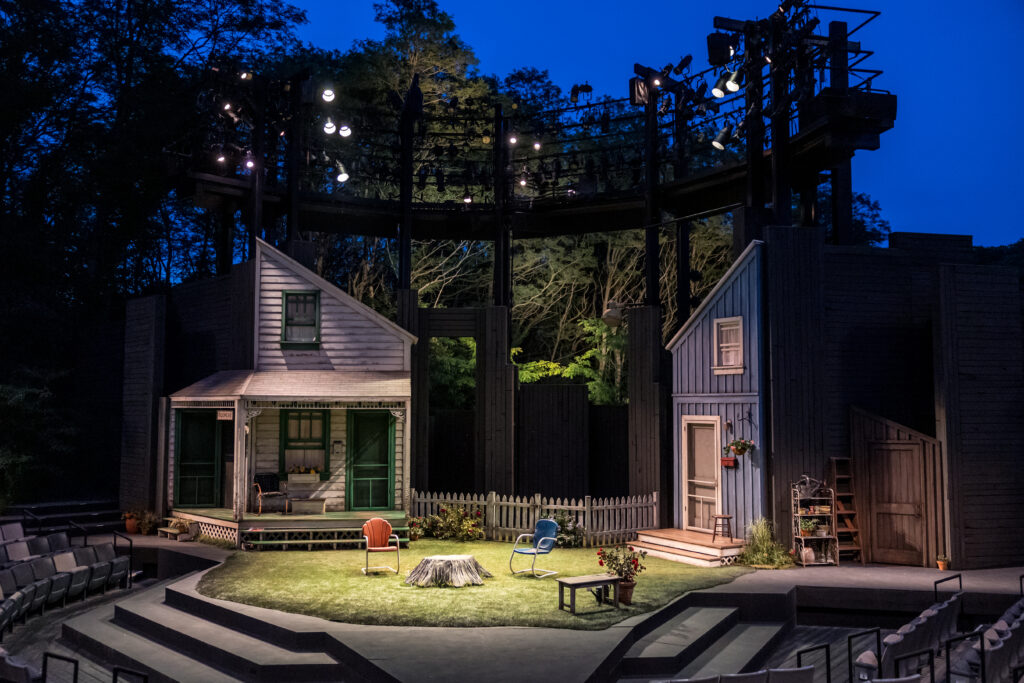
Before we get to the play, let’s talk about the first thing we encounter as we enter the seating bowl of the Hill Theatre. We see two modest homes, probably late 19th or early 20th Century middle American rural homes, modest, solid, and in need of a bit of TLC. They have adjacent yards where all of the visible action occurs the only fences separate the yards from the street because we have good neighbors! Scenic Designer Takeshi Kata has done an incredible job bringing to mind that era, that culture, that environment.
In her Director’s Notes, Brenda DeVita states: “William Inge, from Kansas, always felt to me like he was someone who lived in the town I grew up in in Iowa. It even felt as if we grew up at the same time, though he was born 50 years before me. I always wondered why. Maybe it’s because there are very few American playwrights who write about the Midwest – the small town, the “small people.” Regardless, he clearly understood the gifts that came along with this kind of life. But he never sugar-coated that life either—the abiding boredom of such places. The Midwest. The Flyover States. Iowa, Kansas, Nebraska, they were decidedly NOT Illinois, or even Minnesota or Wisconsin.”
Well, I beg your pardon Brenda. This all feels so so familiar to me as well. Well, not 2025 me, but 1958 me, when Pewaukee WISCONSIN was just a rural backwater and not the bedroom suburb that it is today. And I bet others from Wisconsin of my vintage or who have more recently grown up in similar rural areas will feel that sense of boredom and nostalgia endemic to Picnic, just as much as I did, before I even sat down.
Just a brief background…quickly. The houses belong to Mrs. Potts who lives alone with and is the caregiver for her elderly mother, who is never seen but sometimes heard. And the other is the home of Mrs. Owens and her two daughters Madge and Millie. She also takes in lodgers and her current resident is a ‘old maid’ school teacher Rosemary Sydney. The other characters are friends and neighbors, many of whom I will talk about.
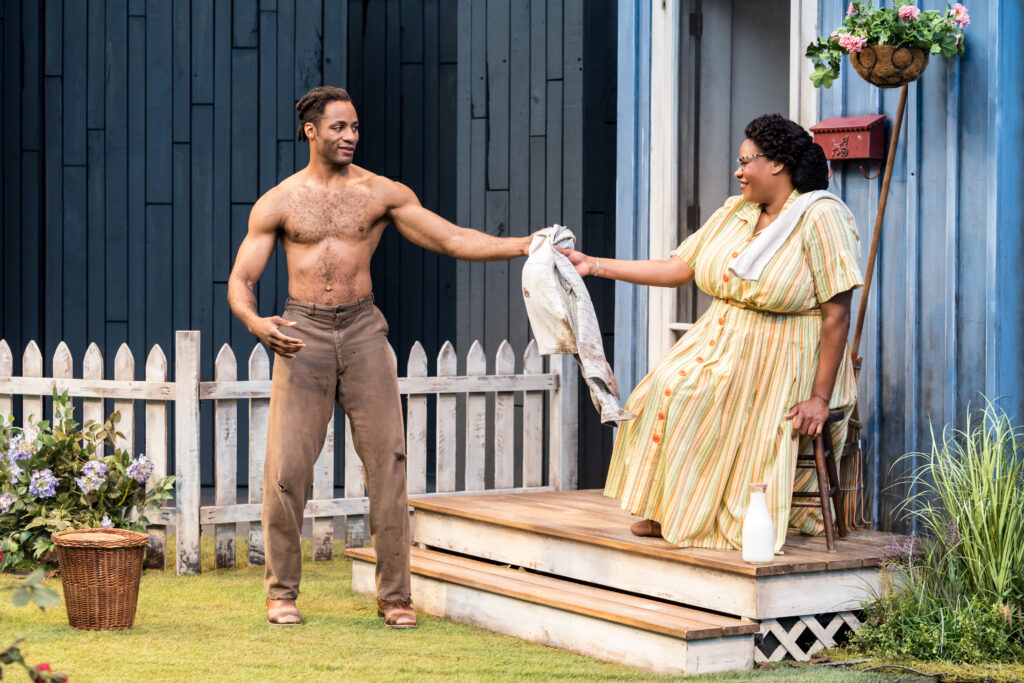
Let’s start with one of my favorites here, Dee Dee Batteast, as Helen Potts. At some point in the play Millie exclaims that if she gets to heaven she expects that everyone she meets there will be as nice as Mrs. Potts. And that is exactly the person that Batteast brings to life on stage. Despite getting some bad breaks in her own life, she is the life of the backyard in many ways and helps and supports her friends and neighbors as well as being the long suffering caregiver for her mother. But she does have one tendency that her neighbors question: she occasionally takes in ‘strays’. And that is exactly what she has done as the play opens, taking in Hal Carter, and exchanging breakfast for his help with some household chores. There is a fair amount of humor around Hal’s initial presence and introductions as he’s a right hunka man and is working without his shirt, attracting the female gaze from the entire female cast at this point. But little do any of us know that he is the catalyst that will change everyone’s destiny.
Hal is played by Rasell Holt who clearly has the physique bona fides for the role as he totes trash barrels or leaps the picket fence…but also is a glib talker, a bit of braggart, and more intelligent than the apparent vagabond they all take him for. His appearance isn’t totally random after all. It appears he was at college on a football scholarship until he flunked out and was frat brother to Alan Seymour, who he is hoping can help him find work…not just any work…some how he hopes Seymour can help him skip a few rungs. Holt knows what he’s about here. He certainly can strut under that female gaze and can morph into the glib talker at any time and change his story and persona as needed dependent on his audience. And Holt can turn on the charm as the ladies’ man which starts the changes across our little universe.
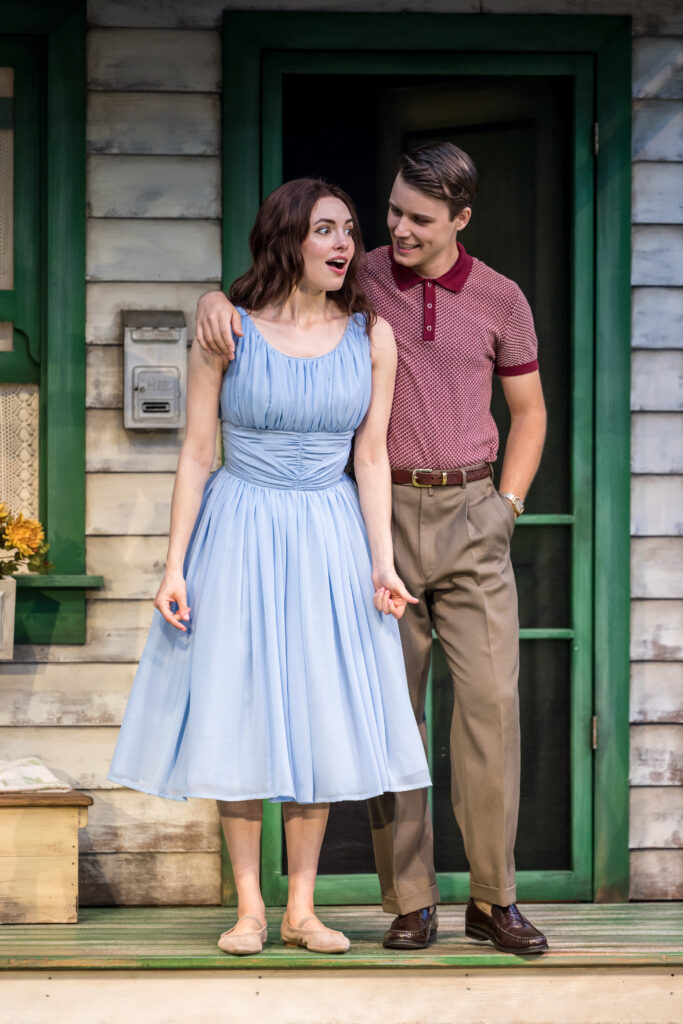
Colin Covert plays Alan Seymour as the cool college boy you’d expect in 1953 Kansas. Clean cut, conservative, well dressed, well placed and headed back to college soon. Apparently Hal’s only friend in the frat, he has his own stories to tell about Hal. Some real, some, we find out not so real, and a lot of issues left out of the conversation. Covert gives us a Seymour who plays it way too cool as he courts his steady, the prettiest girl in town, Madge.
And Madge is the prettiest girl in town and everyone says so. But feeding into the image, Alina Tabor knows how to play that game to her advantage. But she also exhibits a sense of self doubt as she wants something more, a recognition that she is more than a pretty face. And Tabor brings us that nagging bit of angst as she does want more and she’s not sure if the attentions of Seymour are her goal or if his hesitancy to commit is a red flag. And then there is Hal, who openly flirts with her and takes her to the picnic in a way, or not. And the Madge/Seymour/Carter world explodes.
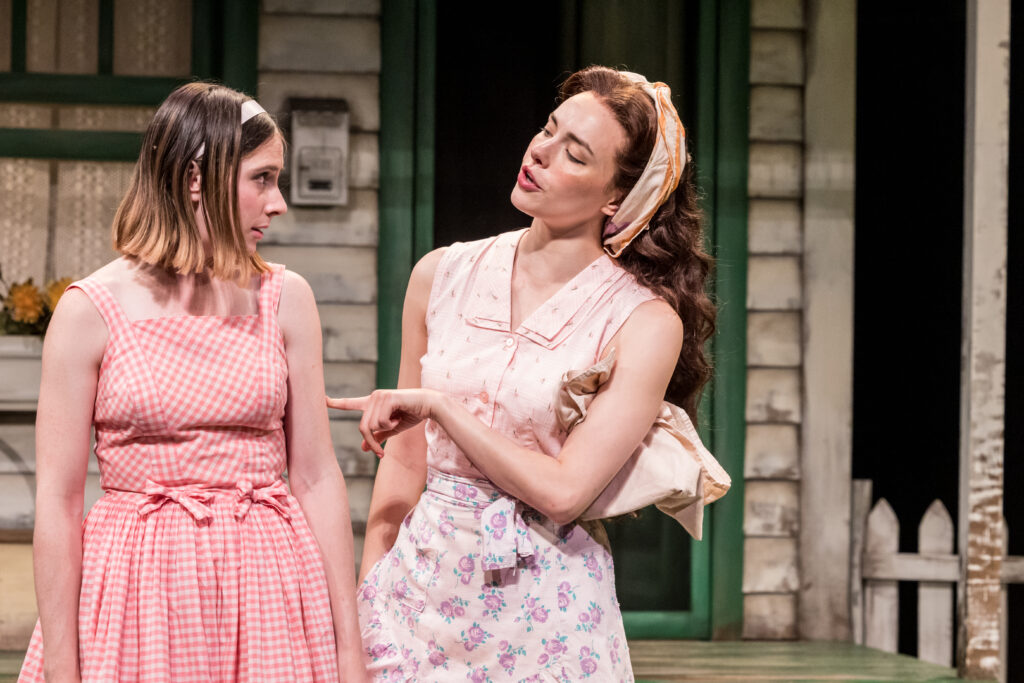
And Millie is the smart one, Madge’s younger sister. My favorite character here, because: Kelly Simmons plays Millie with such a boisterous enthusiasm you can’t help but focus on her. From sneaking cigarettes from her hidden coffee can stash to her boyish wardrobe, she is playing into being labelled the smart one. So Simmons has caught that bit of her quality but in her poses aside the main action at times you can see her growing sense that she wants to be an adult. And then Hal sets his eyes on Millie and Simmons brings out a new Millie who revels in the attention and then glows red with jealousy when Hal turns his attention to Madge. Probably for the first time in her life. It’s then that Millie realizes that she can be the smart one and a pretty one and Simmons turns that page as well!
Colleen Madden has a role that suits her fancy! She is Rosemary Sydney, the maiden school teacher. Madden presents us with a preening, yes I think preening is right, woman of a certain age who is proud that she is a single woman and school teacher. And she has a boy friend…well no, a friend who is a boy. But me thinks, that Rosemary doth protest too much. And that proves true, as Rosemary too falls under Hal’s charm, demands that Howard marry her. Madden is hilarious and outrageous in this scene! There may have been a bit of alcohol involved.
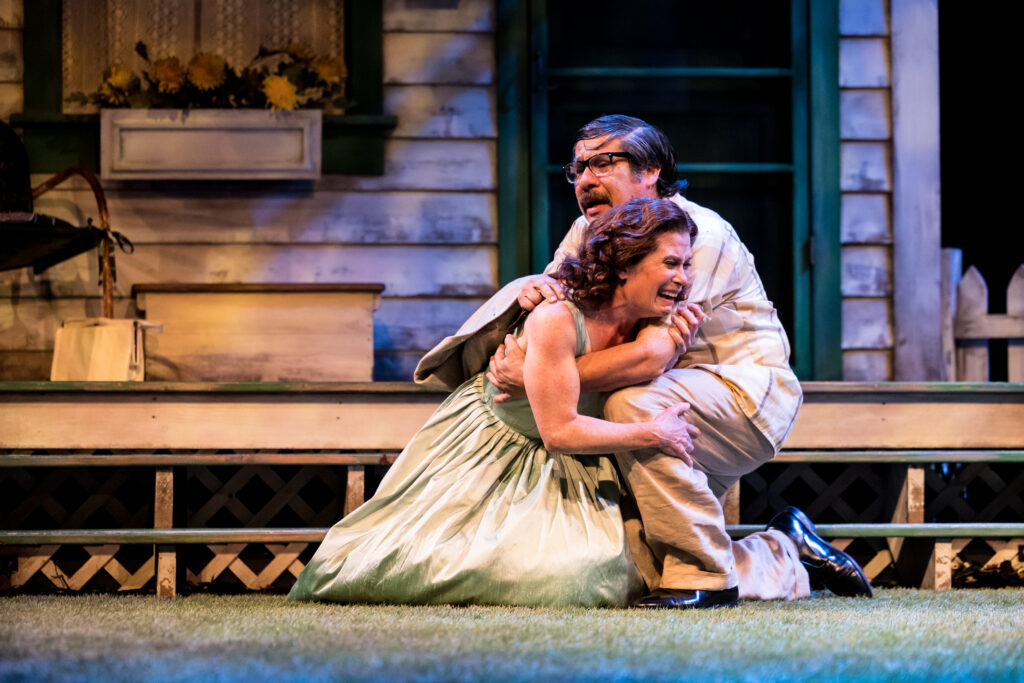
And then there is the girls’ mother, Flo Owens, who Tracy Michelle Arnold plays as a subdued and resigned woman who wants nothing but a better life for her daughters. She sees that in Alan Seymour and openly pushes Madge in that direction. Arnold gives us the frustrations of a single mother who is struggling to provide a stable home and solid economic base for her family. And Arnold also shows us the love of a mother despite the distractions her daughters either face or present.
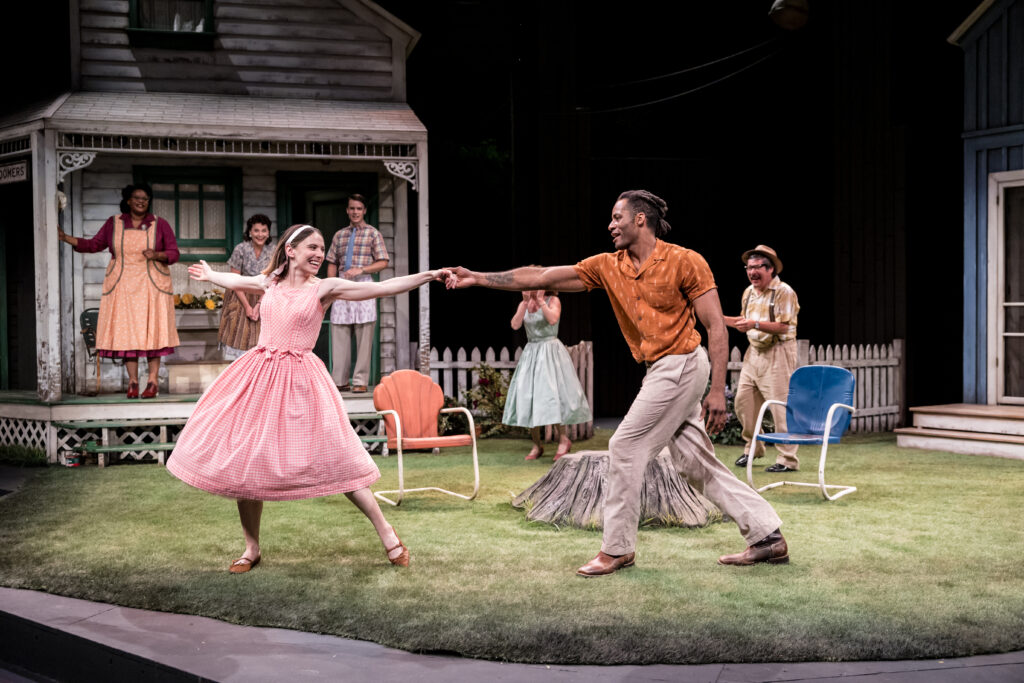
Director Brenda DeVita has made a very quiet but very bold statement with the casting of Picnic. If you have enjoyed the photos that accompany this article, you will have noticed that Hal and Mrs. Potts are played by black actors. That isn’t an issue per se but given the history and culture of the United States, no matter what the level of our suspension of disbelief, it does subconsciously put a different twist to some of the dialogue. But DeVita has done an amazing job casting and directing this play. The characters ring true and believable and the story telling is succinct and memorable.
I loved this!
More about William Inge’s Picnic at American Players Theatre including ticket info.
Picnic is being presented in the Hill Theatre in repertory so the dates are spread out through the summer and early fall. The last show is Saturday September 13, 2025
Spoiler Alert: We don’t get invited to the picnic!