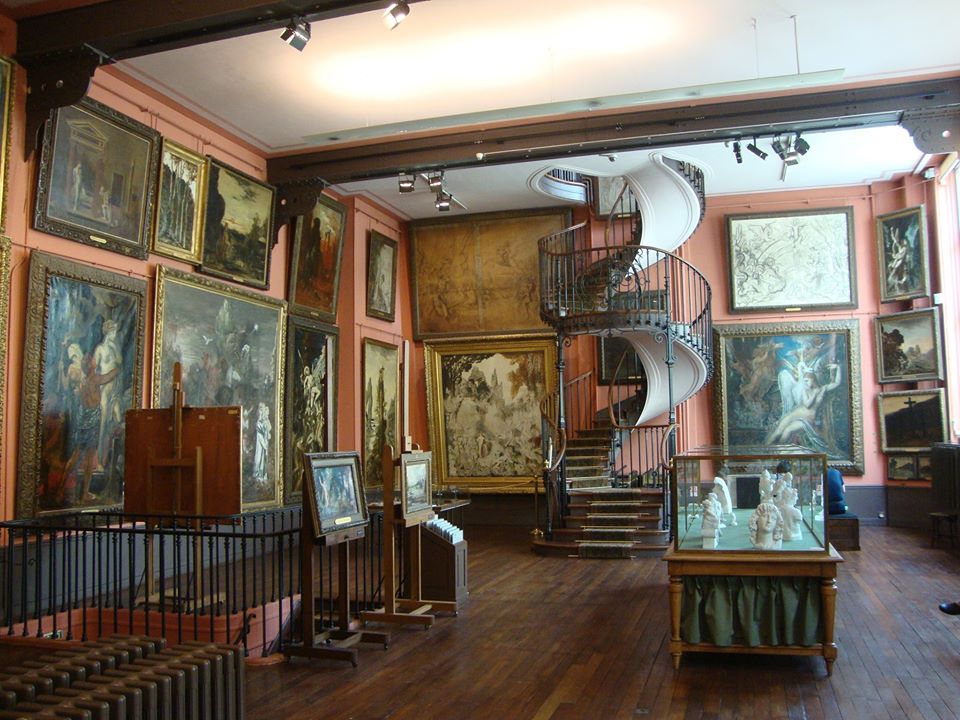
The first sentence in my title is the title of the play currently on stage at the Milwaukee Chamber Theatre. The second is a paraphrase from Doug, the alter ego of playwright Doug Wright, from one of his interactions with Charlotte von Mahlsdorf in the play. Charlotte is an open transvestite living in Germany. She is an impossibility because she survived the Nazis during the Second World War and later the Soviet occupation of East Germany. She was an antiquarian, portrayed as having a particular affinity for Victrolas and other late 19th and early 20th Century music systems and mechanical clocks. And according to Wright’s play, she kept a museum of her treasures and conducted detailed tours through the 28 rooms of her museum. The items were acquired through purchase and trades but much of it salvaged during WWII and the Cold War. The story revolves around interviews between the play’s fictional Charlotte and the fictional Doug…
Jonathan Riker. Photo courtesy of Milwaukee Chamber Theatre. Photographer: Michael Brosilow
Charlotte’s life wasn’t an easy one by any means. First an abusive father who meets an untimely end and of course the indignities that queer people and transvestites in general experience in the mid 20th Century. All of these instances are described in detail in conversation with Doug or acted out for our benefit, sometimes in great detail, by Riker/Charlotte. So there is a lot of different contexts here. From general and specific homophobia and its changing face over 50 years and of course the antisemitism of the Nazis. This is history that 21st Century society needs to remember and guard against forever.
Jonathan Riker. Photo courtesy of Milwaukee Chamber Theatre. Photographer: Michael Brosilow
There is but one actor in I Am My Own Wife. And that actor is Jonathan Riker who is credited at Charlotte et al. And that is because as written, Riker plays all of the roles. Not an easy task at any time but particularly difficult here given not only the varieties of gender but the varieties of nationality. Riker is an impeccable Charlotte, the graceful moves, the lilt in her German, and the intense feeling for the music and the music machines. Oh, and a delightful German accent that clearly makes the point but without being too strict for these Midwestern ears to understand. But with a droop of the shoulders or a turn of the head, Charlotte becomes Doug the playwright and interviewer, or Doug’s friend John who ‘discovers’ Charlotte and alerts Doug to her existence, or her lesbian Tante who helps Charlotte identify her sexuality and provides support, or any number of other friends or acquaintances who are keys to the story. Going from the feminine lilting German to a very deep masculine Texas drawl would be daunting for anyone, but particularly here in the midst of a half dozen other voices. But Riker nails it and has fun with it. There is an audible chuckle in the audience the first time he makes the transition. There’s also a sly look on Riker’s face!
Jonathan Riker. Photo courtesy of Milwaukee Chamber Theatre. Photographer: Michael Brosilow
Director Alexander Coddington has orchestrated a very simple but inviting dance on stage for telling this involved story. How he put this all together is simply staggering…so seemingly simple…but such elaborate story telling. And kudos to Coddington for keeping Riker so focused and on track through the two hours it takes to tell this story well.
Jonathan Riker. Photo courtesy of Milwaukee Chamber Theatre. Photographer: Michael Brosilow
There is a second star of the show, the set. Riker works in a spare shallow space with a dining room table, two chairs, and a cabinet. But behind is a painted backdrop that resembles a paneled dining room until the lights behind are turned on…and at one time we see an elaborate bar and back bar setting that Charlotte saved from a gay bar and later a mass collection of furnishings adorned with a milieu of mantel clocks and hall clocks or simply a sitting room. Quite s stunning achievement from the scenic staff of Sarah Hunt-Frank, Adam Hastings, and Maaz Ahmed.
Jonathan Riker. Photo courtesy of Milwaukee Chamber Theatre. Photographer: Michael Brosilow
Let’s start in the middle, shall we? We are witnessing the Book Of Will at the Lake Country Playhouse and Academy. And I am going to paraphrase here since I wasn’t sitting with the groundlings transcribing the spoken text (YKIYK). After reading a purloined copy of the first folio of William Shakespeare’s collected works, a very drunken and depressed Ben Jonson barges into the Globe Tap Room and explains his three day drunken bender: “I have seen them acted and I have heard them acted but I have never been alone with them before.” And that is the key takeaway from this story. A well told and well imagined telling of what may have happened as the surviving original members of the Globe Theater Company assemble and publish the collected works of William Shakespeare. Without these efforts, the audiences of the 21st Century would never have had the opportunity to see Shakespeare acted or hear Shakespeare exclaimed or to just be alone with him.
left to right, Diane Kallas, Topher Lowmar, Evelyn Ewald, and Paul Weir. Photo courtesy of Lake County Playhouse and Academy.
And now, the beginning: Sophia Bernhardt commands the stage as Hamlet! Bernhardt is impish, over confident, and hams it up to the max and acting for a company in competition to the Globe is working from a tainted script. We can all cringe as she mauls the most famous bit from Shakespeare, To Be or Not To Be! And then Bernhardt dares to appear at the Globe Tap Room and plays the preening star and clearly knows her appearance her makes here a scoundrel. But never fear, Paul Weir’s Richard Burbage, the star in many Globe productions, drives the young Hamlet and the other members of the rogue company from the establishment with of all things, a baseball bat (conveniently hanging from the bar wall along with a number of epees and a badminton racket). Weir’s Burbage is regal, dynamic, eloquent, and maybe just a bit pompous. But clearly in control of his faculties and cleanly recites any number of soliloquies from memory to the amazement of his companions. A fact worth noting as we lose Burbage immediately after this act and the remaining company realizes that he was the only one who knew ALL of the plays and what should they do now?
left to right, Evelyn Ewald, Madison Nowak, and Diane Kallas.Photo courtesy of Lake County Playhouse and Academy.
So let’s discover the marvelous characters that playwright Lauren Gunderson has gifted to us and the remarkable actors who bring them to life.
The anchor or focus is John Heminges, one of the founding members of the Globe Theater. He had given up acting to become the theater’s manager. Naturally when the group decides to assemble Shakespeare’s plays and publish them, they all turn the Heminges as the man to get it done. Cory Klein portrays Heminges as an assured and confident manager of the theater and he agrees that a folio must be produced. But during the work toward publication he expresses regret over leaving acting and at times has doubts about his ability to lead the project. And that introduces a true love story from Gunderson that certainly is worthy of a play about Shakespeare. Diane Kallas is Rebecca Heminges and John’s rock. And she has as much knowledge of the theater and Shakespeare’s importance as anybody in the company and Kallas is a solid source of support and sees past the doubts Klein portrays and insists that he complete publishing the plays. And their final scene together as she takes sick and eventually passes is so full of drama and love that you can’t help be feel choked up as well.
left to right, Cory Klein and Oliver Kuhtz. Photo courtesy of Lake County Playhouse and Academy.
Another theater couple are the Condells. Henry is also a founding member of the Globe and Oliver Kuhtz’s character loves Shakespeare and the Globe and his fellows too. And he is a calming hand during the various events and wholly supports Heminges in the efforts to produce the folio. His wife, Elizabeth, also is involved in encouraging the folio and as played by Evelyn Ewald is also a supporting character for Henry and the others. Ewald is entirely a graceful spirit throughout the change in moods and scenes.
left to right, Cory Klein, Oliver Kuhtz, and Victoria Wozniak. Photo courtesy of Lake County Playhouse and Academy.
Victoria Wozniak plays a very key and central character to pulling together the disparate parts to complete the folio, Ralph Crane. The Globe’s copyist, hand writing out each part for the actors, Wozniak first gives a little bit of push back but once committed is essential to putting the plays in the correct internal order and historical order. Only Crane has handled and read every script in its entirety in the past and other than Burbage probably has the most complete understanding of the entire catalog. Wozniak certainly jumps into the work and provides a get it done no nonsense personality once the real work gets underway. And Alice Heminges is the daughter of John and Rebecca. She is also the barmaid at the Globe Tap Room. Madison Nowak is delightful as Alice. With a quick wit, an eye for who needs another round and who needs to be cut off, flirtatious at times, but always alert to the mood in the room. She would be an agile and competent barkeep in any watering hole hereabouts. She too gives her father the confidence to carry on.
And then there is Ben Jonson. Per David Wise, Jonson is something of a braggart and self-promoting loud mouth. And as a competitor of Shakespeare, willing to belittle and denigrate the bard’s work. And at the Tap Room, he easily imbibes too much and openly flirts with Alice who fittingly puts him in his place. And then the raw shift to depression and drunkenness after reading the portfolio and realizing what we may have all lost and how wrong he was about the plays.
left to right, Oliver Kuhtz, Sophia Bernhardt, Topher Lowmar, Victoria Wozniak, and Cory Klein. Photo courtesy of Lake County Playhouse and Academy.
The publishers: William Jaggard is the villain at first, having published Shakespeare works without license, to hero when he is the only publisher willing to take on the project. William Molitor plays the blind publisher who knows who he is and what he has and is willing to compromise to take on the job and cement his reputation. But as events unfold he softens a bit. His son Isaac Jaggard is the actual publisher of the folio and is eager to take on the task. Topher Lowmar is Isaac, earnest, dedicated, and in love with the idea of publishing Shakespeare’s complete works. He is so involved that his father suggests that he take full publishing credit in the end.
William Molitor, Photo courtesy of Lake County Playhouse and Academy.
And Sophia Bernhardt reappears…a number of times as a crier announcing the next shows at the Globe, to great comic affect, and later as the compositor/printer at Jaggard’s shop. Bernhardt turns from madcap to serious and persnickety artisan for this part of the play.
and just let’s leave Pericles out of it.
Sophia Bernhardt. Photo courtesy of Lake County Playhouse and Academy.
Director Morgan Gates assembled a remarkable cast and kept the action moving across a number of locales, changing emotional expressions, and 18 scene changes. The quick changes and the continuity is marvelous to experience. Although he has the cast working with British accents they never got too thick and in the way, every line was easy to understand. And let’s circle back to Victoria Wozniak who besides playing a number of roles, was the costume designer here. Simply perfect.
Book of Will runs through Feb 1. 2006 at Lake Country Playhouse and Academy in downtown Hartland WI. Tickets here! Run time is 2 hours including plus a 15 minute intermission.
I think that the words engaging and compelling are starting to get a little overworked in theater criticism and I have begun making an effort to avoid using them. But I am about to fail. Director Elyse Edelman has crafted a compelling and engaging performance at Renaissance Theaterworks from Playwright Hansol Jung’s engaging and compelling script for Cardboard Piano. So in other words, this presentation is remarkable.
Part of the description for the play is, A War Torn Love Story, but as is often the case, that’s only the half of it. But let’s start there. The entire play takes place in a Christian mission church in rural Uganda and for the first act, the day is January 1, 2000. Adiel, a young Ugandan woman, is decorating the church and is in a very excited state. She is waiting for Chris, the daughter of the American missionaries who built the church. Chris arrives and surprises Adiel and scares her just a bit. Tyler Cruz is the energetic and excited Adiel. She is excited because she and Chris are going to get married today. Chris is played by Rebecca Kent, also excited but maybe just a little bit devious. Because her Christian parents are opposed to the marriage she has given them sleeping pills to keep them out of the way. So the plan is to marry Adiel in their own private little ceremony which Adiel plans to tape record to serve as the witnessing of the rite. But Adiel is appalled at Chris’ actions and Cruz clearly exhibits that bit of uncertainty but out of love decides to continue with the plan. And they wed with all of the joy and fervor of any young couple in love. Kent presents a determined Chris who has it all worked out and who is willing and able to pivot on the fly.
Rebecca Kent
Everything is going to plan until Pika bursts into the church brandishing a gun and threatening the young women. Ethan Hightire presents a hyper-active, desperate, and fearful 13 year old boy who is trying to escape the rebel Lord’s Resistance Army. And the women are equally fearful until he passes out from loss of blood from the partial loss of his left ear. He is disarmed and tied up but the drama hardly ends here. And this maybe a spoiler alert but it is critical to what comes next. While Adiel returns home to pack, Chris gains his confidence and calms Pika and tells him the story of the Cardboard Piano. And then Dimonte Henning, as a soldier seeking Pika to return him to the LRA, bursts into the church. Just as Henning is blustering and shouting with all of his macho intimidation and waving his machete around, Adiel returns. He threatens her and she plays coy but he finds the handgun she has kept for protection and all hell breaks lose. Pika comes out of hiding to the rescue and overcomes the soldier. And as Adiel and Chris embrace and kiss in relief, Pika denounces them as sinners and shoots and kills Adiel.
Tyler Cruz
And then 14 years later, a repaired and revitalized church is run by an Ugandan pastor and his wife. Dimonte Henning returns here as the pastor Paul. And he is preparing a fiery sermon for this coming Sunday service when he wife Ruth appears. Ruth is the second role in the play for Tyler Cruz who gives us a confident, loving. and compassionate woman. It’s their second anniversary and they are both looking forward to a bit of celebration. Another clear and sweet love story. And then Chris returns. She wants to bury part of her father’s ashes here in the church yard that he built. Ruth is cool and seems to understand but Paul becomes agitated and leaves. And Ruth recounts the Cardboard Piano story to Chris, with a few minor tweaks and Paul’s alias falls away and we see the adult Pika. And I won’t ruin the rest of the story…well except…Hightire makes a re-appearance as a young man who is seeking solace and blessing from the pastor…but being a gay man finds little support in the church. And that too opens up other parts of the story and history of this little church and these little players.
Dimonte Henning
Elyse Edelman is a new force to be reckoned with as a director. She is continuing to develop a dramatic vision and has an innate feel for what works on stage and how actors work together. I guess this is not surprising given her depth as an actress. And Dimonte Henning too is certainly becoming a sought after and very well liked actor for the variety of roles he’s taken on and the emotion and energy he’s able to share with his audience.
And there are some underlying themes that Jung presents: what are the effects of colonialism, how does faith unite and alienate us, and how does love work when homosexuality is forbidden.
Ethan Hightire
Cardboard Piano runs at Renaissance Theaterworks, 255 S Water St, Milwaukee from now until February 1, 2026. Ticket information here.
The play runs about an hour and 55 minutes including a 15 minute intermission.
Suggested for Ages 13+ Adult Themes, Language, Topics of War, and there is theatrical gunfire.