Next Act Theatre’s Boswell: A Tale Of Two Stories

or maybe three. And once again director Laura Gordon has proven herself to be a consummate story teller and oh my goodness, did Marie Kohler hand her a compelling story, but not necessarily an easy path. So you might expect that a play about the biographer of Samuel Johnson and his subject, to lean somewhat toward the academic…but it is surprisingly natural and human throughout and expands the meaning of friendship, ambition, and self-awareness across two centuries. Two centuries? Yes, Kohler has drawn us into parallel universes in 1950s Chicago and Scotland and London of the 1760s and Scotland of the 1770s. And here might be the motto for this play (my paraphrase):

Samuel Johnson: Boswell? Boswell?!? Where are you? James Boswell: I am here. Johnson: Where’s here? Boswell: Well here! Johnson: No, I am here, you are there!

And that is exactly how I felt and maybe how you will feel too, I am here, and you are there (as I write this, heard that last bit in my head in a perfect Walter Cronkite voice). And here is why…we will experience action in two centuries and they aren’t always mutually exclusive. Many times our 1950s protagonist will be much like us experiencing and watching Johnson and Boswell in the 1700s and there are enough parallels in culture and societal norms to feel related.

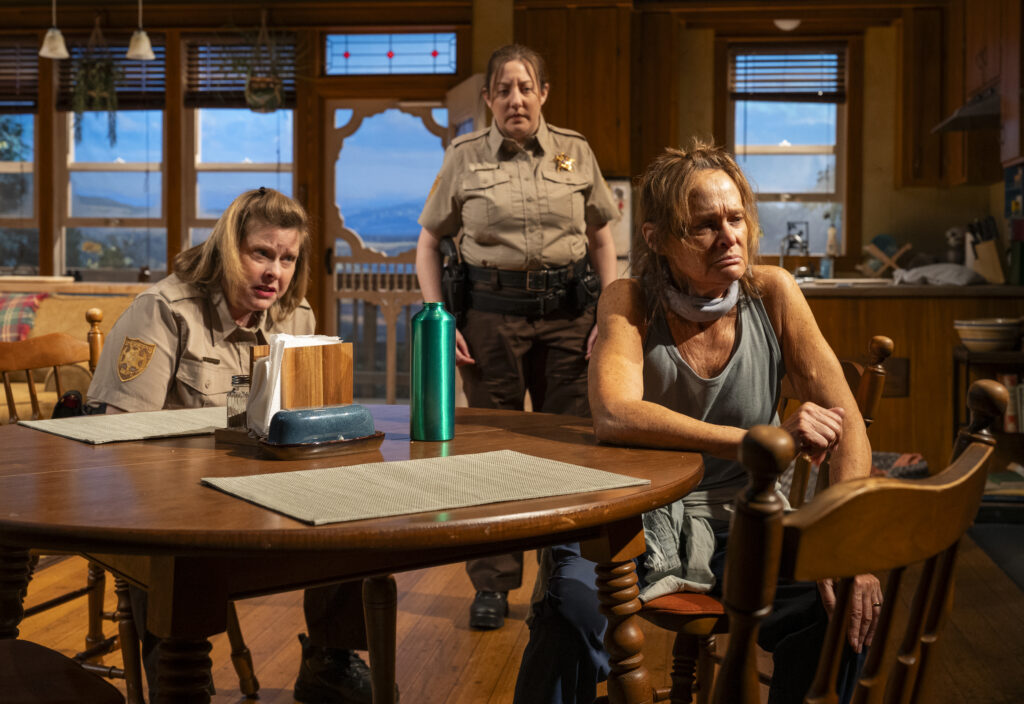
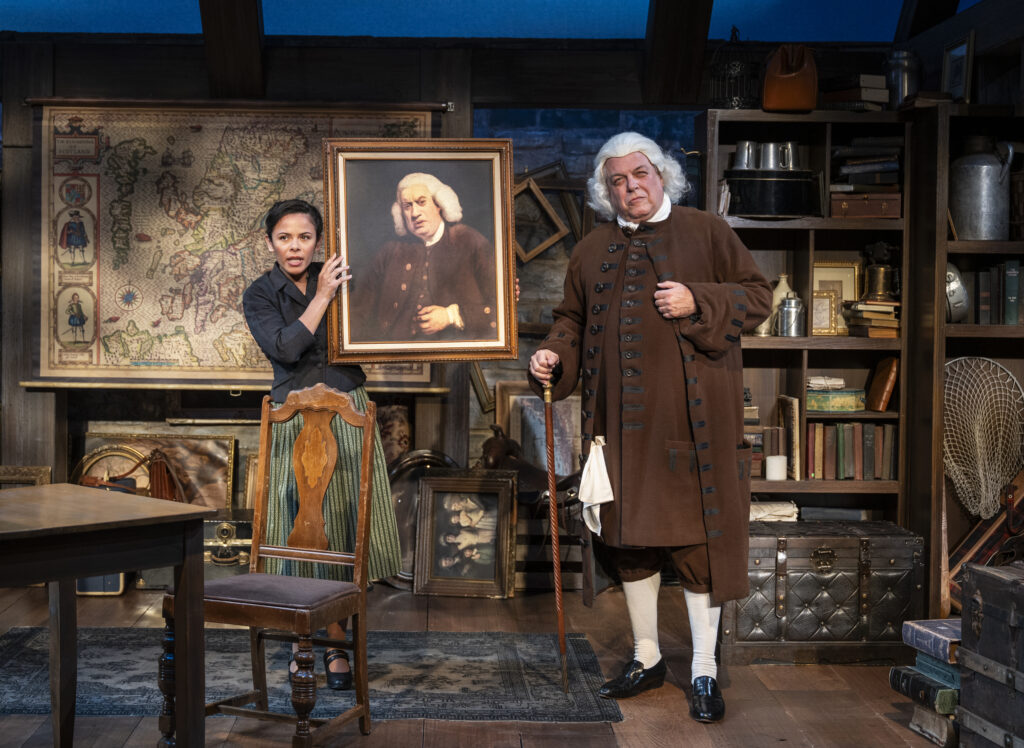
Left to Right: Josh Krause, Madeline Calais-King, and Brian Mani. Photo by Michael Brosilow and courtesy of Next Act Theatre.

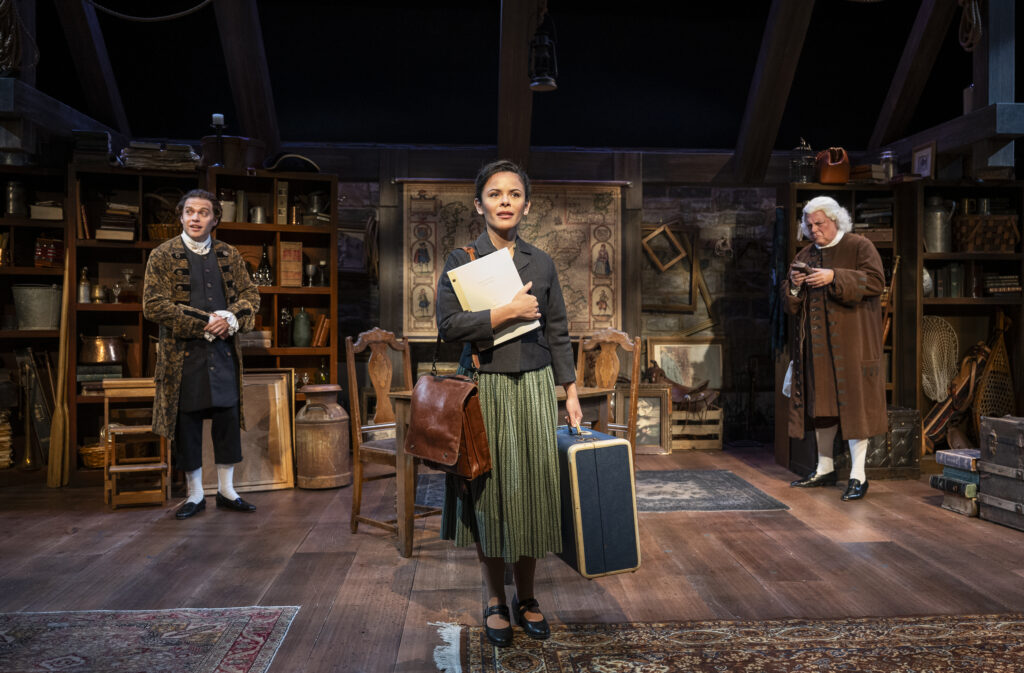
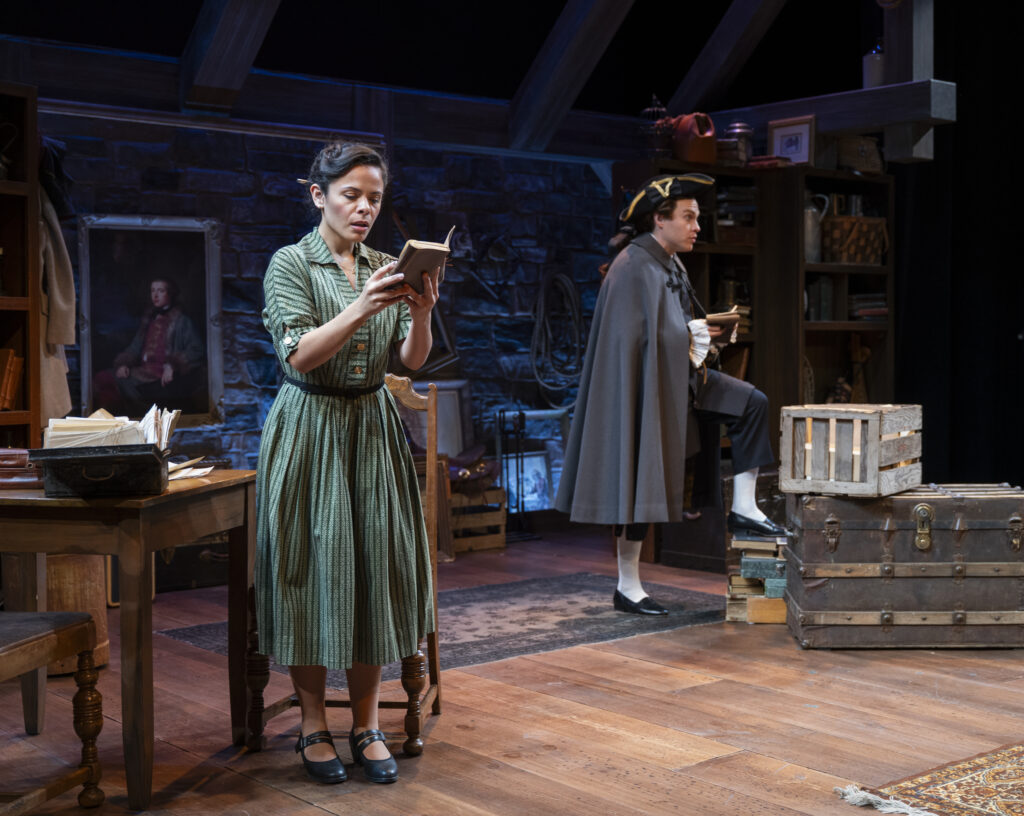
Joan is an academic from 1950s Chicago, the University of Chicago to be exact. And she has been lured to Scotland to research a trove of papers related to Samuel Johnson. She is working with her professor, who stays in Chicago, on her dissertation and a book on Johnson. Madeline Calais-King plays Joan initially as a determined, studious, and ambitious scholar looking to make a name for herself through this research. Calais-King is delightful here as she is full of life and curiosity and eagerness to begin but is a bit put off by her host’s various offers of Scottish hospitality. So Calais-King throttles down a bit when the personal one on one relationships are in play. But once alone with the source materials, she comes alive again.

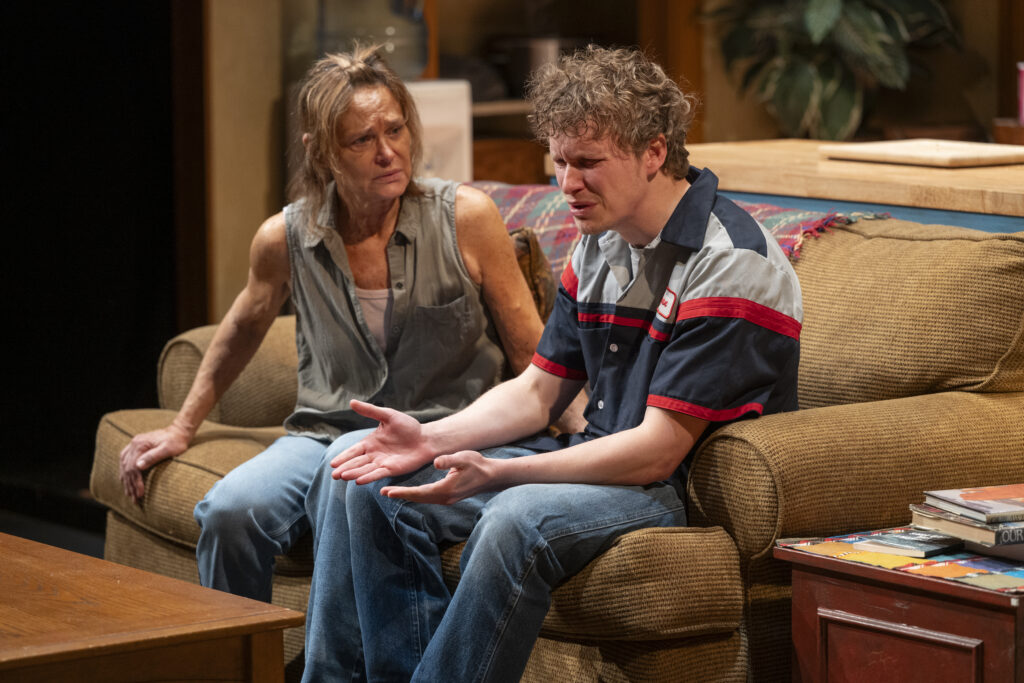
Madeline Calais-King and Josh Krause. Photo by Michael Brosilow and courtesy of Next Act Theatre.

But not all is well with the materials, a trove of letters, drafts, and journals. Joan expected the writings of Johnson, instead these are the writings of Boswell…and that is a problem. Calais-King gives us a Joan who gets directly into the face of her Scottish host for deceiving her about the source of the documents and thinking she was mislead simply for the money. Then she has a problem letting go when she tries to discuss the issue with the professor, partly due to his preconceived notions, her own ambition, and technical difficulties around 1950s technology. Her host pushes back, being a distant relative of Boswell, she somehow spurs Joan into further consideration…and Joan through Calais-King starts to pace and quote from the journals and visualizes them (Boswell and Johnson) across the room just as they were in 1770. Eventually she starts to come around …she might be the last or maybe only the latest Boswell seduction. And Calais-King gives us a triumphant successful Joan in the end. By the way, listen for the term side kick…it seems to change targets during the play.

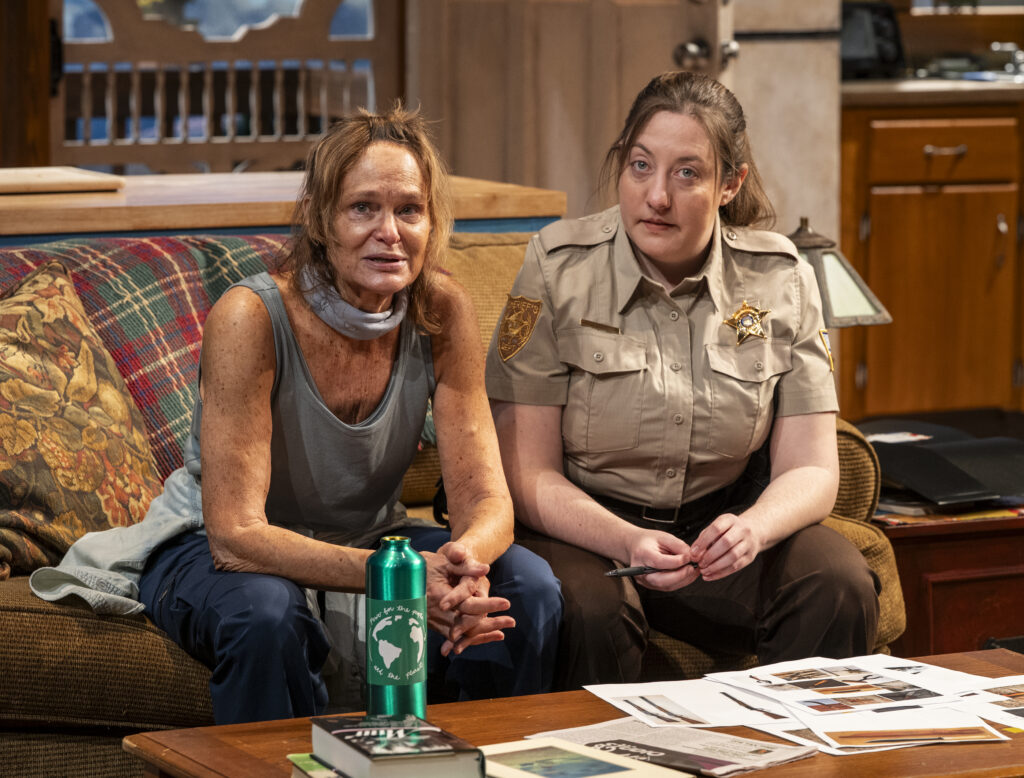
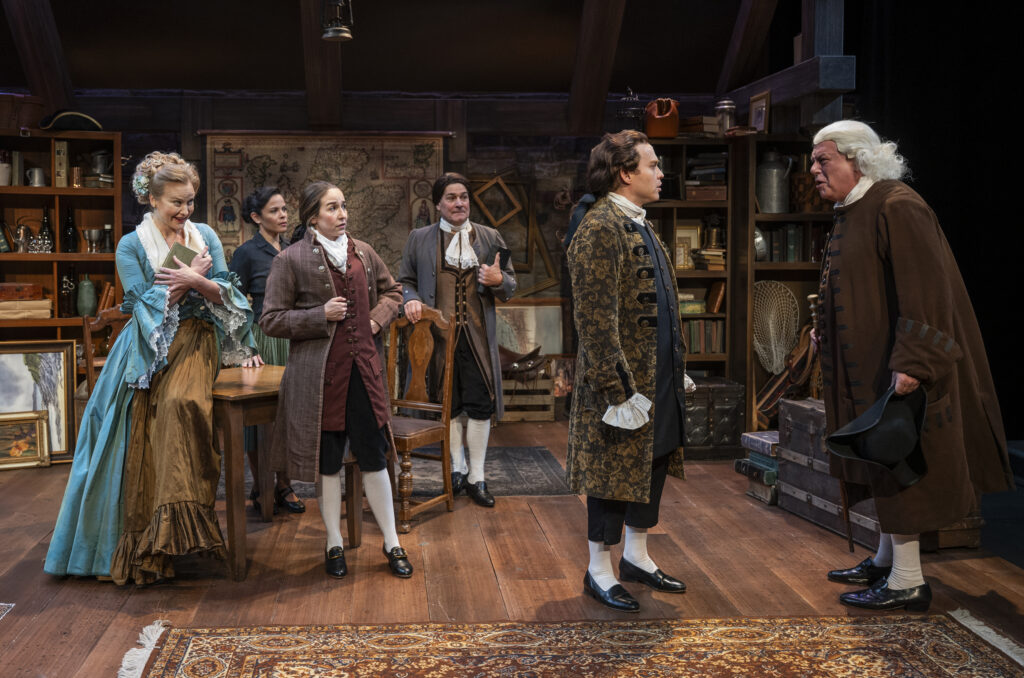
Left to Right: Heidi Armbruster, Madeline Calais-King, Sarah Zapiain, David Cecsarini, Josh Krause, and Brian Mani. Photo by Michael Brosilow and courtesy of Next Act Theatre.

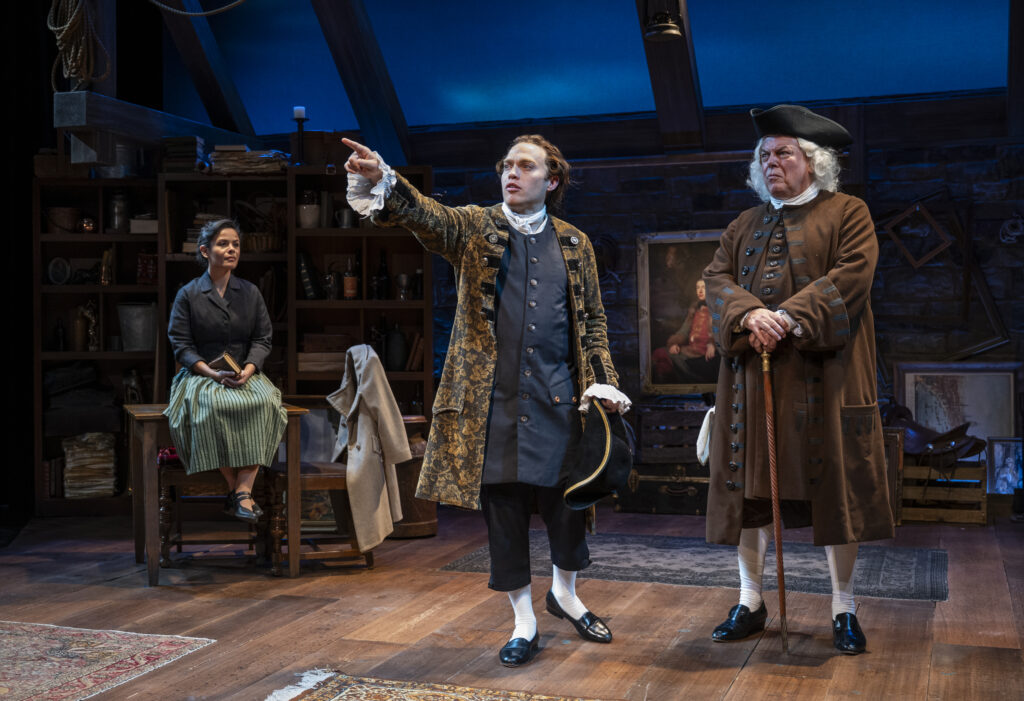
Brian Mani plays the great man, Samuel Johnson. He presents a Johnson full of ego and self-importance and as curmudgeonly as they come. Mani perfectly handles Johnson’s disclaiming in public, shout outs of word definitions or histories, with an assuredness that he is always right. But Mani can bring it down a notch once Johnson is outside the salons of the time and once he becomes friends with Boswell. Mani exhibits a friendship here that feels quite genuine. From blustering pomposity to gentile friend and traveling companion, Mani feels it all.

And James Boswell is played by Josh Krause. Krause starts out as an excitable boy in London and on to fan boy when he realizes that he is about to meet Johnson. Despite Johnson’s bias against Scots, the Scottish Boswell endears himself to Johnson and Krause easily moves his mood from fan boy to confidante to biographer. And during their joint tour of the Hebrides, Krause brings back that earlier excitement as he gets to share his love and knowledge and the beauty of his homeland.

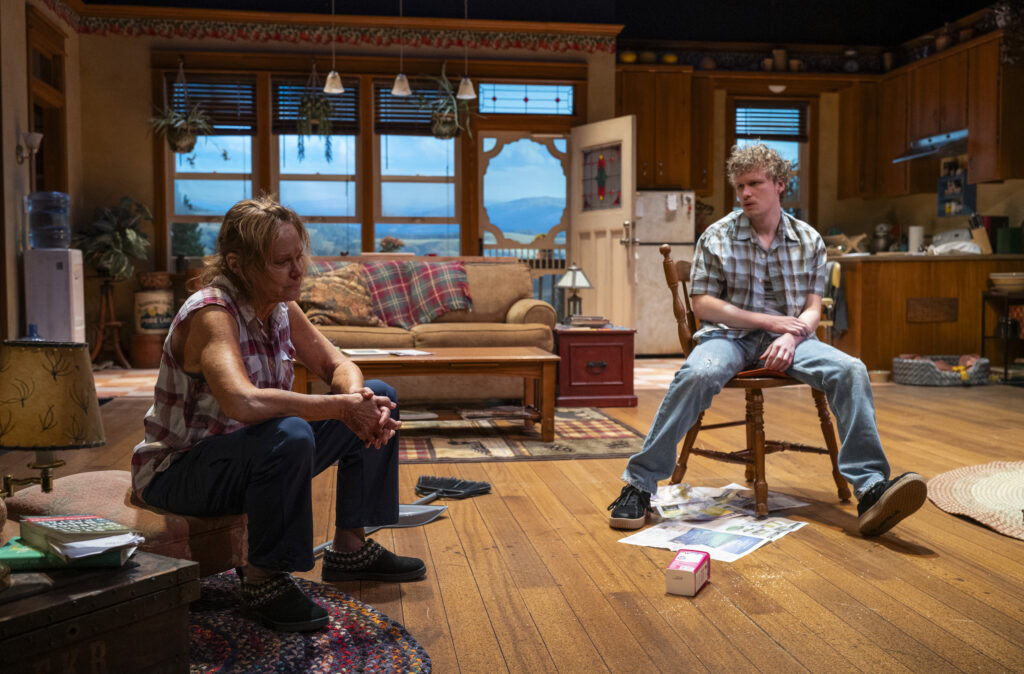
Left to Right: Madeline Calais-King, Josh Krause, and Brian Mani. Photo by Michael Brosilow and courtesy of Next Act Theatre.

Early in the play, just before Boswell meets Johnson, we get to meet several other intellectuals of London. Sarah Zapiain plays portrait painter Joshua Reynolds, who has his own bit of ego and pomposity on display. Zapiain then goes on to play any number of ladies who fancy Boswell including his wife Margaret. At the same time we meet Oliver Goldsmith, also a writer of poetry, novels, and sundry, played skillfully by David Cecsarini. Cecsarini plays a number of other characters, but maybe his best role is of David Hume. Here is able to get into a heated philosophical debate with Johnson about death and religion. I don’t think that there was a winner here…but it gave us another look at culture and society of the time. And Heidi Armbruster also appears in a number of roles (and in case you missed it, she is the playwright of Murder Girl currently at Milwaukee Chamber Theatre). Armbruster also appears as a noted personage in the role of David Garrick, the most famous actor of the time. Here Armbruster gets to emote and preen and prance about as Garrick. Quite a bit of fun!

Boswell runs through December 14, 2025 at Next Act Theatre at 255 S. Water St. Milwaukee. More information and tickets here.

BOSWELL is 1 hour and 35 minutes with no intermission.

Extra credit reading: The Playbill and the Audience Guide.

Madeline Calais-King, Brian Mani. Photo by Michael Brosilow and courtesy of Next Act Theatre.

A Note To My Readers and Milwaukee’s Art Organizations!

The Milwaukee 2024 – 2025 art season was simply remarkable. I was continually surprised and challenged by the art, music, dance, and theater events that I was fortunate to experience. And I hope that it also helped me to improve my understanding of the arts and increase my ability to see. I know that I was able to expand my coverage of theater as the Milwaukee Chamber Theatre and Next Act Theatre invited me to participate in their seasons. And I want to thank the artists, performers, directors, art admins, and university professors who encouraged and supported me in 2024 – 2025. It let me know that I was adding value and moving in the right direction with my efforts at An Intuitive Perspective.

So I felt a great deal of excitement and anticipation as the 2025 – 2026 season got underway. And I was off to a great start with Next Act’s Sanctuary City and Vanguard Milwaukee’s Presentation of Lungs. And then I was called away for a family emergency and missed a few other season openers and felt a profound sense of loss. And it just reinforced in me that art is important: to the individual and to the community. I am home now and intend to jump back into the season with both feet this weekend. So for those readers looking forward to a review of your favorite theater company, I am sorry. And to those organizations looking forward to my support, I am sorry. I may get called away again, so if I seem to be missing in action, please bear with me.

So this seems like a good place to add these thoughts. Milwaukee’s arts scene is incredibly vibrant and diverse and the level of professionalism is truly remarkable. But please don’t take it for granted. As Wisconsin has slipped to 50th place in public support of the arts, please support your favorite art groups by attending every event that interests you. And donate to them in any manner and any means that you can. It is important.

I love you all!

Next Act Goes For The Heart and Then The Gut With Sanctuary City

Next Act Theatre didn’t hesitate a moment about starting their new season with a compelling and hard hitting drama. Yes, with a name like Sanctuary City, it does deal with two stories about two undocumented young adults whose paths cross in their adopted land. And they were brought to the United States as children so they really know no other culture or life style than America.

Now in the current sociopolitical environment, sanctuary city may invoke thoughts about safe haven but the 2006 version of Newark, where the play takes place, isn’t such a place. Instead, to me, the play supports the relationship built between our two protagonists, as sanctuary cities. I hope I can fill that idea in without giving too much of the story away. But, yes, much of the undercurrent of this story has to do with the struggles and fears and stresses experienced here, so in a very meaningful way it is of the day. But there are a few scenes and conversations that are more of their time, insects stuck in amber as it were. But we will all understand the angst that we see here.

King Hang, Ashley Oviedo. Photo by Michael Brosilow. Photo courtesy of Next Act Theatre.

We meet G, played with incredible grace and determination by Ashley Oviedo, when she climbs the fire escape to B’s bedroom to escape from her home situation. B is played by King Hang as a conflicted young man who isn’t sure which way to turn as his world is coming apart. So, here are our sanctuary moments. B physically shelters G in his home while G shelters B’s mind and confusion with her empathy and compassion. When we meet them, they are young adults still attending high school. And this scene is confusing at first because it seems to be repeating in an endless loop with slight shifts in the dialogue and differences in inflection. These resets are cleverly delimited by a click track, so you know when they restart. I don’t know who thought that click thing up but director Jake Penner put it to amazing use here. Eventually you realize that the story is actually in something of an endless loop. I don’t know how Oviedo and Hang keep track of the changes in what is nearly identical dialogue.

Ashley Oviedo, King Hang. Photo by Michael Brosilow. Photo courtesy of Next Act Theatre.

The issue? G is beaten by her step father and her mother is unable to do anything about it because they are undocumented. So B allows her to shelter in his home. B is conflicted because his mother is determined to return to their country of origin but leave B to his new life in America. G supports his efforts to stay and succeed. And this series is repeated and repeated until surprisingly, G’s mother achieves citizenship and G does as well as a minor, and then leaves her husband, and B’s mother actually does return home leaving him to fend for himself.

They both finish high school, but the original dynamic has been shattered. And G proposes to use her new found citizen status to protect B by getting married. And we encounter a wholly new repeated dialogue as G and B rehearse their responses to imagined immigration questions…and then the world changes again as G goes off to Boston on a college scholarship and B becomes a bartender in their home town. And although they keep in touch by phone their world changes…

King Hang, Ashley Oviedo. Photo by Michael Brosilow. Photo courtesy of Next Act Theatre

Ovieda is a force to be reckoned with…presenting a G angry over her mistreatment but able to focus on how to move forward instead of languish in despair. And her G is also sharp witted and quick to take advantage of situations and events that come her way. Hang presents a very resilient B although he isn’t aware of it. So he often exhibits his stress through layers of doubt and indecision.

After intermission, we find that B is still in what had been the family apartment and G shows up but they haven’t seen each other for over three years. I won’t provide any spoilers if I can help it, but we now have a third character, Henry, played as a very confident and maybe a bit smug law student by Joe Lino. He is a catalyst in the final scenes of the play. And no, the play doesn’t end well for any of the characters, but probably not in the way you are picturing. You need to experience it…and feel the carpets pulled out from under while sitting in the audience. And there are questions about what love is and who loves and how much, that are never quite answered. There is a whole lot packed into this little play.

Joe Lino. Photo by Michael Brosilow. Photo courtesy of Next Act Theatre.

Kudos to Hang, Oviedo, director Jake Penner, and the production staff for the subtle but effective aging of B and G as they leave for intermission as teens and return for the climax as 20 somethings. It is an incredible transformation.

Now a note on why our characters are G and B. Playwright Martyna Majok has left the casting in Sanctuary City rather open ended. In her script she notes G is female and B is male and they are both 17 to 21 (depending on the scene, my note). And “The countries of origin can suit the actors chosen. These characters have grown up within working class multicultural America.” As a result, no country is ever mentioned, only discussion on ‘going back’.

A final word from G: “I’m from here.”

Extra Credit Reading: The Audience Guide and the Playbill!

SANCTUARY CITY contains strong language, descriptions of emotional abuse and domestic violence and themes related to deportation and family separation. The play also includes moments of heightened emotional intensity.

Sanctuary City runs from now through October 5, 2025 and runs one hour and 30 minutes without intermission. Additional information and tickets here!