This past Monday evening I was pleasantly surprised to find an email from Lia Smith-Redmann letting me know about her new dance company and their inaugural performance this October. It is always a good day to find out about an arts group that I am not familiar with but it is even more exciting to hear about a brand new local adventure in the arts. And although I don’t have an education in dance or any real grounding in the art form, I have always enjoyed the events that I have been able to attend. Actually I love dance.
I kinda wondered how Smith-Redmann knew about An Intuitive Perspective but they were thorough and mentioned that a mutual friend (who happens to be a principal dancer in the upcoming concert) provided my contact information. So now I am doubly excited to see them perform!
Here’s what Smith-Redmann provided (edited from a personal email for your reading pleasure):
The Smith-Redmann Dance Co., is a 501(c)3 nonprofit dance company that provides cultural enrichment and professional growth opportunities across Wisconsin and the broader Midwest. We established ourselves in 2025 and have been performing year-round, touring the country, and hosting choreographic residencies since 2020. On October 17th, 2026 we are holding our first live dance concert.
Inspired by tales such as Rumplestilskin, Little Match Girl, The Giver, and Rite of Spring, this contemporary story ballet depicts a chilling world of dystopian cruelty, and the spirits of rebellion that come from unlikely places. Featuring characters from Slavic Carnival traditions and inspirations from the likes of Akram Khan and Pina Bausch, 10 Milwaukee-based dancers bring the heat that is The Firekeeper.
It’s that wonderful time of the year…a week or so after Groundhog’s Day and just a few days into the Spring semester…UWM’s Winterdances. I always find this to be a cheerer upper in the gloomy days of February. And the 2026 version, named Resilience, didn’t disappoint. We were graced with four world premiere dances, each unique and extremely expressive, and absolutely engaging.
The first dance would be an exhilarating start to any dance program. Be My Ground, When The World Lets Go was choreographed by Peck School of the Arts Associate Professor Mair Culbreth in movement collaboration with the cast. Opening with an ensemble front stage dancing in a great bit of fluidity…we slowly become aware of four more dancers hanging against the back wall from harnesses and cable who begin to move up, down, or across the wall, only to eventually join their colleagues on the floor. Fluidity! This piece is all about that…as individual dancers, or pairs of dancers, or small groups spin off or leap across the stage in very natural yet hyperactive motions that just simply personify fluidity. But then everything gets crazy fun and each dancer takes a turn locking into a rope and harness and takes a turn defining space and distance on their own terms…sometimes solo and other times in unison with another dancer. You may be excused if you sense chaos here because no one dancer or core group is center focus anymore and it is hard to decide where to look and whom to watch…but it looked like such fun! And the sense of confusion was enhanced by the selection of different pieces of music providing a variety of sensual moods and feeling. From her notes, Culbreth stated: “This work began with a kinesthetic investigation of vertigo—as both a bodily sensation and a condition of ambivalence.” Her cast certainly took on that investigation in full.
Next dance, Ghana Must Go, is a very different experience…more sober…but also an example of fluidity, but more human and less mother nature perhaps. Assistant Professor Ishmael Konney is the choreographer on Ghana Must Go in collaboration with the performers. Based on the 1983 expulsion of Ghanians from Nigeria, this is a very telling human story. We first encounter a troupe of eight dancers moving in unison carrying bundles on their heads. At first just seemingly marching together, each dancer eventually breaks out for a moment and performs a short solo performance before reentering the group. The music is beautiful and rhythmic allowing the dancers to keep in time with each other while still moving away to express their individual personas. And as the dance progresses there is some signs of distress and sadness for certain, but the group comes together as a community…certainly an expression of resilience.
And after intermission, we were instantly called to pay full attention, as PSOA faculty member, Dawn Springer’s Harps That Once, bursts out as loud and fast and athletic. Many opening moves involve running break neck across the stage and later the group is running place…this all certainly exhibits references to athleticism. And then it evolves into an organic matrix of arms stretching skyward and legs kicking toward the horizon, and then falling back in graceful arcs to perpendicular, while the dancers spin and swirl and form and reform like a flock of birds. Using a vast variety of music for the settings, things change, break down, and again take on different moods and feelings. There is also a bit of chaos here, but a sense of structure too…and resilience!
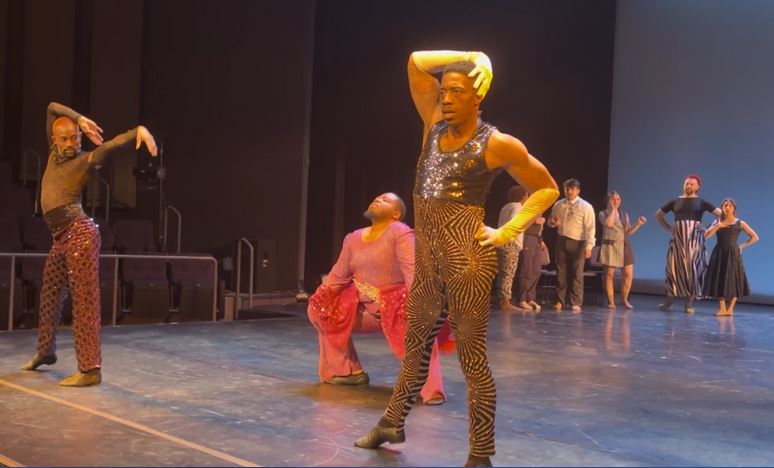
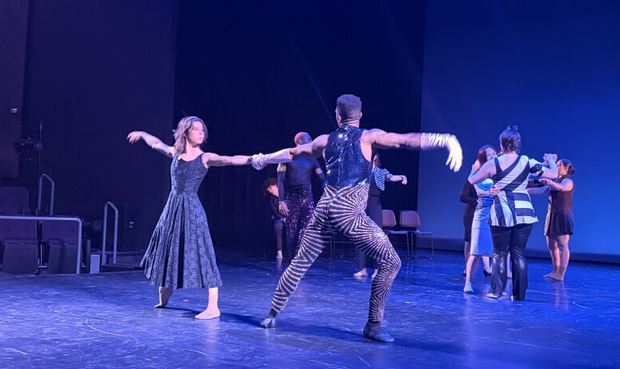
And the finale, Care, conceived by visiting choreographer David Roussève, was also choreographed by Roussève in collaboration with the performers including guest performers Richard ‘Buda’ Brasfield, Jacques Infiniti-Hall (Mizrahi), and DaCosta Martin. Care is a homage to Ballroom House dancing and the LGBTQIA+ community that developed it over the years and celebrates it today. In Care, we first experience a Debutante Ball, chaperoned by a very vigilant chaperone, PSOA Artistic Director, Maria Gillespie. With a keen eye and harsh whistle Gillespie keeps the dancers moving and separated at the ‘appropriate’ distance. UNTIL, Buda, Mizrahi, and Martin show up expecting a Ballroom House ball. “What kind of a ball is this?”, they ask. “A debutante ball”, Gillespie replies. And? “Not anymore it isn’t!”, is their reply. And the music shifts and our three guests start to vogue, making their own presence in turn, and starting to attract the younger dancers. Gillespie tries to maintain decorum and control and keep some of her charges in line but it is a losing battle. One by one the debutante ball participants move over to the voguing trio and urge them to continue and to show them how to do it. The dance continues as each guest teaches and encourages the new devotees on the dance floor and a whole new energy comes to life right there on stage. The victory is complete when Gillespie is gifted with a bright red pair of elbow high satin gloves and they are quickly put on and showcased. There was no end to the flash, glamour, and exuberance during Care, until it did finally come to an end. Care received the biggest applause and cheering of the evening…obviously a big hit with the mostly student audience.
There were a number of stand out performers over the evening, but I don’t know their names so I can’t go on in detail. But as I said in my opening, Winterdances 2026, is still the highlight art event at UWM’s Peck School of the Arts in the spring semester.
Extra Credit Reading: The Playbill with bios, choreographer notes, and complete music listings
Editors Note 2/12/2026. While listening to WUWM this morning, they said that they had some photos from this version of Winterdances…but in my search I only found a few for Care…so I stole two of them an inserted them here!
There are two touchstone seasonal traditions in the fine arts world…in Milwaukee they are the Milwaukee Rep’s A Christmas Carol and the Milwaukee Ballet’s The Nutcracker. In both instances the Milwaukee presentations are based solidly on the legacy literature but personally molded and directed by the local artistic directors to great effect!
I don’t remember the last time that I saw The Nutcracker…certainly this century but maybe not during the Michael Pink era. Much to my dismay. So my wife and I decided to revisit the Marcus Performing Arts Center and catch up with the Milwaukee Ballet as part of our 20th Anniversary celebration. Yes, the music is always memorable and rewarding and the dance a whirling giddy spectacle, but what I hadn’t remembered was the magic. Not the magic in the story, but the magic in the storytelling. I wasn’t prepared to choke up at times or have a tear come to my eye as the dance and the music and the sets spoke to my heart…and my soul.
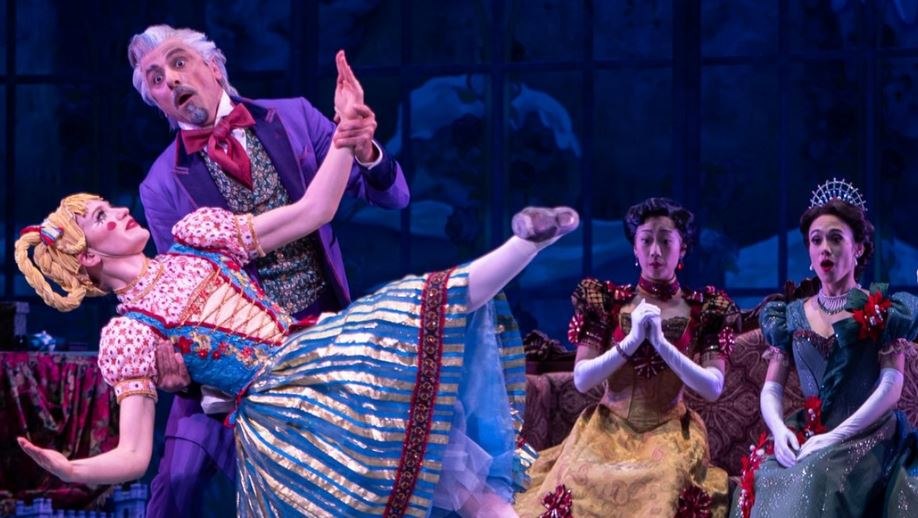
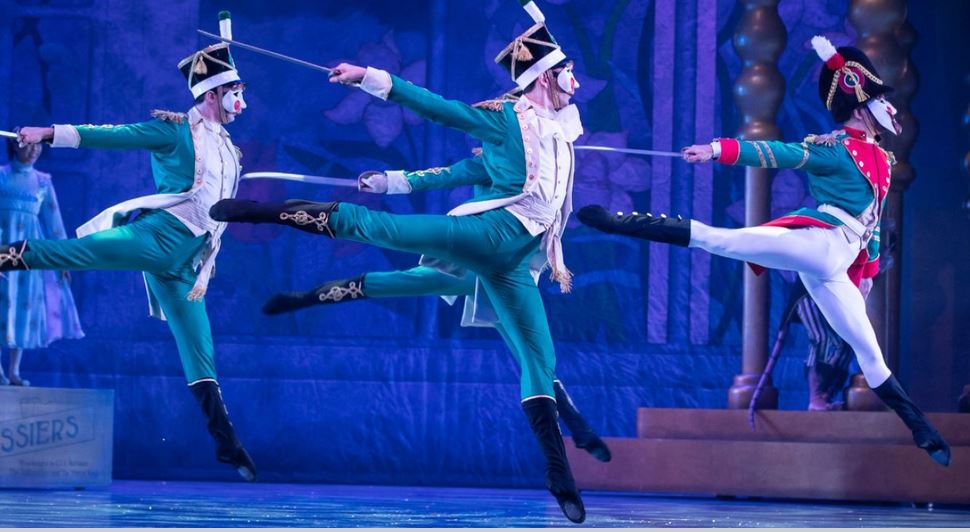
photo from The Milwaukee Ballet’s website
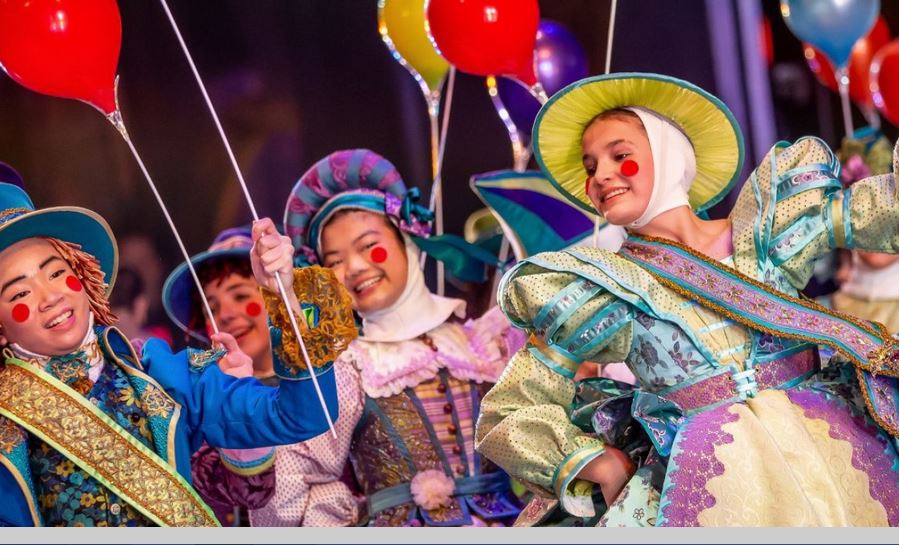
The set was simply amazing. Designs and painted surfaces were readily influenced by Art Deco, Art Noveau, and fairy tale design from everywhere. And the colors went from muted to brilliant depending on how the lighting director focused on them at each phase in a dance sequence. Plus buildings flew, trees grew great, and secret entrances and exits appeared to admit to or remove characters from the stage at will. And the costuming was gorgeous and over the top just as you’d expect from grand ballet. I was simply in awe throughout the performance. Milwaukee gets a fair share of credit across the board for the talent in their acting, dancing. performing, and directing. But I don’t think we give enough credit the lighting and set designers at any level of the arts nor to the costumers without whom the others couldn’t as effectively tell their stories. So props to Lighting Designer David Grill, Scenic Designer Todd Edward Ivins, and Costume Designer Gregory A. Poplyk.
photo from The Milwaukee Ballet’s website
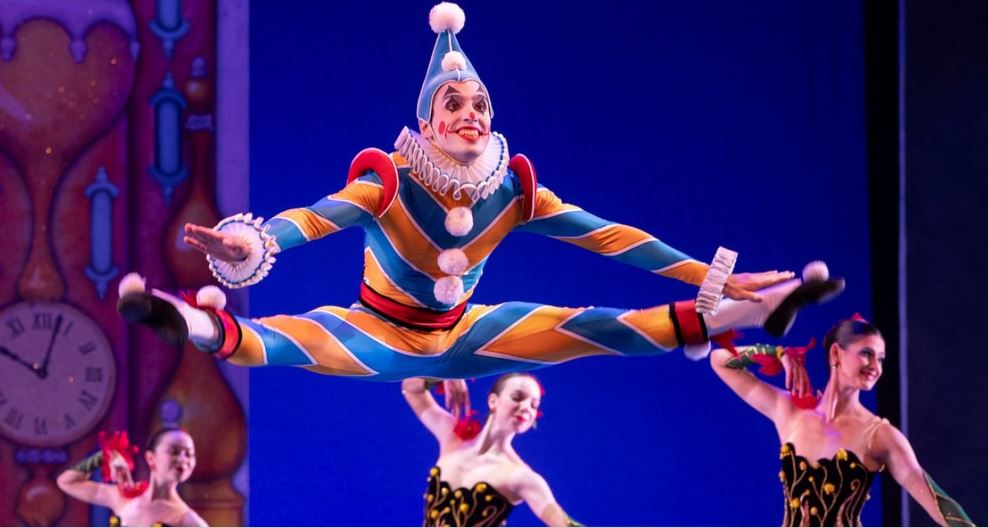
Of course there is no storytelling in ballet without the dancers. Pink’s ensemble is simply as artistic and coherent as any dance troupe I have ever experienced. There is grand storytelling here and this is what I felt throughout..a simple but profound sense of awe that stayed with me the rest of the evening. Most amazing of course is the dream sequence but we weren’t just watching them perform the dream dances…we were totally assumed into the dance and became the dreamers too. I had a hard time going to sleep that night when we returned to our room at the St. Kate’s Hotel.
photo from The Milwaukee Ballet’s website
The cast varied depending on the night of performance, but given the talent and skills displayed the evening we attended, I doubt that any other evening would have felt any different. But I do want to mention one dancer: Garrett Glassman who danced Drosselmeyer. He was so limber and fluid it appeared that he didn’t have a bone in his body (and I coveted his purple velvet coat).
AND: the live orchestra right down in front, was simply sublime!
I promise that I won’t repeat my great mistake here and put off seeing The Nutcracker again in the future. And I resolve to visit the Milwaukee Ballet for some of their other performances in 2026.