August Wilson’s The Piano Lesson At Milwaukee Rep

Pulitzer Prize winner August Wilson is certainly one of the preeminent American playwrights of the 20th Century. Particularly his ten play Pittsburgh Cycle (aka the Century Cycle). One play was written for each decade of the century and represents the Black experience and culture for that time. The stories are told in great detail through the interactions and daily lives of typical Black Americans. They are all set in Wilson’s home town of Pittsburgh PA. The Milwaukee Rep has been presenting one of the cycle every few seasons and now, one of his Pulitizer Prize winning plays, The Piano Lesson is gracing the new Checota Powerhouse Theater.

The set of August Wilson’s The Piano Lesson. Photo by Michael Brosilow and courtesy of the Milwaukee Repertory Theater.

It is 1936 and we are in the home of Doaker Charles in Pittsburgh. He shares the home with his niece, Berniece, and her daughter, Maretha. It is a comfortable home, not lavish, but comfortable. Doaker has worked for the railroad for decades and is currently a porter. So his home has a lovely couch and matching chair, a fairly modern refrigerator and stove, and a magnificently carved upright piano. And this lovely piano will be the focus of The Piano Lesson.

It is 1936. It is just over 70 years since the Civil War has ended. All of our characters, of course, are the descendants of enslaved people. Many of the adults most likely knew relatives who had actually been enslaved people. And that piano has a long and storied history. The elaborate carvings were done by an enslaved grandparent. The carvings represent enslaved family members of that time. And it belonged to the land owner who held their ancestors in slavery. But now the Charles family owns it (Doaker has a great long story about that,that you need to hear from him) and the question is what to do with it. How do you honor the past and how can that past provide for the future. The family dynamic differs in opinion in dramatic fashion and that drives Wilson’s narrative here.

L to R: Nubia Monks, Lester Purry, James T. Alfred, La’Tevin Alexander, Ny’ajai Ellison. Photo by Michael Brosilow and courtesy of the Milwaukee Repertory Theater.

Yes, Doaker and Berniece are comfortable in their home until Berniece’s brother Boy Willie bursts in at 5 AM and insists on waking the entire household. Boy Willie has just arrived from Mississippi with his buddy Lyman with a truckload of watermelons which they intend to sell on the street. Lyman, along with Doaker and Berniece, are examples of the diaspora of Black Americans migrating from the South to the industrialized North. Lyman wants to use his money to stay and find his way in Pittsburgh…but for Boy Willie, it’s another story. Boy Willie wants to sell the heirloom piano and add it to the watermelon proceeds and return home to purchase a portion of the land where his family was enslaved, becoming a landowning farmer rather than continue as a sharecropper. And here is the rub between the members of the family…what to do with the piano…and how do you honor the family legacy?

Pictured James Craven. Photo by Michael Brosilow and courtesy of the Milwaukee Repertory Theater.

Doaker Charles has worked on the railroad for decades and is now a porter. James Craven gives us a Doaker who has dignity and gravitas and acts as the nominal head of the family. But he also can show a man at wit’s end at times and just backs away to keep his own counsel. Nubia Monks presents initially, a strong and in control young woman as Berniece. A loving and a bit stern mother, she is certainly intent on bringing up Maretha right. But Monks also brings an edge and sometimes a brittleness to Berniece when Boy Willie pushes her buttons just the wrong way. Berniece is a bit superstitious though and maybe with good reason…it seems that the piano may actually be haunted and the spirit of the dead plantation owner may have followed Boy Willie to Pittsburgh or came to seek out the piano. Monks tries to keep her cool while sensing these spirits but eventually overcomes her fears and takes on her future head on!!

L to R: James T. Alfred and La’Tevin Alexander. Photo by Michael Brosilow and courtesy of the Milwaukee Repertory Theater.

Boy Willie is a loud self interested obsessive man. James T. Alfred plays him loud and obnoxious and self-centered and just moving all of the time…at full voice! How Alfred maintains that intensity and activity level is truly a wonder. His friend Lyman is played by La’Tevin Alexander as a quiet easily swayed young man. Alexander wants to listen to everyone without taking sides but is too often distracted by the last person he’s spoken to and that too often is Boy Willie. Anthony Irons’ Avery is a thoughtful, quiet, and patient man who is trying to become a preacher and start his own congregation. He too is from Mississippi and his newly arrived friends tease him a bit but also show him some respect. He is trying to woo Berniece but she is not quite ready to give up her mourning for her late husband. And the last Charles family member is Wining Boy, who is Doaker’s brother. Lester Purry plays him as a player…a piano player too…and a gambler who it seems could be something but instead is something of a ne’er do well. Purry certainly finds his braggart ways to be the pivotal personality trait for Wining Boy.

L to R: James T. Alfred, La’Tevin Alexander, Lester Purry Photo by Michael Brosilow and courtesy of the Milwaukee Repertory Theater.

Director Lou Bellamy certainly has a fundamental feeling for Wilson’s play here. It can’t be easy to put all of these aspects and characters together when the period is, on the one hand nearly 90 years ago, but on the other all too real, fresh, and contemporary at times. And with a run time of about three hours it must be hard to keep the flows going from start to finish.

The Piano Lesson runs at the Checota Powerhouse Theater in the Associated Bank Theater Center from now through March 22, 2026.

More information and tickets can be found here.

Extra Credit Reading: Program
First Stage Presents Peter Pan And Wendy With NO Strings Attached

Certainly since the original appearance of J.M. Barrie’s play, Peter Pan in 1904, and his later novel, Peter And Wendy of 1911, there has been a certain magic felt across the land by the young of heart in every age group. Being a man of a certain age, my first experience with the magic was a televised broadcast of the Broadway presentation starring Mary Martin. Yes, it did make a lasting impression on me and I was excited to see how the artists and young actors of First Stage would bring that magic to life once again.

Working from an adaptation by Doug Rand, First Stage Artistic Director Jeff Frank directs his own theatre for young audiences adaptation. Frank has rediscovered and reveled in all of the magic found in Peter Pan. All of the magic! The whole story is here, from Wendy and Nana and the great window in the nursery, to a flying boy in Peter Pan, to the Lost Boys, to Captain Hook and Smee, and the crocodile and the clock….and Tinker Bell of course (or Tinkerbell? I have found it both ways but for a real fairy I’d have named her Tinkerbelle).

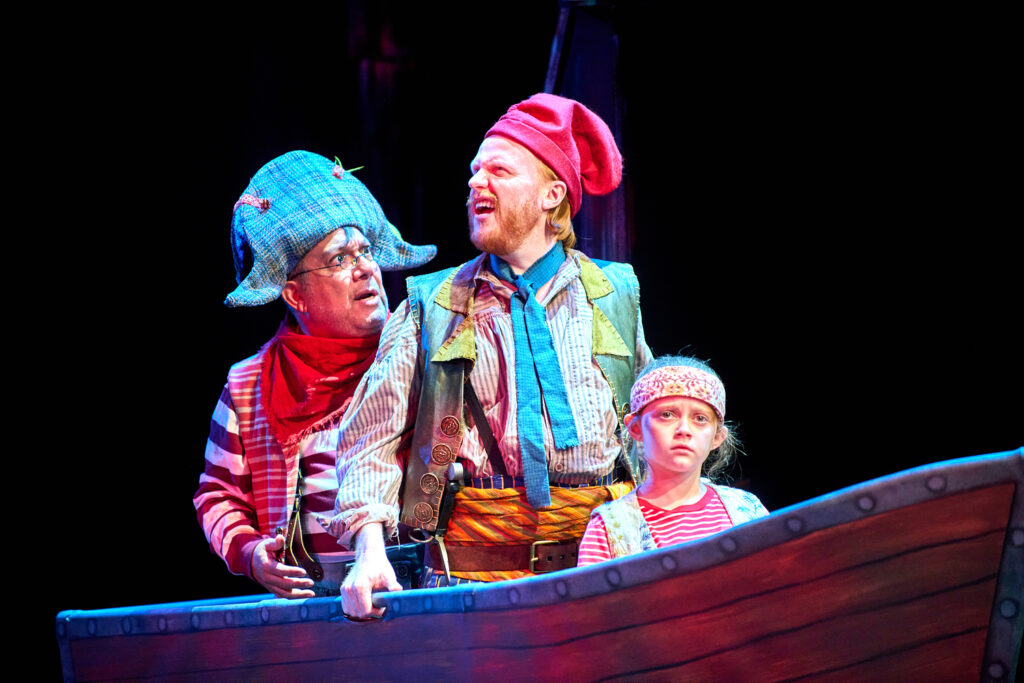
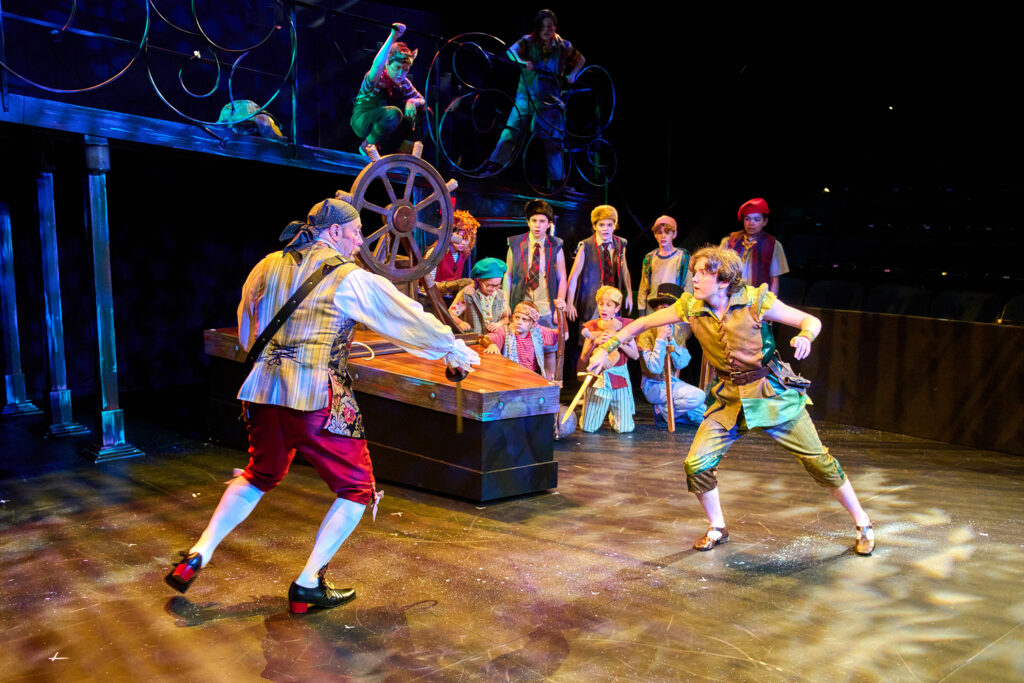
Todd Denning (front left), Marko Van Slyke (front right), and cast in Peter Pan and Wendy. First Stage, 2026. Photo by Paul Ruffolo.

First Stage presentations for young audiences can often be hard to describe because they are anchored by a number of adult actors but feature two rotating casts of young actors. Peter Pan And Wendy is no different, featuring a Shadow Cast and Light Cast of actors. So if you are interested in seeing a particular youngster on stage, make sure you know which cast they are in and select a date and time appropriately.

First Stage presentations at the Todd Wehr Theater in the Marcus Performing Arts Center are often big cast musicals…Peter Pan And Wendy isn’t a musical but it is a BIG cast. But don’t be fooled about not being a musical. Peter Pan And Wendy is still a rowdy boisterous bit of theater that kept all of the young audience completely entranced. So much so that their laughter and gasps and sidebars sometimes interfered with me hearing the dialogue on stage…but that’s one of the highlights of attending plays at First Stage: seeing the reactions of the youngsters in the audience. Rest assured that this play satisfies!

Simon Phillips (top right) and cast in Peter Pan and Wendy. First Stage, 2026. Photo by Paul Ruffolo.

Now, on to the adult actors. Todd Denning is a regular at First Stage but you probably remember seeing him most recently as the Ghost of Christmas Present at the Milwaukee Rep. For Peter Pan And Wendy he handles two roles…first the loving but maybe just a bit ditzy father of Wendy and John and Michael Darling. Denning’s befuddlement around tying his tie in the opening scenes and leading the way to the drawing room while wondering if the Darlings have a drawing room in the finale. But more importantly is his portrayal of…dah dah dum dum…CAPTAIN HOOK! Oh Denning can be as sinister as need be and leads his pirates by dint of force and personality only to instantly cower at the sound of a ticking clock and the possibility of being attacked by THE crocodile. Tori Watson is Mrs. Darling, and is the perfect elegant and doting mother at first but turns equally fretful when describing her first encounter with Peter Pan…and Watson easily takes on the mourning mother when her children go missing and finally the restored mother who eagerly adopts the Lost Boys and instantly works to help a clearly conflicted Peter Pan.

(L to R) David Flores, J.T. Backes, and Sawyer Felkey in Peter Pan and Wendy. First Stage, 2026. Photo by Paul Ruffolo.

And our pirates, Tim Linn, Sherrick Robinson, David Flores, and J.T. Backes are jolly rogers all. A great team dedicated to protecting their captain and swashbuckling to the nines! David Flores as Smee is a bit of comic relief that suits Flores instinctively and suits the pirates presence just as well.

The two most important characters of course are those in the title of the play, Peter Pan and Wendy. Frank’s adaptation perfectly exhibits Peter’s determination to remain young and have fun which of course appeals to Wendy’s sense of adventure. But there is a bit more to their relationship than that. Wendy senses it but Peter, like many young men, doesn’t really know what is happening and doesn’t respond as Wendy expects. From my note above, there are two casts of young actors. I saw the Shadow Cast and Marko Van Slyke as Peter Pan and Niamh Mayne as Wendy were amazing. Overall the blocking and choreography for such a large cast (there are nine lost boys plus Peter, Wendy, and her two brothers) and a moving set was fluid and riveting and you just can’t seem to take it all in at once, but somehow you do.

SPOILER ALERT: We saved Tinker Bell

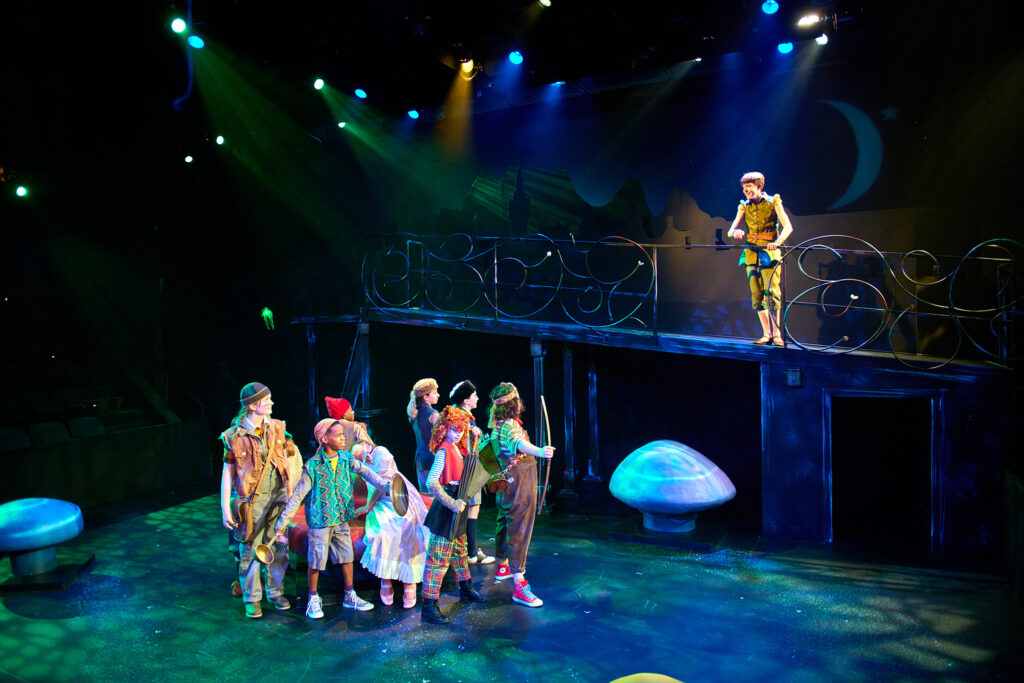
But there is more magic here than just the story of Peter Pan. There is First Stage magic. As always First Stage lighting designers and set designers put together these amazing designs that seem so simple at first but are so deeply ingrained in the story telling that they are almost a character in their own right. And for Peter Pan And Wendy it was no different…as we had the nursery and its great window and Neverland and the pirate ship and and and. So thank you to Sarah Hunt-Frank, Nicki Kulas, Jason Fassi, Josh Schmidt (sound designer), and Jason Orlenko (costume designer)!

And let’s talk about Nicki Kulas again. First Stage productions often feature mythical creatures or natural creatures that can’t necessarily be portrayed on stage, so they use PUPPETS: magical, phantastical, puppets! In this case, a bit of a shaggy sheepdog, the children’s nursemaid Nana, the ever lurking and very creepy crocodile, and two iterations of Tinker Bell. One little lacy bit of green light that flits around the action and a bit larger version that at times lands on a shoulder or chair back and has the semblance of a fairy rather than just a bit of flashing light. How they all work is in the next paragraph.

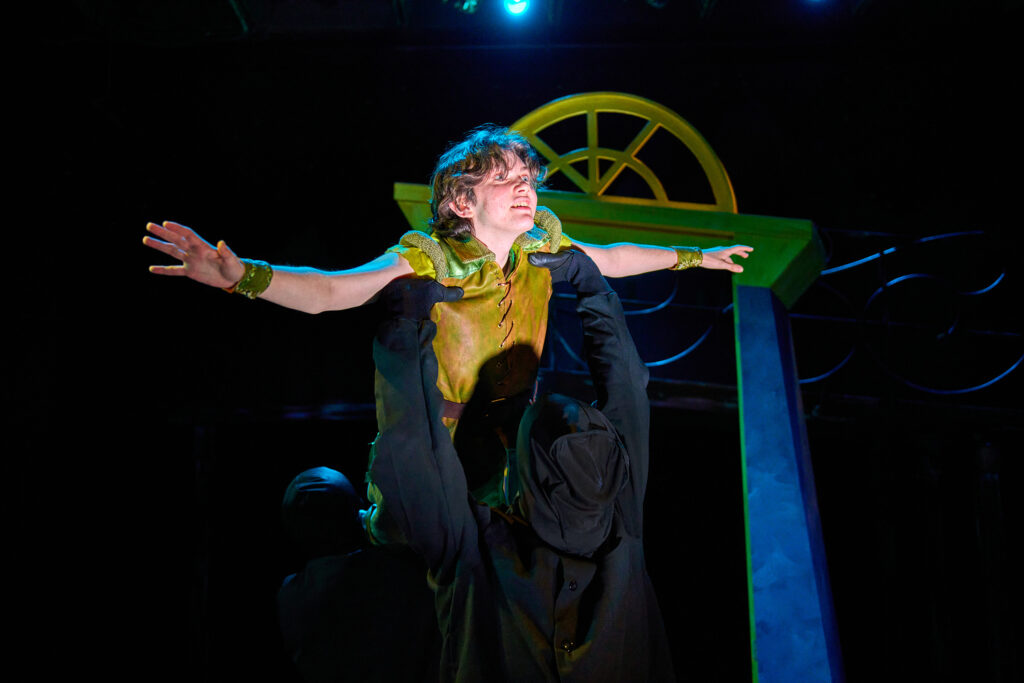
Marko Van Slyke in Peter Pan and Wendy. First Stage, 2026. Photo by Paul Ruffolo.

And let’s not overlook that Peter Pan can fly, and Peter teaches Wendy, John, and Michael how to fly. The primary key to being able to participate in all of the other adventures. And fly they do but without wires. Inspired by Japanese theater, Frank has employed the use of koken in Peter Pan And Wendy. Koken are black clad characters who appear on stage unnoticed by the actors. In this adaptation, the koken lift the young actors portraying Peter and Wendy and let them ‘fly’. They also work the puppets representing Tinker Bell, Nana, and the crocodile. And yes you notice them but you don’t…I can’t quite explain the effect, but it quite simply works.

Ooooh. I almost forgot. There is always a brief talk back after the curtain when young theater goers can ask a question of the cast. My favorite this time was some young man who wanted to know where they found the crocodile. After some giggles, a cast member described the puppet and how it was made by the puppet master!

Beyond the main story, all of the subplots are here. The desire for eternal youth, the desire for freedom from authority, the desire for family and structure, and the desire for a sense of purpose all prevail.

Peter Pan And Wendy continues through March 22, 2006 at the Todd Wehr Theater in the Marcus Performing Arts Center. Run time is about 75 minutes plus a 15 minute intermission. Recommended for families with young people ages 6-14 and magical dreamers of all ages.

More information and tickets can be found here.

Extra Credit Reading: Enrichment Guide