
Next Act Theatre’s Swing State Reverberates Across The Driftless Area

The State of Wisconsin has been enjoying something of a Renaissance on Wisconsin stages these past few seasons. And Next Act’s presentation is no exception as Pulitzer Prize nominated playwright Rebecca Gilman sets Swing State in Wisconsin’s Driftless Area, in the imaginary Cardiff Township. No don’t let that idyllic pastoral setting fool you into thinking that this is a delicate play…Swing State is anything but a delicate play. Swing State is a full in your face, touching your heart, and surprising your brain human drama. But it is a Wisconsin Premiere!
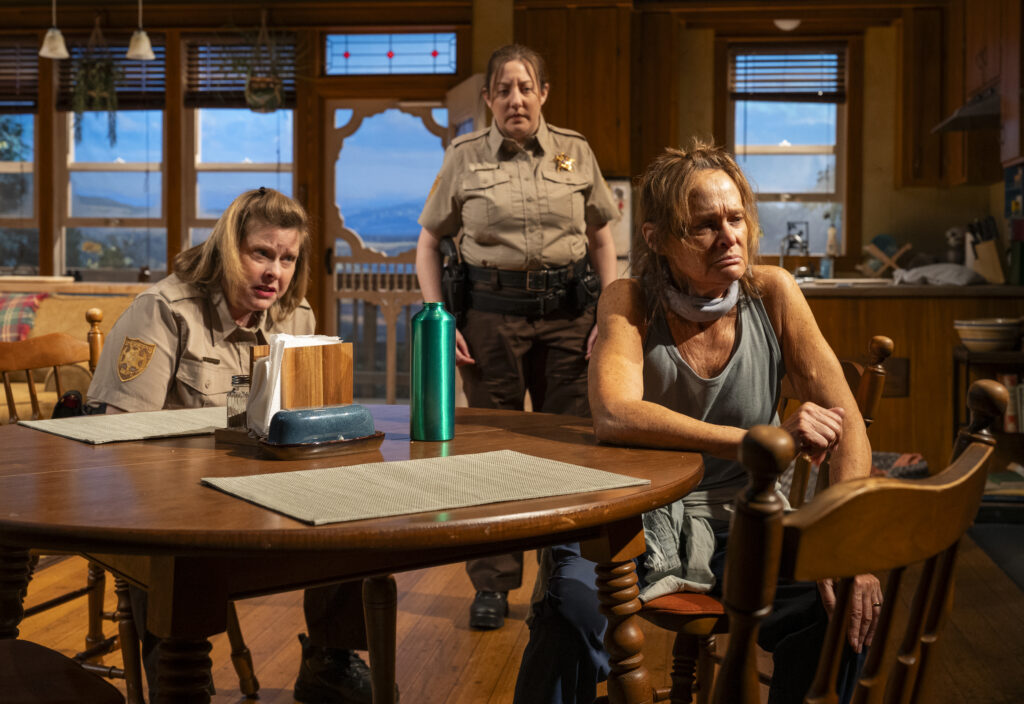
Kelli Strickland, Elyse Edelman, Tami Workentin. Photo by Michael Brosilow. Photo courtesy of Next Act Theatre

We are going to meet four very different and unique characters who live in a very small town. The kind of Wisconsin small town where you don’t lock your doors. Where everyone knows everyone else, and everyone knows everyone else’s business, or at least everyone knows all of the gossip about everyone else’s business. A simple place where people can live simple and fulfilling lives. A reminiscence of the American Dream of a hundred years ago? Well, maybe not. Each of our characters has a secret…some of them are seriously hurting inside…one has demons that he is constantly struggling against…and they are all wondering what exactly are they supposed to do?

Peg Smith is living alone in her quaint farm home on a bit of prairie that she and her late husband discovered during one of their trips through the area. She is pondering her legacy and trying to determine how to protect the pristine prairie that she and her husband lovingly nurtured and tended for decades. It was their happy place. But she is deeply mourning his loss and that is certainly taking a toll on her emotions. She is also mourning the changes that she is seeing in their prairie. Drought is reducing the number of wild flowers that are returning and causing the surviving plants to produce fewer seeds. She notices that the frogs have gone from the pond and certain sparrows are in decline as is the neighborhood bat population. She brings these topics into conversation any number of times during the play and this bit of subtext draws the different personalities together, although not always thinking about it in the same way. But this subplot, if you are like me and grew up in a similar rural environment, or if you adopted that lifestyle later, or immerse yourself into it on occasion now, this subplot will pull you in hard and remind you of your connection to the land and to its flora and fauna. Tami Workentin brings us a Peg who is solid and thoughtful and somewhat direct. But we also feel the hurt and despair of mourning in her Peg as well…and Peg’s unity with her prairie and the people of her little community. Not quite a mother earth figure but leaning that way…

Tami Workentin, Jack Lancaster. Photo by Michael Brosilow. Photo courtesy of Next Act Theatre.

Peg’s next door neighbor is a young man named Ryan. Since Ryan lives next door he is about the only person that Peg sees on a regular basis since the death of her husband. Like their prairie, it seems that Peg and her husband also nurtured and supported Ryan as a youth and later when he ran into some trouble. The Ryan we know is played by Jack Lancaster, as an always angry man who has recently returned home from a short stint in prison. Angry when he has a right to be, angry even in generally benign situations, and just just angry. Lancaster gives us a classic example of someone suffering PTSD as a result of his life trials. But Lancaster also shows us a thoughtful and concerned Ryan who is very aware and observant of the things going on around him. And Lancaster brings out a gentler side when Ryan is talking to Peg about the prairie and later when talking with Dani about his concerns about Peg and his own emotional investment in the prairie.
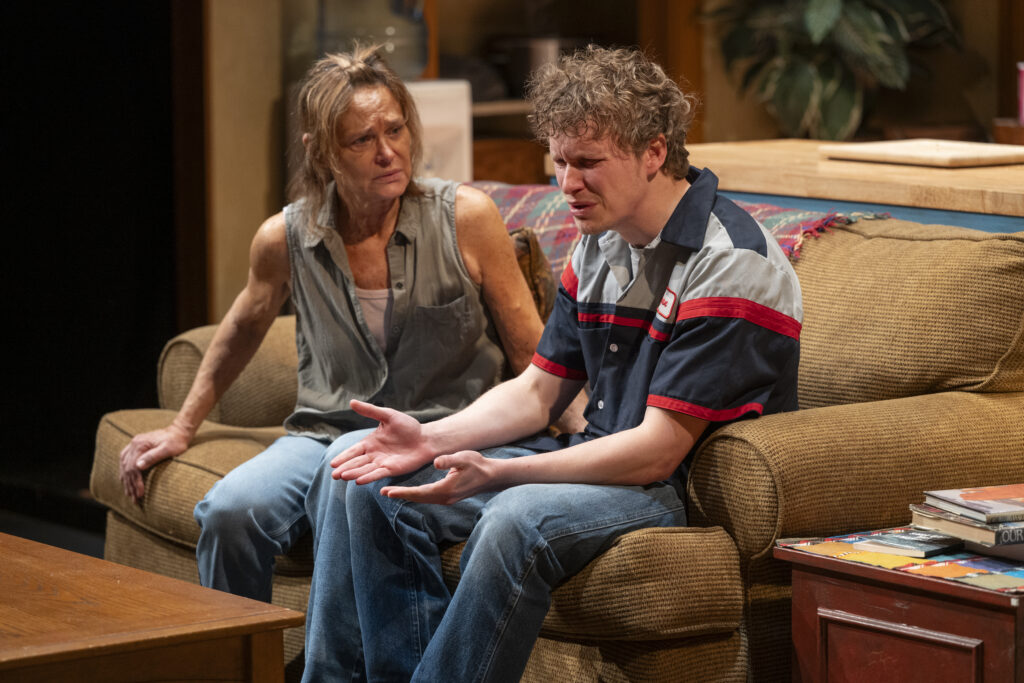
Tami Workentin, Jack Lancaster. Photo by Michael Brosilow. Photo courtesy of Next Act Theatre.

Kelli Strickland is a complete badass as Sheriff Kris Callahan Wisnefski. On the surface Strickland is a forceful by the book sheriff who proclaims her duty to serve and protect her constituents…even those who didn’t vote for her. But she too has suffered a loss and is in mourning and she too is trying to push past it by building her legacy as a no nonsense law enforcement officer. Strickland has developed the voice, the stagger, and the aggressive presence that this portrayal requires. But there are cracks once in a while.
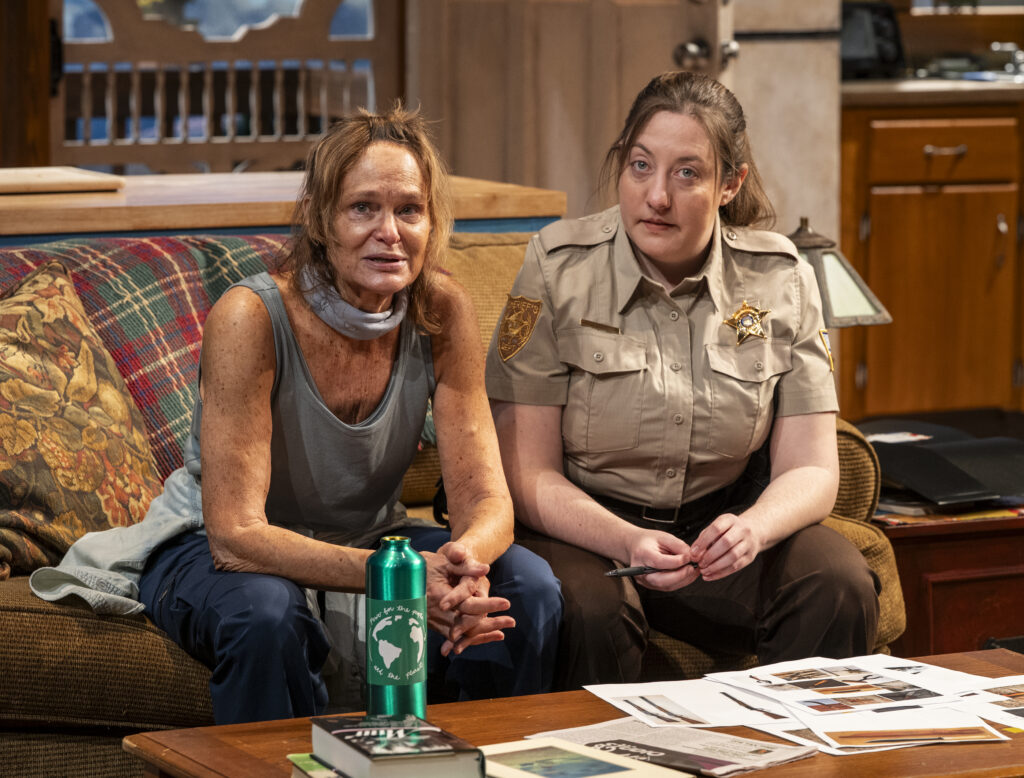
Tami Workentin, Elyse Edelman. Photo by Michael Brosilow. Photo courtesy of Next Act Theatre.

And her niece, Deputy Dani Wisnefski is played by Milwaukee favorite Elyse Edelman. Edelman’s Dani is looking for a purpose and thinks that she has finally found it under Sheriff Kris’ tutelage. But she exhibits a bit too much empathy at times…but that will make her a great deputy when she learns to temper the empathy against enforcing the law. She makes people more comfortable that Sheriff Kris ever can. Edelman balances the tug of these two issues immaculately.

Next Stage Artistic Director Cody Estle directs Swing State and does an amazing job of identifying the essence of the characters and helping the actors inhabit them and then inserts them into the story accurately and precisely as the script demands. And Estle got some serious help from Scenic Designer Jeffrey D. Kmiec’s set design: a very warm worn in cabin/farm house living area of a certain age! Not exactly like any I’ve experienced but close enough that I would feel right at home. And the backdrop outside the windows of the hills and fields and forests just add a certain bit of nostalgia for a time past as well. Unfortunately there aren’t any young people in the cast so we never get to hear the screen door properly slammed.

Now the title Swing State would, in contemporary conversation, suggest a bit of political discourse about moving from one end of the spectrum to the other. It is a very subtle undercurrent here. The real story is how people struggle or cope with real life losses and disappointments no matter what their surroundings.

Swing State continues through March 8, 2026 at Next Act Theatre, located at 255 South Water Street in Milwaukee, Wisconsin. The play runs about an hour and 45 minutes without intermission.

This is an adult play with adult subject matter and discussions about suicide. And it contains some violence.

Additional information and tickets can be found here.

Extra Credit Reading: Playbill! and Audience Guide.
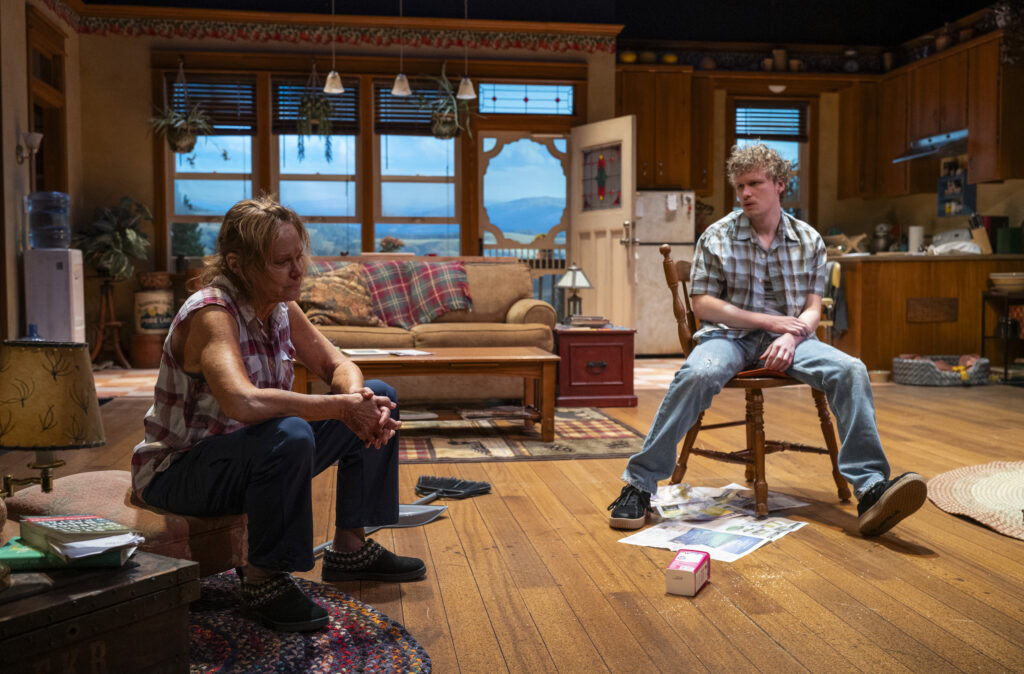
Tami Workentin, Jack Lancaster. Photo by Michael Brosilow. Photo courtesy of Next Act Theatre.

Wisconsin Premiere of Ayad Akhtar’s McNeal. A.I.A.I. Oh.

Ayad Akhtar’s McNeal is ostensibly about artificial intelligence. But I am here to suggest it was written with artificial intelligence. There are a number of intimations and subtexts that might suggest so. Some of them apparent by the queries fed into an AI app as displayed across the top of the set and the replies then received. All very realistic and wholly believable for the current state of AI.

The Cast of McNeal. Photo by Michael Brosilow. Photo courtesy of the Milwaukee Rep.

We know that Jacob McNeal’s latest novel is written by AI. He admits as much after telling his agent that it only took two days to write. And we know it is true since we saw his prompts along the top of the set and the volumes and volumes of output that he received back. What is the novel about? Well I have a guess and I suggest that Akhtar fed it back into his AI app and got the play McNeal out of it. SPOILER ALERT: A sad, twisted, retelling of Hedda Gabler with the genders re-assigned and relationships altered…but there are tell tale signs (well other than the queries into AI which are blatantly displayed), like the ‘missing’ and burned manuscript, the wish to ‘recreate’ it from scratch, and finally when a major female character eats her pistol after waving it around at McNeal, all in a hallucination, yet.

Jeanne Paulsen, Peter Bradbury. Photo by Michael Brosilow. Photo courtesy of the Milwaukee Rep.

And this feels like a one character play…yes I know there are six other characters…but the focus is so intensely on McNeal and his feelings and actions are so focused on McNeal that all other characters seem to fade away (which is also much like Hedda Gabler). And given the computer based nature of our discourse, where computers work via the manipulations of ones and zeroes, lets just say that Jacob McNeal is a ONE and everyone else is a ZERO.

There is something else here that speaks to today. We first meet McNeal as he is using AI to determine his place in the pecking order for winning a Nobel Prize in Literature. Not getting the responses he wants, he keeps editing his prompts until they give him what he is looking for. It is clearly an obsession. Unlike that other guy you are thinking about, McNeal eventually wins. And that starts a whole new set of experiences for the audience as director Mark Clements and his production staff cosplay with AI and project McNeal into a reward ceremony and later morph his face into Ronald Regan and Barry Goldwater and back. Certainly very equivalent to videos we often see on social media and maybe a little reminiscent of certain Forrest Gump experiences some thirty years ago?

N’Jameh Camara, Peter Bradbury. Photo by Michael Brosilow. Photo courtesy of the Milwaukee Rep.

But yes, the play revolves around the myriad questions we all hold about AI. So plagiarism, influences, truth, disclosure, what is art, what is an artist, and what is art making. However, you will not find any answers here.

Interestingly, Akhtar delineates McNeal with the stereotypes we have accumulated around male novelists: moody, depressive, brilliant, reclusive, grouchy, compulsive, anti-social, misogynistic, suicidal, and alcoholic. Chekhov is rolling over in is grave. Amazingly Peter Bradbury takes that all in stride and makes it too very real on stage. From orator to falling down drunk to troubled spouse and parent, Bradbury is wholly believable and makes us feel McNeal. I am not sure if we have any empathy for him or not…I don’t think that I can find that in me…but I know Bradbury’s McNeal is real. I know it!

Peter Bradbury. Photo by Michael Brosilow. Photo courtesy of the Milwaukee Rep.

Jeanne Paulsen plays McNeal’s agent Stephie Banic, as an appealing tough cookie who takes care of her client professionally but has a soft spot as well that Paulsen shows the audience in her questions and care of McNeal…but something, I think, McNeal remains unaware of even when he’s doing something she urged him to do and he stoutly refused to do initially (I assure you that this run on sentence wasn’t written my AI). She’s impressed with the Nobel but more interested in the commercial opportunities it may provide. Paulsen stays cool under fire. The other character who provides some push back is Natasha Brathwaite, played by N’Jameh Camara. Camara comes on like the NY Times special feature reporter she portrays here, but she softens as her interview with McNeal continues even admitting she liked his books more than she expected. Camara knows when to be direct and knows when to shift to coy in playing Brathwaite. Bridget Ann White is feisty and intense as Francine Blake but this part isn’t big enough to showcase her whole talent. Hopefully we will see her here on a Rep stage again!

Sara Sadjadi, Peter Bradbury, Jeanne Paulsen. Photo by Michael Brosilow. Photo courtesy of the Milwaukee Rep.

McNeal is more than just a play premiere. It also celebrates the grand opening of the Herro-Franke Studio Theater. It replaces the Stiemke Studio Theater. And it is a major improvement…better seating (comfy!)…better and additional restrooms…and a real bar and better traffic flow through the lobby. And for this very first show, the seating bowl is shaped in a L-shape with the stage occupying one corner of the studio. And for McNeal the gnomes and elves in the Rep shops have created a rotating stage that facilitates the change in scenes and moods and environments. And they are breaking the third and fourth wall. I don’t want to leave out the lighting and sound crew who project and highlight the action but project scenic backgrounds with our change of locales…some of it AI generated since I recognized some buildings but they didn’t seem to be where they actually reside…and city noises in city scenes and rustic noises in rural ones. Sounds easy to miss given the concentration required to fully appreciate the story…but marvelous attention to detail.

and finally, to paraphrase Akhtar’s AI conjured ‘Prospero’ in his closing soliloquy: “Is it real or is it not real?” Well, I can’t tell you.

McNeal continues from now until March 22nd, 2026 at he Herro-Franke Studio Theater in the Associated Theater Center. More information and Tickets Here!

Running Time: Approximately 1 hour and 45 minutes with no intermission.
Recommended Age: 16 and up

Extra Credit Reading: The Program

Peter Bradbury. Photo by Michael Brosilow. Photo courtesy of the Milwaukee Rep.